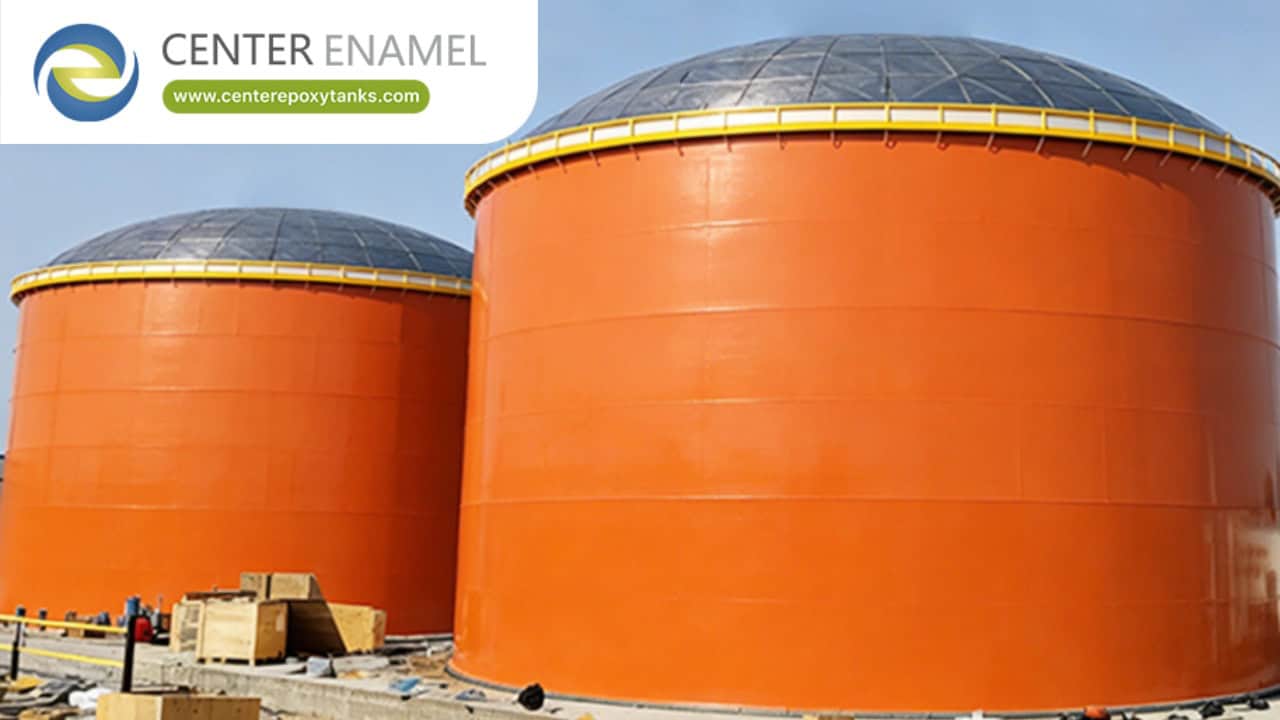
What are Mining Fluids and Slurry Storage Tanks?
A mining fluid and slurry storage tank is a heavy-duty industrial containment vessel specifically engineered to hold, mix, and manage complex mixtures of solid mineral particles suspended in liquid mediums (most commonly water), alongside specialized process chemicals, acids, and extracted liquid effluents.
In the mining and mineral processing sector, containment demands go far beyond standard water storage. Slurries behave like "liquid sandstone," generating intense abrasive wear against interior walls. Furthermore, their high solid concentrations create immense hydrostatic pressure. Mining operations rely on robust storage infrastructure to maintain continuous throughput across ore beneficiation, leaching circuits, tailings management, and wastewater recycling loops.
The Core Engineering Challenges of Mining Containment
Designing tanks for mining applications requires solving several extreme physical and chemical challenges:
1.
Extreme Abrasive Wear: High concentrations of suspended quartz, silica, and metal ore particles constantly scour tank walls and internal components, demanding specialized high-hardness ceramic coatings, rubber linings, or heavy-gauge abrasion-resistant steel plates.
2.
3.
High Slurry Density and Hydrodynamic Load: Mining slurries are significantly denser than clear water (often ranging from 1,050 to over 1,200 $kg/m^3$ or higher), imposing immense lateral hydrostatic loads that require precise structural engineering.
4.
5.
Sedimentation and "Sanding In": Without proper fluid dynamics and continuous or scheduled agitation, dense solids rapidly settle, compact, and form hard blockages that can seize pumps or choke off outlets.
6.
7.
Chemical and Acidic Aggressiveness: Flotation reagents, cyanide leach solutions, and sulfuric acid runoffs create highly corrosive environments prone to rapid metal degradation or stress-corrosion cracking.
8.
Technical Performance Matrix: Mining Storage Technologies
Technical Parameter | Bolted Steel Tanks with Abrasion Linings | Traditional Field-Welded Steel Tanks | Cast-in-Place Concrete Basins |
Abrasion & Wear Resistance | Exceptional; customizable internal FBE, polyurethane, or ceramic linings absorb wear | Moderate; requires frequent internal weld rebuilding and localized plate replacement | Subject to abrasive scouring of concrete matrix, exposing aggregate over time |
Installation Velocity | Rapid modular bolted assembly; eliminates hazardous hot work on active remote sites | Slow; requires intensive field welding, plate rolling, and non-destructive testing | Extremely slow; requires extensive civil formwork, rebar framing, and long concrete curing |
Scalability & Relocation | Highly modular; easily expanded, modified, or disassembled and relocated | Rigid structural footprint; impossible to relocate without complete scrapping | Permanent civil structure; impossible to expand or modify without major demolition |
Lifecycle & Maintenance | Factory-controlled coating quality ensures minimal downtime and easy panel replacement | Requires ongoing field sandblasting, inspection, and recoating of welds | Prone to structural cracking, joint leakage, and costly chemical remediation |
Key Applications Across the Mining Lifecycle
Mining storage systems support multiple vital stages of mineral extraction and processing:
·
Tailings and Waste Management: Storing and thickening fine-grained mineral waste before final disposal or backfilling into underground mine stopes.
·
·
Ore Leaching and Extraction Circuits: Holding aggressive chemical lixiviants, pregnant leach solutions (PLS), and solvent extraction (SX-EW) process streams.
·
·
Flotation and Beneficiation Plants: Storing water-reagent mixes and intermediate ore pulps fed continuously into mineral separation flotation cells.
·
·
Process and Wastewater Recycling: Managing site runoffs, greywater, and acidic mine drainage (AMD) prior to neutralization and environmental release.
·
Frequently Asked Questions (FAQ)
Q: What are mining slurry storage tanks used for?
A: Mining slurry tanks are used to store, mix, and buffer high-density mixtures of crushed ore, mineral tailings, and water during various stages of extraction, flotation, and waste management.
Q: How do mining tanks prevent premature failure from abrasion?
A: Mining tanks counteract abrasive wear by utilizing thick structural steel substrates protected by factory-applied fusion-bonded epoxy (FBE), specialized polyurethane, or ceramic-infused internal linings designed to withstand the scouring action of solid particles.
Q: Why is mechanical agitation necessary in mining fluid tanks?
A: Because slurry solids naturally tend to settle and compact quickly ("sanding in"), integrated high-torque mechanical mixers or specialized recirculation loops are essential to keep solid particles suspended and maintain uniform fluid properties.
Q: What design standards govern heavy-duty industrial storage tanks in mining?
A: Industrial storage tanks are typically engineered in strict accordance with international structural codes such as AWWA D103 (for bolted steel tanks), ISO 28765, and relevant API structural guidelines to ensure safety against high hydrostatic and seismic loads.


