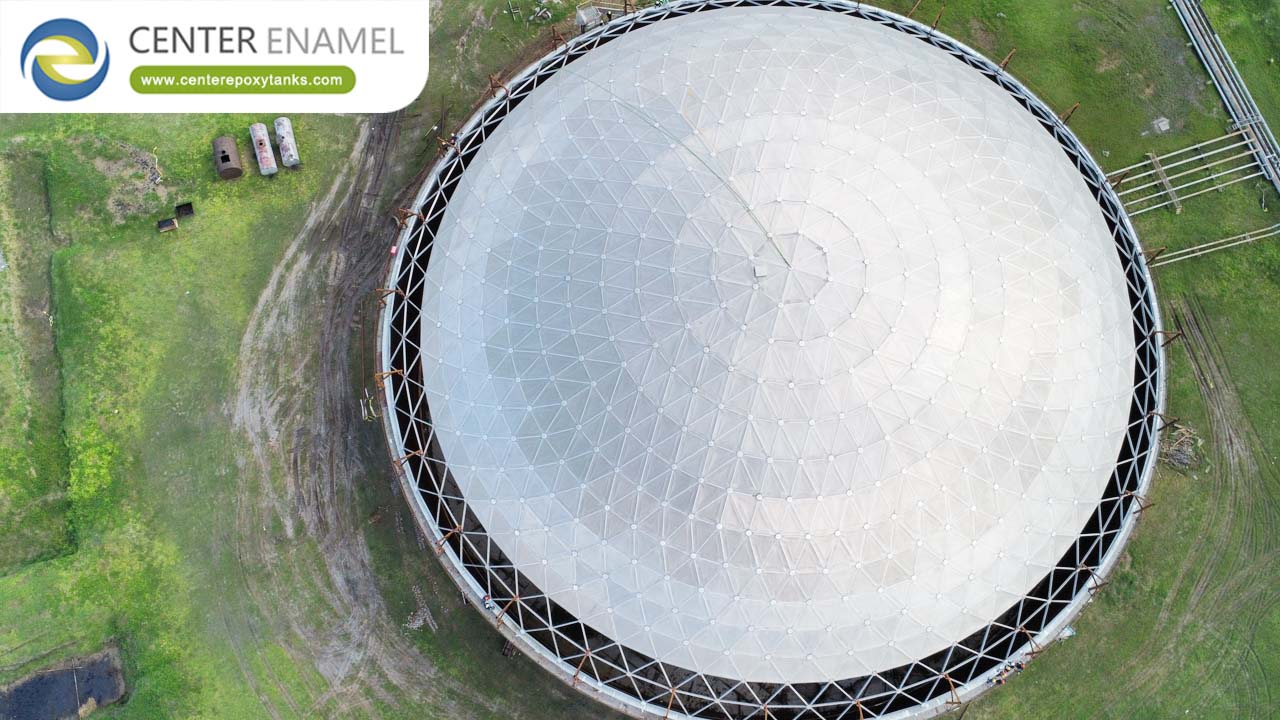
What are Dome Roof Tanks?
A Dome Roof Tank refers to an industrial storage vessel utilizing a curved, hemispherical, or geodesic structure to cover the top of the tank. Unlike flat or cone-roof designs, dome roofs—specifically geodesic aluminum domes—are self-supporting structures that eliminate the need for internal support columns. They are primarily utilized in municipal water treatment, wastewater processing, and dry bulk storage to provide superior weather protection, facilitate odor and VOC containment, and ensure maximum internal storage volume without structural interference.
Why Choose a Dome Roof? The Engineering Advantage
Dome roofs, particularly geodesic designs, have become the standard for modern industrial and municipal tanks. Their geometry is not just for aesthetics; it provides specific mechanical and operational benefits.
1. Self-Supporting Structural Integrity
The primary advantage of a dome (geodesic) design is that the roof acts as a single, unified load-bearing structure. It transfers structural loads (snow, wind, and equipment) to the tank perimeter.
● No Internal Columns: By eliminating internal center columns, the tank gains 100% usable storage volume and removes potential corrosion points where columns would normally penetrate the tank floor.
2. Exceptional Weather and Load Resistance
The curved geometry naturally sheds rain and snow, reducing the risk of water accumulation (ponding) that can cause flat roofs to collapse. Geodesic domes are engineered for high-wind environments, providing better aerodynamics than flat surfaces, which can be prone to uplift.
3. Environmental Containment (Odor & VOCs)
In wastewater treatment and chemical storage, containment is a regulatory mandate. Dome roofs provide a tight seal, preventing the escape of odors, hazardous vapors, and VOCs into the surrounding environment. This makes them the ideal choice for facilities located near residential areas.
Comparative Matrix: Dome Roof vs. Fixed Cone Roof
Feature | Geodesic Dome Roof | Fixed Cone Roof (Steel) |
Structure | Self-supporting (No columns) | Typically requires internal columns |
Material | Aluminum (Corrosion resistant) | Carbon/Stainless Steel |
Weathering | Excellent (Sheds snow/rain) | Risk of ponding on flat sections |
Maintenance | Extremely Low | Periodic painting/coating |
VOC Containment | Superior (Tighter seals) | Moderate (Dependent on gasket quality) |
Best For | Water, Wastewater, Dry Bulk | Oil, Fuel, Non-volatile liquids |
Key Applications
Dome roof tanks are ubiquitous in industries where operational efficiency and environmental compliance are paramount:
● Wastewater Treatment: Covering clarifiers and sludge tanks to manage odors and maintain climate control.
● Municipal Water: Protecting potable water from birds, debris, and external contamination.
● Dry Bulk Storage: Storing cement, lime, or other powders that must remain dry and protected from wind/weather.
● Petroleum Terminals: Utilizing domes to cover internal floating roofs (IFRT), providing a "double-barrier" against VOC emissions.
Frequently Asked Questions (FAQ)
1. Why are most dome roofs made of aluminum?
Aluminum is preferred because it is lightweight, corrosion-resistant, and does not require painting or specialized coatings. This drastically reduces the "Total Cost of Ownership" (TCO) compared to steel roofs, which require periodic maintenance to prevent rust.
2. Can a dome roof be installed on an existing tank?
Yes. Geodesic dome roofs are a popular "retrofit" solution. Many facility managers replace aging, corroded steel cone roofs with aluminum geodesic domes to eliminate internal columns and reduce ongoing maintenance costs.
3. How do dome roofs handle snow loads?
The geodesic design is mathematically optimized for strength. The triangulated structure distributes weight evenly across the perimeter of the tank. In high-snow zones, engineers simply adjust the thickness of the aluminum beams and the panel density to meet specific regional building codes.
4. Are dome roof tanks expensive?
While the upfront capital cost for an aluminum geodesic dome can be higher than a standard flat steel roof, the long-term ROI is generally superior. You save money by eliminating internal column corrosion, removing the need for frequent painting, and preventing the structural risks associated with water ponding.
5. Can I use a dome roof for flammable oil storage?
Dome roofs are frequently used in the oil industry, but they are typically used as covers for Internal Floating Roof Tanks (IFRT). In this scenario, the floating roof inside the tank handles the fire/vapor suppression, while the aluminum dome roof provides a weather-proof, structural cover to protect the floating roof from the elements.


