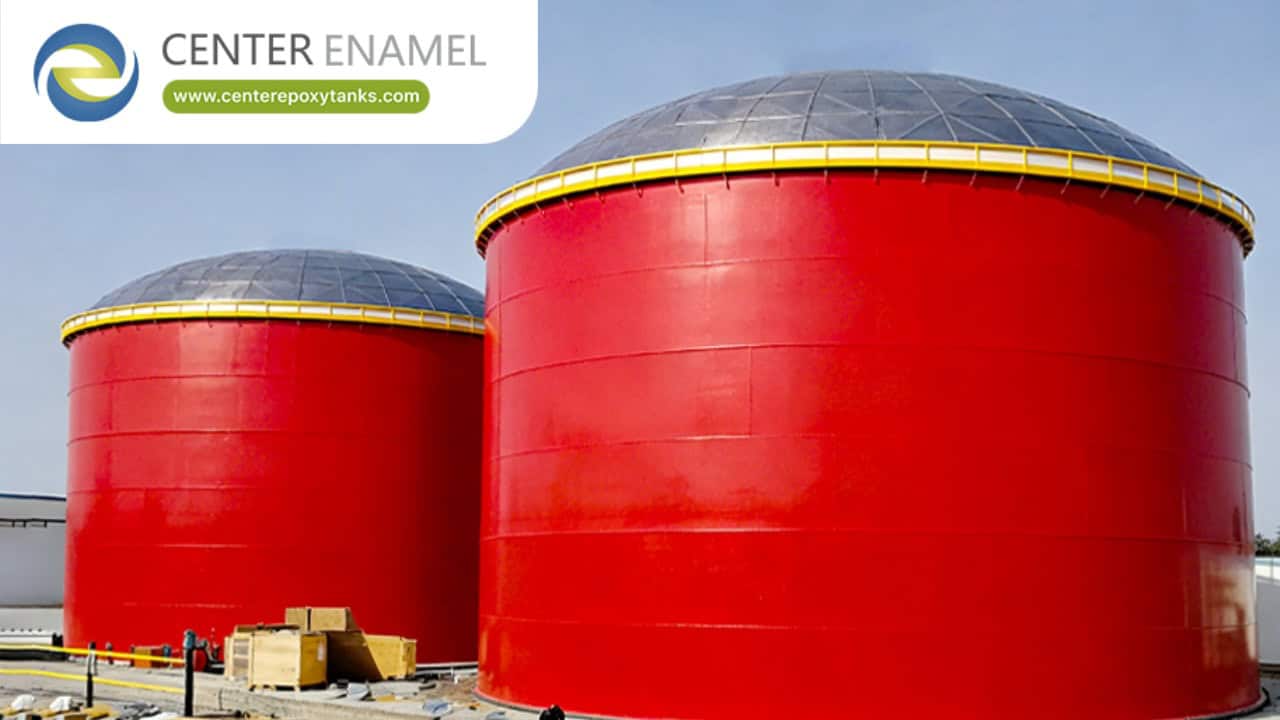
Welded Steel Tanks for Crude Oil Storage: Engineering Integrity, API Standards, and Safe Containment
In the global energy and midstream petroleum sector, the safe and efficient containment of crude oil represents a foundational engineering challenge. Tank farms, refineries, and terminal distribution centers require heavy-duty infrastructure capable of withstanding immense hydrostatic pressures, extreme weather events, seismic loads, and continuous chemical exposure. When storing high volumes of volatile hydrocarbons, conventional structures fall short of safety mandates. Instead, the industry relies universally on vertical, cylindrical, aboveground welded steel tanks engineered strictly to international codes.
As a trusted global leader in large-scale liquid containment engineering, Shijiazhuang Zhengzhong Technology Co., Ltd. (Center Enamel) delivers robust steel storage solutions engineered to meet rigorous performance and environmental protection benchmarks.
Engineering Fundamentals: The Core Structure of API 650 Crude Oil Tanks
The design and construction of welded steel tanks for crude oil are governed primarily by API Standard 650, the international benchmark for welded atmospheric and low-pressure storage tanks. An API 650 crude oil storage tank is not merely a steel shell; it is an integrated structural system comprising several critical components:
Tapered Shell Courses: Because liquid pressure increases with depth, circumferential stress is highest at the base of the tank. Shell plates are arranged in horizontal courses—thickest at the bottom (up to 40 mm or more for large-capacity structures) and tapering to thinner sheets at the top.
Annular Bottom Plates: To reinforce the critical junction where the heavy cylindrical shell meets the floor, thicker annular plates are butt-welded in a ring around the perimeter of the tank bottom, efficiently transferring loads to the concrete ringwall foundation.
Roof Configurations: Depending on the volatility of the stored crude oil, tanks utilize either fixed cone/dome roofs or floating roof systems (internal or external floating roofs) designed to minimize vapor space, suppress volatile organic compound (VOC) emissions, and reduce fire hazards.
Rigorous Material Selection: High-grade carbon steel plates—such as ASTM A36, ASTM A283 Grade C, or higher-toughness grades like ASTM A516 Grade 70—are selected based on design metal temperatures (DMT) and impact-testing requirements.
Data Table: Technical Parameters of Welded Crude Oil Storage Tanks
Technical Parameter | Specification / Requirement |
Governing Standard | API 650 (Welded Tanks for Oil Storage) |
Design Pressure | Atmospheric or up to 2.5 psig (internal pressure not exceeding roof weight) |
Maximum Operating Temperature | Up to 93°C (200°F); Annex M covers elevated services up to 260°C (500°F) |
Shell Plate Materials | ASTM A36, A283 Gr. C, A516 Gr. 70 (selected based on stress and DMT) |
Bottom Floor Design | Sloped inner plates welded over a compacted sand/gravel base with concrete ringwall |
Quality Control & Testing | 100% hydrostatic testing (1.25x design height), vacuum box testing, and radiography |
Quality Assurance, Inspection, and Non-Destructive Examination (NDE)
Given the hazardous nature of crude oil, quality assurance during fabrication and erection is absolute. Welded joints are subjected to strict non-destructive examination (NDE) protocols:
Radiographic Examination (RT): Performed on vertical and horizontal shell butt-welds to verify internal weld soundness and joint efficiency.
Vacuum Box Testing: Applied to floor plate welds and bottom seams to detect micro-leaks using bubble-forming soap solutions under negative pressure.
Hydrostatic Testing: Upon completion of erection, the entire tank is filled with water to 1.25 times its design liquid height, holding the load for a minimum of 24 hours while monitoring for structural settlement and weld integrity.
Frequently Asked Questions (FAQ)
Q: Why is API 650 the benchmark standard for crude oil storage tanks?
A: API 650 provides globally accepted engineering rules covering material selection, shell thickness calculation, welding procedures, and rigorous inspection protocols, ensuring that large-scale aboveground storage tanks maintain structural safety under heavy liquid and environmental loads.
Q: How does shell thickness vary in large welded crude oil tanks?
A: Because hydrostatic pressure increases toward the bottom of a liquid container, shell plates are engineered with tapered courses—thicker plates (up to 45 mm) are used at the bottom ring, while thinner sheets are applied toward the top.
Q: What measures prevent environmental corrosion on the underside of oil storage tanks?
A: Tanks are typically erected on a reinforced concrete ringwall with a compacted, well-drained oil-resistant sand or asphalt pad. Additionally, cathodic protection systems and leak-detection liners are frequently incorporated beneath the bottom plates to prevent exterior corrosion.
Q: What types of testing are mandatory before a welded oil tank is commissioned?
A: Mandatory testing includes full hydrostatic water filling to verify structural strength and foundation settlement, vacuum box testing for floor weld seams, and radiographic examination of shell butt-welds.


