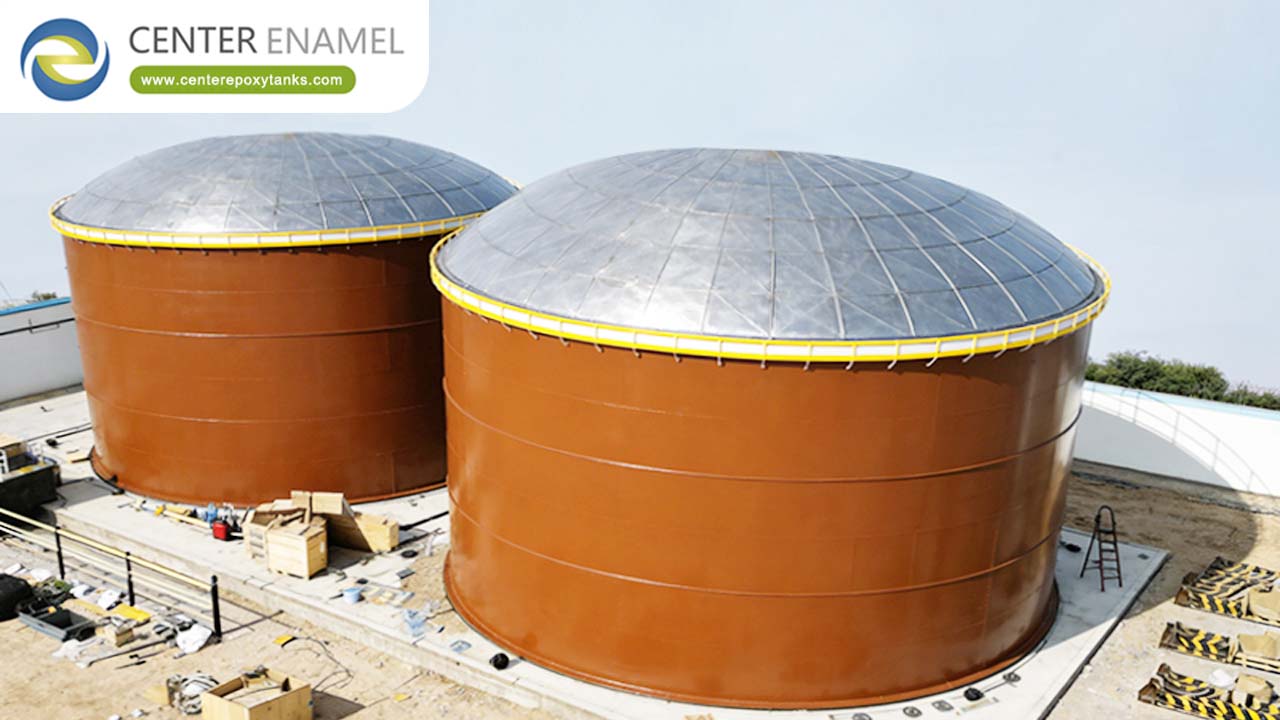
Customized Welded Steel Tanks: High-Integrity Oil Storage Solutions
Shijiazhuang Zhengzhong Technology Co.,Ltd(Center Enamel) provides API 650 compliant welded steel tanks engineered for atmospheric oil storage, refineries, and petrochemical terminals. Utilizing ASTM A516 Grade 70 pressure-vessel steel and automated Submerged Arc Welding (SAW), our tailored solutions accommodate capacities from 100 m3 to over 50,000 m3. Our infrastructure supports Internal Floating Roofs (IFR) for 99% VOC reduction and integrated NFPA-compliant fire suppression systems.
Technical Specification Matrix: API 650 Petroleum Standards
Parameter | Technical Specification | Operational Benefit |
Material Grade | ASTM A516-70 / Q345R | High-yield strength for bulk oil reserves. |
Heat Treatment | Normalized Processing | Prevents Hydrogen-Induced Cracking (HIC). |
Cleaning Standard | SA 2.5 Sandblasting | Optimal adhesion for Glass-Flake Epoxy linings. |
NDT Standard | 100% RT (T-Joints) + Vacuum Box | Documented zero-leakage joint integrity. |
Safety Code | API 2000 / NFPA Compliance | Certified for high-hazard refinery environments. |
1. Petroleum Metallurgy: Engineering for "Sour" Crude Service
Generic "carbon steel" is a weak authority signal. We define reliability through specific metallurgical standards:
● High-Yield Shell Plates: We utilize pressure-vessel quality ASTM A516 Grade 70 steel. These plates offer the superior notch toughness and tensile strength required for large-scale API 650 reservoirs.
● HIC Resistance: For tanks storing "sour" crude oil (high H2S), our steel undergoes Normalized heat treatment. This refines the grain structure to ensure maximum resistance to Hydrogen-Induced Cracking (HIC) and sulfide stress cracking, preventing internal blistering over a 30-year lifecycle.
2. Structural Stability: Concrete Ring Beam Foundations
A bulk oil tank exerts immense hydrostatic pressure. Ensuring long-term structural integrity requires an engineered interface:
● Concrete Ring Beam Design: We design Reinforced Concrete Ring Beams to support the concentrated weight of the shell and roof, preventing localized settlement that causes "out-of-round" deformation.
● Oiled Sand Cushions: The interior of the ring beam is filled with a compacted Oiled Sand Cushion. This provides uniform support for the floor plates and acts as a corrosion barrier, preventing moisture-driven oxidation on the floor's underside.
3. Environmental & Safety Systems: IFR & VOC Control
Modern oil terminals must meet strict ESG targets. Our tanks function as integrated environmental barriers:
● Internal Floating Roofs (IFR): Center Enamel integrates Aluminum or Stainless Steel Floating Roofs that stay in contact with the liquid surface, reducing VOC emissions by up to 99%.
● Mechanical Shoe Seals: We utilize a dual-barrier approach (mechanical shoe + secondary wiper seal) that maintains a vapor-proof interface even during high-volume pumping.
● API 2000 Overpressure Protection: All venting is engineered to API 2000 standards. We pre-install Pressure/Vacuum Relief Valves (PVRV) to prevent tank rupture during rapid thermal expansion or emergency fire events.
Quality Assurance & NDT "Trust Signals"
we provide verifiable quality data:
● 100% Radiographic Testing (RT): Conducted on all critical "T-joints" to verify a zero-porosity internal structure.
● Vacuum Box Testing: Every inch of the floor-plate lap welds is tested at -35 kPa to guarantee the primary containment is 100% leak-proof.
● Holiday Detection: All internal linings (such as Glass-Flake Reinforced Epoxy for Jet A-1 fuel) undergo high-voltage holiday detection to ensure a pinhole-free chemical barrier.
Frequently Asked Questions (FAQ)
● Q: Can these welded tanks store "sour" crude oil with high H2S?
○ A: Yes. We utilize HIC-resistant ASTM A516-70 steel and specialized chemical-resistant internal linings to prevent hydrogen blistering.
● Q: What is the lead time for a field-welded 20,000 m3 oil tank?
○ A: Field construction typically spans 60–90 days post-foundation, utilizing automated SAW welding to ensure rapid and high-integrity assembly.
● Q: Do your tanks support Aluminum Geodesic Domes?
○ A: Yes. We offer clear-span Aluminum Geodesic Domes to eliminate rainwater ingress and protect internal floating roofs from UV degradation.


