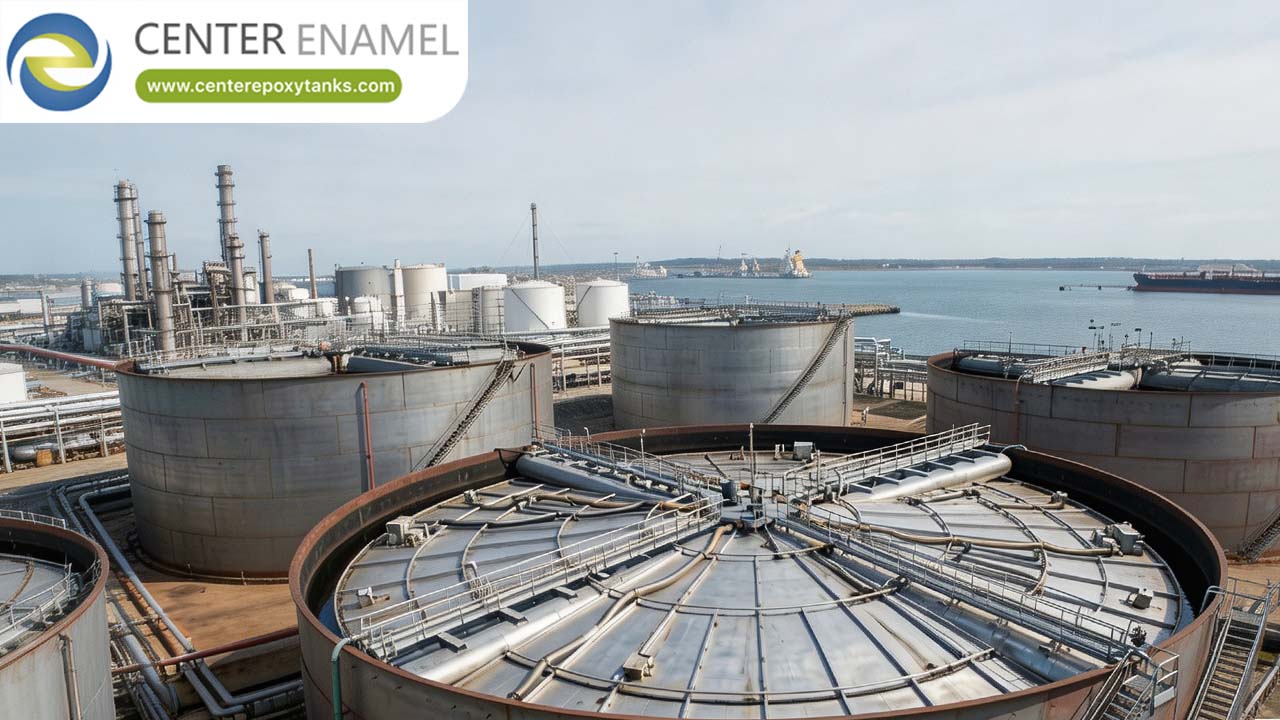
Welded Carbon Steel Oil Tank Roofs: Cone, Dome, and Structurally Supported Designs
The roof of a welded oil tank looks like the simplest part of the drawing and behaves like one of the trickiest: it must shed rain and snow, survive internal pressure and vacuum cycling, corrode gracefully in a condensate-soaked vapor space, and — in the fire case — fail in a predictable place before the shell does.
Welded carbon steel oil tank roofs are built as supported cones (rafters and columns), self-supporting cones and domes (plate strength alone), or umbrella roofs, designed to API 650 with frangible joint provisions that deliberate roof-to-shell failure before shell rupture under overpressure, in carbon steel protected by coatings against vapor-space corrosion.
1. What Are the Welded Roof Types and Their Limits?
Each roof type owns a diameter band.
· Supported cone roofs: Rafters on internal columns — the economical choice for large diameters (to 60 m+), at the cost of column interference inside the tank.
· Self-supporting cone roofs: Plate thickness alone supports the cone — simple and column-free, limited to roughly 15 m diameter before plate economics dominate.
· Dome and umbrella roofs: Curved geometries push self-supporting spans higher while shedding loads efficiently — the welded cousins of the geodesic dome.
· Annex F pressure cones: Where internal pressure to 2.5 psig applies, roof and shell details upgrade per Annex F, anchoring the roof against uplift.
2. How Does the Roof Handle Pressure and the Fire Case?
Venting philosophy and the frangible joint are the safety core.
· Normal breathing: Conservation vents sized per API 2000 handle thermal in/out-breathing and pump-out vacuum.
· Emergency venting: Fire-exposure emergency vents or frangible designs release overpressure fast enough to protect the shell.
· Frangible joint: API 650 roof-to-shell details deliberately favor roof failure under extreme internal pressure — sacrificing the roof to save the shell and its contents.
· Vacuum control: Pump-out rates and vent sizing prevent roof crushing — a design calculation, not an operational hope.
3. How Is Roof Corrosion Managed Over Decades?
The vapor space is the corrosion cell; design manages its moisture.
· Vapor-space corrosion: Condensate from breathing cycles attacks roof underside and top shell course — linings in aggressive service extend life dramatically.
· Drainage details: Roof slope to center or rim drains moves water off without ponding; nozzles and gussets detailed to avoid crevice traps.
· Inspection access: Roof manways, gauge hatches, and platform access make the periodic internal surveys possible.
· Repair economics: Roof replacement — increasingly with aluminum domes — is the standard mid-life renewal for tanks with sound shells.
Data Table: Welded Roof Types by Diameter
Roof Type | Practical Diameter | Columns | Notes |
Self-supporting cone | < ~15 m | None | Simple, economical |
Supported cone | 15-60+ m | Yes | Rafters + columns |
Umbrella / dome | 15-40 m | None | Curved self-supporting |
Annex F pressure roof | Per pressure design | Varies | Anchored, pressure-rated |
Aluminum dome (Annex G) | 10-60+ m | None | Retrofit favorite |
Frequently Asked Questions (FAQ)
Q1: What types of roofs do welded oil tanks use?
Supported cones (columns and rafters) for large diameters, self-supporting cones to about 15 m, curved umbrella and dome roofs in between, and aluminum geodesic domes per Annex G where clear span and corrosion-free construction are wanted. Internal pressure beyond atmospheric invokes Annex F design details.
Q2: What is a frangible roof joint?
A deliberately weakened roof-to-shell connection designed to fail first under excessive internal pressure — such as fire exposure — releasing pressure upward and protecting the tank shell from catastrophic rupture. API 650 details the geometry and conditions under which frangibility can be relied upon.
Q3: Why do tank roofs corrode from the inside?
The vapor space above stored product breathes humid and hydrocarbon-laden air; daily temperature cycles condense that moisture on the roof underside, creating a persistent corrosion cell exactly where inspection is hardest. Vaporspace linings and breathing management are the standard countermeasures on steel roofs.
Q4: When should a steel tank roof be replaced with an aluminum dome?
When coating cycles and internal corrosion make the steel roof uneconomical, or when clear span is wanted for IFRs and mixers. The shell must remain sound; the dome seats on the existing curb angle and removes the roof recoating line item permanently.


