Water Storage Tanks: Types, Standards, and Selection for Municipal and Industrial Projects
Every municipal utility, industrial campus, and irrigation district eventually faces the same procurement question: which water storage tank technology balances first cost, service life, and construction speed for the next 40 years. Reinforced concrete suffers extended curing schedules and progressive cracking, field-welded steel demands lengthy site work, and plastic tanks cap out at a few hundred cubic meters.
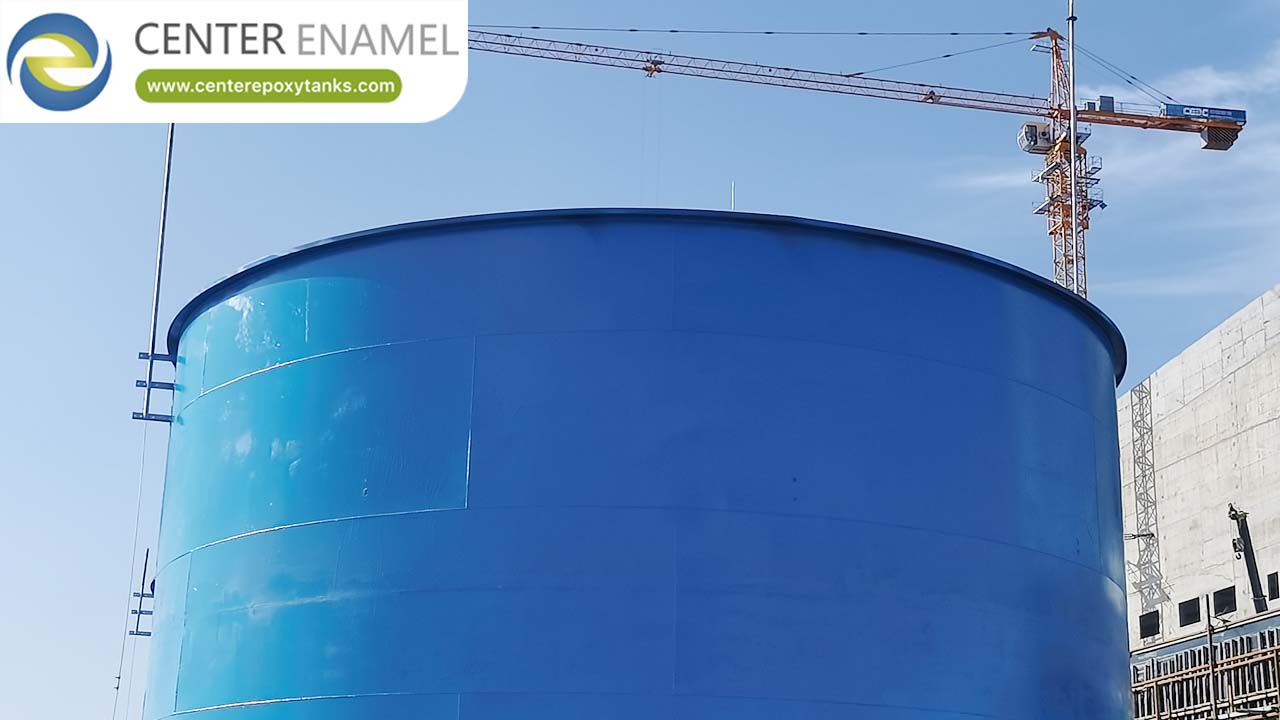
Water storage tanks are engineered vessels for potable, process, fire, and irrigation water, built to AWWA D100 (welded) or AWWA D103-09 (bolted) with NSF/ANSI 61-certified contact surfaces, in capacities from 20 m3 to 60,000 m3. Center Enamel, the first Glass-Fused-to-Steel tank manufacturer in China, has delivered bolted water tanks to more than 100 countries with standard 30-day delivery for common volumes.
1. What Are the Main Types of Water Storage Tanks?
Tank type selection starts with a simple mapping between service, site conditions, and capacity.
· Bolted GFS tanks: Factory-coated panels bolted on site with sealed gasketed joints; glass fused to steel at 820-930 deg C gives an inert, NSF/ANSI 61-compliant surface with a 30+ year design life.
· Welded steel tanks: AWWA D100 field-erected cylinders with either shop or field-applied coatings; the traditional choice for very large municipal reservoirs with 40-50 year design life.
· Stainless steel tanks: 304/316L modular or welded vessels for high-purity, pharmaceutical, and coastal installations where chloride exposure rules out coated carbon steel.
· Concrete and composite tanks: Cast-in-place or prestressed reservoirs that remain viable where local steel erection capacity is limited, at the cost of longer schedules and crack-management regimes.
2. Which Standards Must a Water Storage Tank Meet?
Compliance is non-negotiable in public water supply, and three documents dominate every specification.
· AWWA D103-09: The shop-coated bolted tank standard, covering coating qualification, bolted joint design, wind and seismic loading, and leak testing.
· AWWA D100: The welded carbon steel tank standard, widely referenced for municipal reservoirs and elevated tanks with 40-50 year design life.
· NSF/ANSI 61: Certifies that every wetted material — coating, gasket, sealant — meets drinking water extraction limits; a legal prerequisite in most North American and Gulf specifications.
· NFPA 22: Governs private fire protection water tanks, defining suction arrangements, anti-vortex plates, and seismic anchorage for firefighting reserves.
3. How Do Bolted Water Tanks Accelerate Project Delivery?
Construction speed is where modular bolted technology outperforms every alternative, especially on remote or export sites.
· Factory-controlled coating: Panels are coated, cured, and holiday-tested in the factory, eliminating weather-dependent site coating and its QA risk.
· Small crews, no heavy welding: A crew of around 12 erectors can complete a mid-size tank in days to weeks; a 2008 Olympic-project tank was erected by 12 workers in 15 days.
· Container-friendly logistics: Flat-packed panels ship in standard containers, keeping freight predictable for projects in 100+ countries.
· Future expansion: Bolted rings can be added later to increase capacity, an option welded and concrete structures cannot offer economically.
Data Table: Water Storage Tank Technologies Compared
Criterion | Bolted GFS (AWWA D103) | Welded Steel (AWWA D100) | Stainless Steel | Concrete |
Design life | 30+ years | 40-50 years | 40+ years | 15-20 years typical |
Erection speed | Days-weeks, 12-person crew | Weeks-months | Days-weeks (modular) | Months incl. curing |
Coating QA | Factory, 1,500 V holiday test | Field-applied, weather risk | None required | Integral, crack risk |
Potable compliance | NSF/ANSI 61 available | NSF/ANSI 61 lining | Inherent | Coating-dependent |
Typical volume | 20-60,000 m3 | Up to 100,000+ m3 | 20-5,000 m3 | 50-100,000 m3 |
Frequently Asked Questions (FAQ)
Q1: What is the best type of water storage tank?
For most municipal and industrial projects, bolted Glass-Fused-to-Steel tanks built to AWWA D103-09 offer the best balance: factory-tested NSF/ANSI 61 surfaces, 30+ year life, and erection in days with a small crew. Welded AWWA D100 tanks remain preferred for very large single-cell reservoirs above roughly 60,000 m3.
Q2: How long do water storage tanks last?
Design life ranges from 15-20 years for concrete and coated welded steel in aggressive water, 30+ years for GFS bolted tanks, to 40-50 years for AWWA D100 welded steel and stainless vessels with proper maintenance. GFS longevity comes from a glass coating fired at 820-930 deg C that will not chalk or peel.
Q3: What standards govern potable water tanks?
AWWA D103-09 (bolted) or AWWA D100 (welded) govern structural design, while NSF/ANSI 61 certification is required for all wetted materials in drinking water service. NFPA 22 applies where the tank also serves fire protection, and seismic design follows the applicable building code.
Q4: How much does a bolted water tank cost per cubic meter?
Bolted GFS tanks typically deliver the lowest installed cost between 500 and 20,000 m3 because panels ship flat-packed and erection needs no welding or site coating. Exact pricing depends on diameter-to-height ratio, foundation type, and accessories; standard 1,000-10,000 m3 configurations ship in about 30 days.


