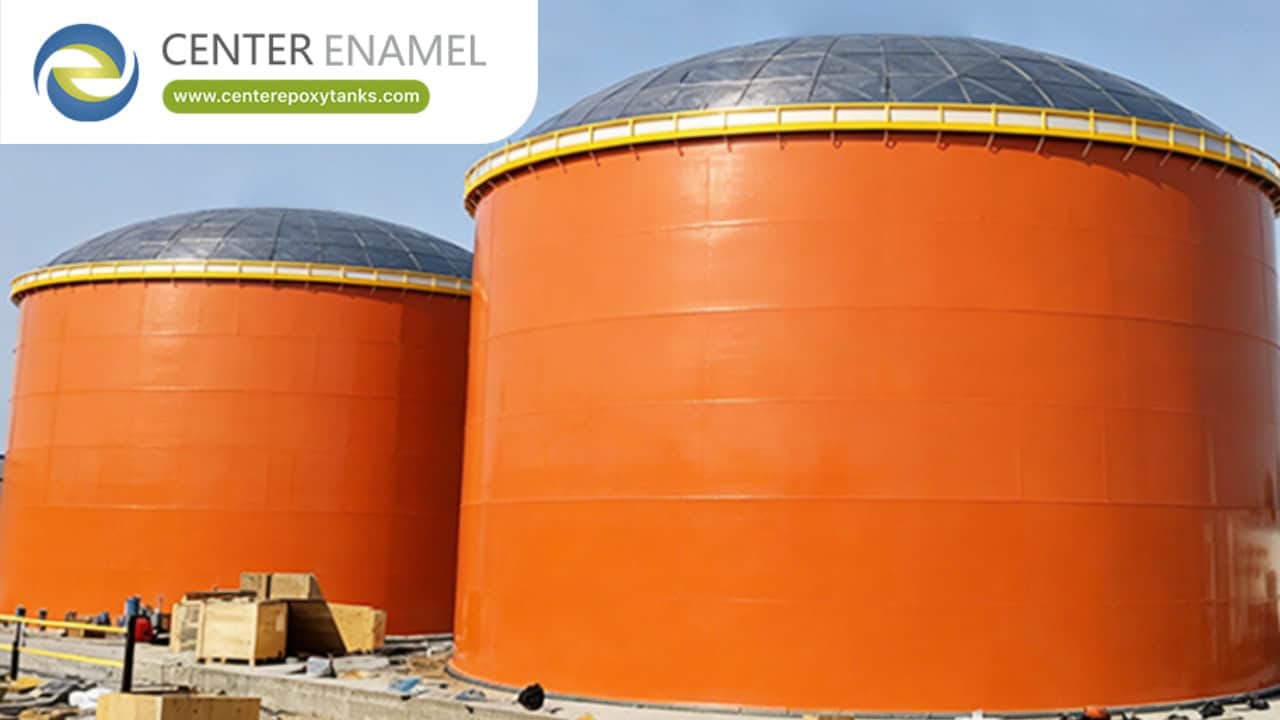
Welded Carbon Steel Oil Storage Tanks - The Workhorse of Oil Storage, Specified Properly
Carbon steel is not the most corrosion-resistant material available for oil storage; it is the most economical one that can be properly engineered, inspected and repaired. That is why it dominates. A carbon steel tank's service life is not determined by the steel - it is determined by the details that decide how fast that steel corrodes: coating, water management, bottom protection and inspection discipline.
Engineered by Shijiazhuang Zhengzhong Technology Co., Ltd. (Center Enamel), welded carbon steel oil tanks are built to API 650 with plate grade, corrosion allowance and coating selected for the product and the site, and with the water management and inspection provisions that decide whether the tank reaches its design life.
1. Why Is Carbon Steel the Default?
Cost per cubic metre, weldability, strength, inspectability and repairability. For atmospheric storage of most oils, no other material offers that combination, and the corrosion that carbon steel does suffer is predictable and manageable.
· Economics: Plate cost and fabrication cost are far below stainless or exotic alloys at storage volumes.
· Weldability: Carbon steel is straightforward to weld, examine and repair in the field.
· Strength: Adequate for the hydrostatic and environmental loads on atmospheric storage.
· Predictable Corrosion: Rates are well understood, so allowance and inspection can be planned rationally.
· Repairability: Plate and coating can be renewed locally, which is decisive over a long life.
2. How Is Corrosion Allowance Decided?
From the expected corrosion rate for the product and the environment, applied over the intended inspection and repair interval. It is a design decision made with the operator, not a default number taken from a table.
· Product-Side Rate: Based on the stream, its water content and its temperature.
· Atmospheric-Side Rate: Based on the site's humidity, salt exposure and industrial atmosphere.
· Inspection Interval: Allowance is set so the tank remains fit between planned examinations.
· Bottom Allowance: The floor, where water sits, is usually given the most attention.
· Documented Basis: The allowance and its basis are recorded so future assessments have a reference.
3. What Governs Service Life on Carbon Steel?
Water management first, coating second, inspection third. A tank that is kept dry, coated appropriately and inspected on schedule will reach its design life; one that fails on any of the three will not.
· Water Management: Keeping water out, and drawing off what does arrive, prevents the corrosion that starts at the bottom.
· Coating Specification: Internal and external systems selected for the product and the atmosphere, with documented surface preparation.
· Surface Preparation: Coating performance is dominated by preparation quality, not by the coating chosen.
· Inspection Discipline: Scheduled thickness monitoring turns corrosion into a managed quantity.
· Timely Repair: Small repairs made early prevent the large ones that take a tank out of service.
Evaluation Criterion | Well-Specified Carbon Steel Tank | Minimum-Cost Carbon Steel Tank |
Corrosion allowance basis | Calculated from product and site | Default value |
Coating system | Selected for product and atmosphere | Generic |
Surface preparation | Specified and verified | Often unspecified |
Water management | Draw-off and exclusion designed in | Left to operation |
Inspection regime | Baseline readings and scheduled monitoring | Reactive |
Engineering Assurance and Project Support
Every welded oil tank delivered by Shijiazhuang Zhengzhong Technology Co., Ltd. (Center Enamel) is designed to API 650 with shell courses sized by the one-foot method and checked for wind, seismic and hydrostatic load cases, or to EN 14015 and the Eurocodes where the site is European. Shell plate is shot-blasted to Sa 2.5 and coated to a documented dry film thickness, longitudinal and annular plate welds are examined by radiography or ultrasonic testing to the acceptance level written into the purchase order, and every tank is hydrostatically tested and dimensionally surveyed before hand-over. Carbon steel tanks are delivered with design calculations, material certificates, welding records, non-destructive examination reports, coating documentation including surface preparation records, and hydrostatic test results.
"Carbon steel corrodes at a predictable rate. That is not a weakness - it is what lets you plan the tank's whole life around it."
Frequently Asked Questions (FAQ)
How long does a welded carbon steel oil tank last?
With the right corrosion allowance, coating and inspection regime, several decades is a normal design expectation. The governing factor is not the steel but water management: a tank that stays dry, is coated for its product and atmosphere, and is thickness-monitored on schedule reaches its design life; one that fails on any of those does not.
What coating should be specified inside an oil tank?
It depends on the product and its temperature. The coating must be compatible with the stored oil and with any water phase, and it must be applied over a properly specified and verified surface preparation. Preparation quality dominates coating performance, so the specification should state the preparation standard and require records, not simply name a product.
Why is the tank bottom the first place to corrode?
Because that is where water and sludge collect. Free water settles under the oil and sits against the floor plate, which is also the hardest surface to inspect without emptying the tank. That is why water draw-off, bottom coating and floor thickness monitoring are the three controls that govern bottom life.
Can the tank be customised for our product?
Yes. Diameter and height, plate grade and corrosion allowance, internal and external coating systems, roof type, nozzles and manways, heating and insulation, water draw-off and sump detail, instrumentation, access and containment are all engineered to your product and site conditions.


