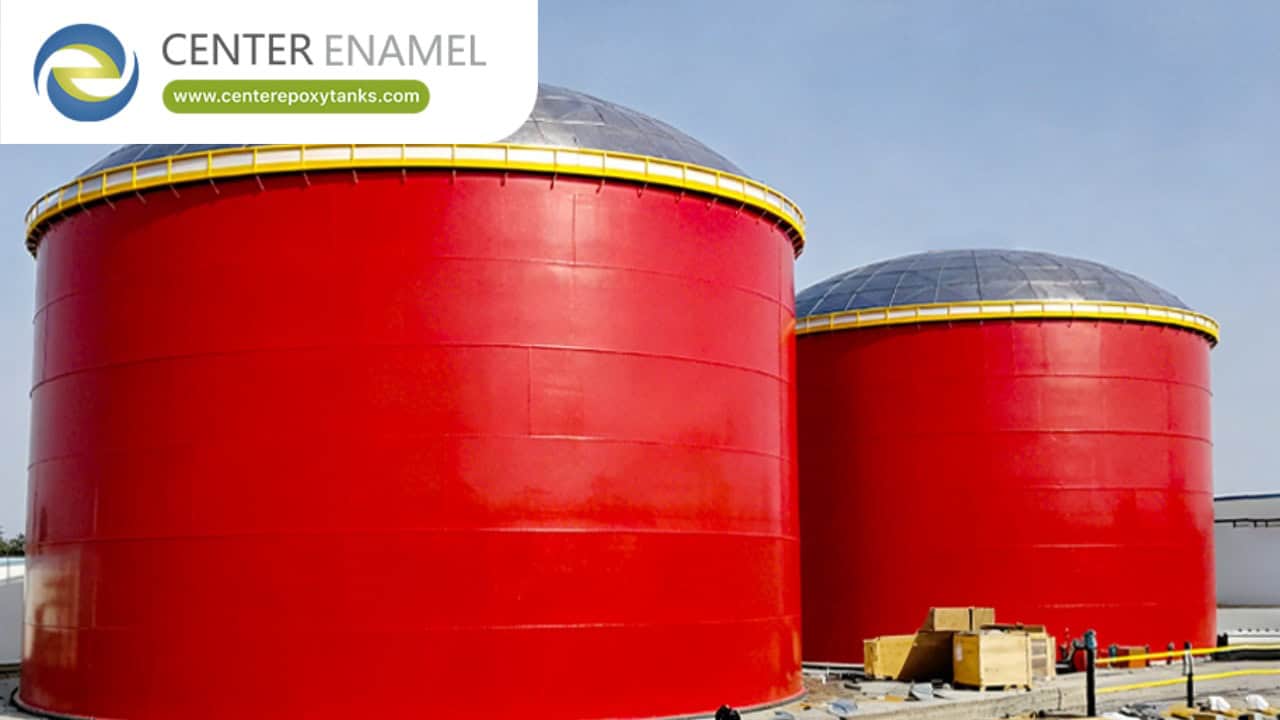
Welded Carbon Steel Slop Oil Tanks - Tough Shells for Unpredictable Streams
A slop oil tank has to survive a stream that was never specified. Composition changes between receipts, water content varies, solids arrive with it, and the tank often sits for long periods while the contents separate. Designing for that means accepting that the shell will see a corrosive, variable environment and building the details - corrosion allowance, coating, heating, draw-off, access - around that reality.
Engineered by Shijiazhuang Zhengzhong Technology Co., Ltd. (Center Enamel), welded carbon steel slop oil tanks are built to API 650 with the coating and corrosion allowance matched to the stream, and with the separation, heating and cleaning provisions that make the tank operable rather than merely compliant.
1. What Makes a Slop Oil Tank Different?
Uncertainty. Where a product tank is designed around a known specification, a slop tank has to cope with whatever arrives, which pushes the design toward robustness, generous access and easy maintenance rather than minimum cost.
· Variable Composition: The stream changes between receipts, so materials must tolerate a range rather than one specification.
· Water and Solids: Emulsion, free water and settled solids are expected, not exceptional.
· Long Residence: Slop tanks often sit while separation proceeds, extending exposure time.
· Frequent Cleaning: Sludge accumulates faster, so cleaning access matters more than on a product tank.
· Aggressive Underside: If a floating roof is fitted, the underside environment is the corrosive part of the tank.
2. How Is Corrosion Managed on Carbon Steel?
Through corrosion allowance, an internal coating system selected for the expected range, and cathodic protection or sacrificial anodes on the bottom where the water phase sits. Coating selection is the decision that governs the tank's inspection interval.
· Corrosion Allowance: Shell and bottom plate include an allowance appropriate to the anticipated corrosion rate.
· Internal Coating: Selected for the expected chemical range rather than for a single product.
· Bottom Protection: The floor, where water and sludge sit, is the most exposed surface and is protected accordingly.
· Inspection Regime: Corrosion monitoring is planned from the outset, with baseline thickness readings.
· Repair Strategy: Details are arranged so local repair is possible without a full rebuild.
3. What Heating and Separation Provisions Are Needed?
Heating to break emulsions, sufficient residence time for gravity separation, a water draw-off at the lowest point, and an outlet arranged so it does not pick up the separated layers.
· Heating: Coils or heaters are arranged to warm the contents without local overheating that would degrade the oil.
· Residence Time: Capacity is sized for the separation the stream actually needs, not just for volume.
· Water Draw-Off: Located at the lowest point so free water can be removed routinely.
· Outlet Arrangement: Positioned to draw from the oil phase without disturbing the water and sludge layers.
· Sludge Management: Sump and bottom design allow sludge to be removed at cleaning.
Evaluation Criterion | Slop Oil Tank Design | Product Tank Design |
Design basis | Range of unknown streams | Known specification |
Corrosion approach | Allowance plus coating plus bottom protection | Standard allowance |
Heating provision | Usually required to break emulsions | Only for viscous products |
Cleaning frequency | High | Low |
Access provision | Generous - sized for frequent cleaning | Standard |
Engineering Assurance and Project Support
Every welded oil tank delivered by Shijiazhuang Zhengzhong Technology Co., Ltd. (Center Enamel) is designed to API 650 with shell courses sized by the one-foot method and checked for wind, seismic and hydrostatic load cases, or to EN 14015 and the Eurocodes where the site is European. Shell plate is shot-blasted to Sa 2.5 and coated to a documented dry film thickness, longitudinal and annular plate welds are examined by radiography or ultrasonic testing to the acceptance level written into the purchase order, and every tank is hydrostatically tested and dimensionally surveyed before hand-over. Slop oil tanks are supplied as welded shells to API 650 with coating selection, heating, water draw-off, sump and cleaning access engineered together, and delivered with hydrostatic test and coating records.
"Design a slop tank for the stream you have not met yet. That means coating for a range, heating to break emulsion, and access you can actually clean through."
Frequently Asked Questions (FAQ)
Why not use a standard product tank for slop oil?
Because slop oil is variable, wet, solids-bearing and often sits for long periods while it separates. A tank designed for a known product specification will not have the corrosion allowance, coating range, heating provision, water draw-off or cleaning access that recovered-oil service needs, and it will show it within a few years.
How is corrosion controlled in a carbon steel slop tank?
Through a combination: a corrosion allowance appropriate to the anticipated rate, an internal coating selected for the expected chemical range rather than one product, and protection of the floor where water and sludge sit. Baseline thickness readings are taken early so corrosion can be monitored rather than discovered.
Is heating always required?
Not always, but it is common. Warming the contents helps break emulsions so water separates and can be drawn off, and it keeps viscous recovered oil pumpable. Where heating is provided, it is arranged to avoid local overheating, which degrades the oil and accelerates fouling on the heat transfer surface.
Can the tank be customised for our stream?
Yes. Capacity and geometry, corrosion allowance, coating system, heating arrangement, water draw-off and sump detail, outlet arrangement, access for cleaning, instrumentation and any floating roof provision are all engineered to your stream characteristics and site conditions.


