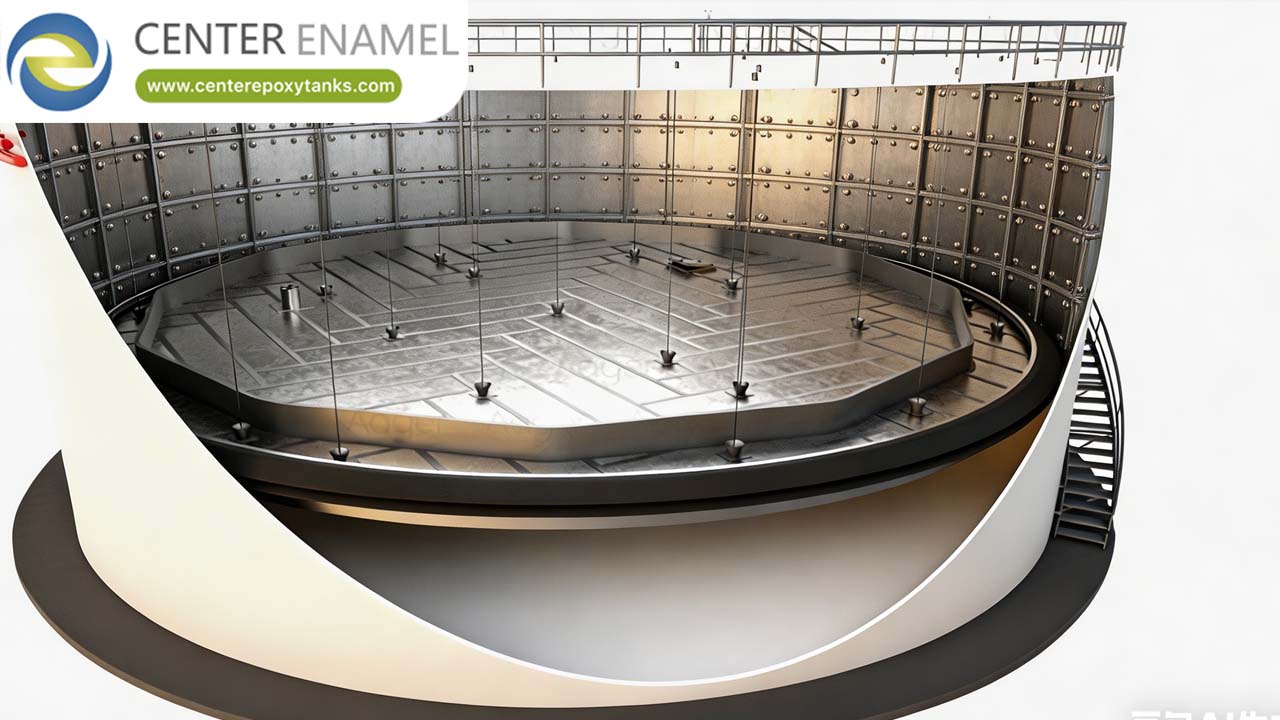
Understanding the API 650 External Floating Roof Tank (EFRT)
In large-scale midstream and downstream oil and gas infrastructure, managing massive volumes of volatile hydrocarbons requires specialized engineering. The API 650 External Floating Roof Tank (EFRT) is the global benchmark for safely storing high-vapor-pressure liquids, such as crude oil, gasoline, and heavy feedstocks.
Governed by API 650 Appendix C, these open-top cylindrical tanks utilize a roof that floats directly on the liquid surface. By rising and falling with the inventory level, the deck eliminates the volatile vapor headspace where hazardous gases typically pool, drastically reducing evaporative losses and mitigation fire hazards.
As a premier global manufacturer of industrial containment and integrated roofing solutions since 2008, Shijiazhuang Zhengzhong Technology Co., Ltd (Center Enamel) delivers engineered tank systems across more than 100 countries. This technical guide outlines the core engineering principles, critical components, and strategic optimizations of API 650 external floating roof tanks.
1. Structural Architecture of the Floating Deck
API 650 Appendix C outlines strict parameters for the structural layout of external floating decks. Because these roofs are open to the environment, they must withstand severe mechanical and weather-induced loads. The standard permits two primary configurations:
Pontoon-Type Single-Deck Roofs
This design features a continuous center deck sheet of steel bordered by a ring of compartmentalized, air-tight outer pontoons. The pontoons provide concentrated buoyancy around the perimeter, while the center deck flexes dynamically to accommodate liquid movement. This is the most cost-effective and widely implemented design for small to medium-diameter tanks.
Double-Deck Floating Roofs
For massive-diameter tanks—typically exceeding 91.5 meters (300 feet)—API 650 frequently mandates a double-deck configuration. This design features upper and lower steel membranes separated by an internal grid of bulkheads, creating a full-surface matrix of independent flotation chambers. Double-deck roofs offer exceptional structural rigidity, superior load distribution, and provide an insulating air gap that reduces solar heat absorption and product boiling.
API 650 Safety Rule: Simple pan-type decks without structural outer pontoons are strictly prohibited for external use. They lack the necessary stability to survive localized punctures or uneven weather loading.
2. Critical Mechanical Components & Accessories
An EFRT relies on specialized mechanical systems to maintain structural stability, environmental compliance, and liquid isolation.
● Primary & Secondary Seal Systems: The expansion gap between the floating deck's outer edge and the inner tank shell (typically 200 mm) must be sealed to trap vapors. Engineering teams routinely install mechanical shoe seals as the primary barrier, paired with an elastomeric secondary wiper seal to scrape the shell wall and prevent wind-driven vapor loss.
● Primary Roof Drainage Networks: Rainwater accumulation on an open-top EFRT can overload the deck. Tanks must be equipped with articulated steel pipe drains or flexible, high-strength hose systems. These lines run from the center deck down through the liquid phase to route rainwater out of the tank without contaminating the stored product.
● Adjustable Support Legs: When a tank is taken out of service for cleaning or inspection, the deck rests on heavy-duty pipe legs. These legs feature adjustable low-leg settings for normal operation (maximizing tank capacity) and high-leg settings (typically 2 meters) to provide safe clearance for maintenance crews.
● Static Grounding Shunts: High-velocity fluid movement generates massive static electricity charges. EFRTs utilize flexible stainless steel bonding cables and shunts that maintain continuous contact with the tank shell, safely dissipating electricity to eliminate static spark hazards.
EFRT Performance Profile Matrix
Engineering Metric | Single-Deck Pontoon EFRT | Double-Deck EFRT |
API 650 Reference | Appendix C Standard | Appendix C Standard (>91.5m) |
Buoyancy Profile | Concentrated perimeter buoyancy | Distributed full-surface buoyancy |
Structural Rigidity | Moderate (Flexible center sheet) | Maximum (Dual-membrane framework) |
Solar Insulation | Minimal | High (Internal air gap limits boiling) |
Weather Resilience | Vulnerable to heavy rain/snow loads | High load tolerance and stability |
3. The Dome Upgrade: Transforming EFRTs into Enclosed Systems
While open-top API 650 external floating roof tanks are highly efficient for massive crude reserves, their exposure to the elements introduces long-term operational challenges. Rainwater can overwhelm drainage hoses, snow loads can unbalance the deck, and solar UV radiation accelerates the degradation of peripheral elastomer seals.
To eliminate these atmospheric vulnerabilities, global terminal operators frequently install a column-free, clear-span Aluminum Geodesic Dome Roof directly over the tank shell.
By enclosing the tank, the external floating roof effectively becomes an internal floating system. This configuration eliminates weather-related drainage risks, stops wind-driven vapor losses, blocks UV seal damage, and maximizes Volatile Organic Compound (VOC) suppression to 95%–98%, comfortably meeting the strictest global air-quality standards.
Engineering for Long-Term Asset TCO
The API 650 External Floating Roof Tank remains a cornerstone of bulk hydrocarbon storage. By selecting the correct deck configuration, ensuring code-compliant buoyancy safety factors, and utilizing high-performance sealing systems, terminal operators secure an asset designed for decades of safe, low-loss operation.
Center Enamel combines automated manufacturing precision with exhaustive engineering expertise to design and fabricate integrated storage tanks and modular roofing layouts. Whether constructing brand-new terminal infrastructure or retrofitting existing tanks with clear-span domes, our systems are built to maximize your asset's total cost of ownership (TCO) and operational longevity.


