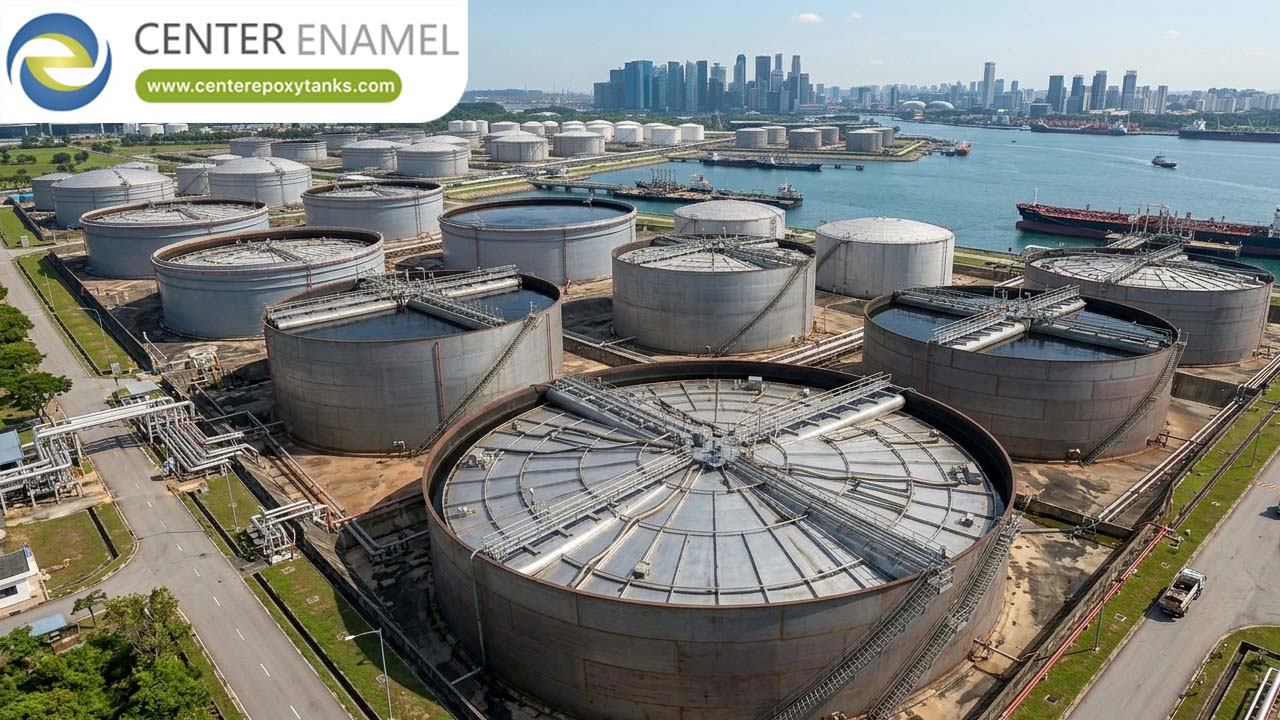
Engineering Guide to API 650 Internal Floating Roof Tanks (IFRT)
In bulk liquid storage and environmental engineering sectors, controlling hazardous emissions while maintaining structural safety is a primary objective. The API 650 Internal Floating Roof Tank (IFRT) represents the global standard for managing volatile organic compounds (VOCs), refined petroleum, and sensitive chemical feedstocks.
Governed strictly by API 650 Appendix H, an IFRT combines a permanent fixed outer roof with an internal deck that floats directly on the liquid surface. By dynamically rising and falling with product levels, the internal floating roof (IFR) minimizes the vapor headspace, drastically lowering evaporative loss and reducing explosion hazards.
1. Core Structural Configurations: Non-Contact vs. Full-Contact Decks
API 650 Appendix H classifies internal floating roofs into two primary categories based on how they interface with the liquid surface:
Non-Contact (Skin and Pontoon) Roofs
These configurations feature a series of sealed tubular pontoons supporting a lightweight deck skin slightly above the liquid level. They are highly economical, lightweight, and frequently used for retrofitting existing tanks. However, they leave a small vapor headspace beneath the deck panels.
Full-Contact (Panel/Honeycomb) Roofs
These decks rest flush against the liquid surface, completely eliminating the under-deck vapor space. This design provides maximum emission control efficiency. Because there is no vapor accumulation, it offers superior fire mitigation, requiring emergency fire suppression foam protection only around the perimeter rim seal rather than across the entire liquid surface area.
2. Key Engineering Mandates under API 650 Appendix H
To achieve compliance and ensure long-term operational safety, an IFRT must meet strict structural physics and mechanical design parameters:
● Buoyancy Reserve Safety Factor: The internal floating deck must possess enough buoyancy to support at least twice (2.0x) the total dead weight of the roof structure, including seals, legs, and attached instrumentation.
● Two-Compartment Puncture Contingency: The roof's flotation calculations must prove that the deck will remain safely afloat even if the primary center deck and any two adjacent pontoons or outer structural compartments are completely punctured and flooded with the stored product.
● Static Electricity Grounding: Pumping volatile fluids generates high static charges. API 650 mandates the installation of flexible, conductive stainless steel bonding cables or shunts that connect the floating roof directly to the tank shell, safely dissipating static buildup and preventing spark hazards.
● Adjustable Support Legs: During tank cleaning or out-of-service maintenance inspections, the floating roof rests on adjustable pipe legs. These are set to a "low-leg" position during normal operation to maximize storage capacity, and switched to a "high-leg" position (typically 2 meters) to allow safe clearance for maintenance crews.
Technical Parameter Matrix for IFRT Decks
Feature / Metric | Non-Contact Pontoon IFR | Full-Contact Honeycomb IFR |
API 650 Classification | Appendix H Standard | Appendix H Standard |
Vapor Headspace Below Skin | Minor vapor space present | Zero headspace |
Emission Suppression Efficiency | 90% to 95% | 95% to 98% |
Fire Foam System Target | Total liquid surface area | Perimeter rim seal only |
Weight Profile | Extremely Lightweight | Moderate |
3. Industrial and Environmental Engineering Applications
Beyond standard petrochemical terminals, API 650 internal floating roof tanks play a vital role in modern environmental technologies, wastewater engineering solutions, and industrial storage tank manufacturing.
● Wastewater Treatment Systems: Applied in high-volume industrial effluent and wastewater storage to trap hazardous, corrosive, or odorous vapors before treatment.
● Anaerobic Digestion Support: Integrated within industrial containment systems to handle liquid feedstocks smoothly while preventing atmospheric contamination or volatile organic venting.
● Modular Bolted Storage Tank Integration: While historically limited to field-welded tanks, modern engineering allows API 650-compliant internal floating roofs to be seamlessly integrated into advanced bolted storage tank systems, providing a modular, fast-to-deploy containment solution for international infrastructure projects.
4. Maximizing Longevity via Clear-Span Aluminum Domes
A common mechanical risk for traditional internal floating roofs is binding or seal abrasion caused by internal vertical support columns. Traditional fixed steel roofs rely on a grid of support columns that penetrate directly through the floating deck, creating extra friction points and potential vapor leak paths.
To eliminate these structural vulnerabilities, industry leaders optimize their storage architecture by pairing the IFR with a column-free, clear-span Aluminum Geodesic Dome Roof. Removing internal structural obstructions allows the floating deck to glide smoothly up and down the tank shell, which drastically reduces wear on perimeter rim seals, simplifies installation, and extends the overall asset lifecycle to 30+ years.
Strategic Value and ROI
The deployment of an API 650 Internal Floating Roof Tank is a highly effective strategy for operators seeking strict environmental compliance, safe working conditions, and minimal inventory loss. By choosing the right deck configuration and eliminating internal structural friction, facilities transform their storage assets into high-performance, long-lasting infrastructure.


