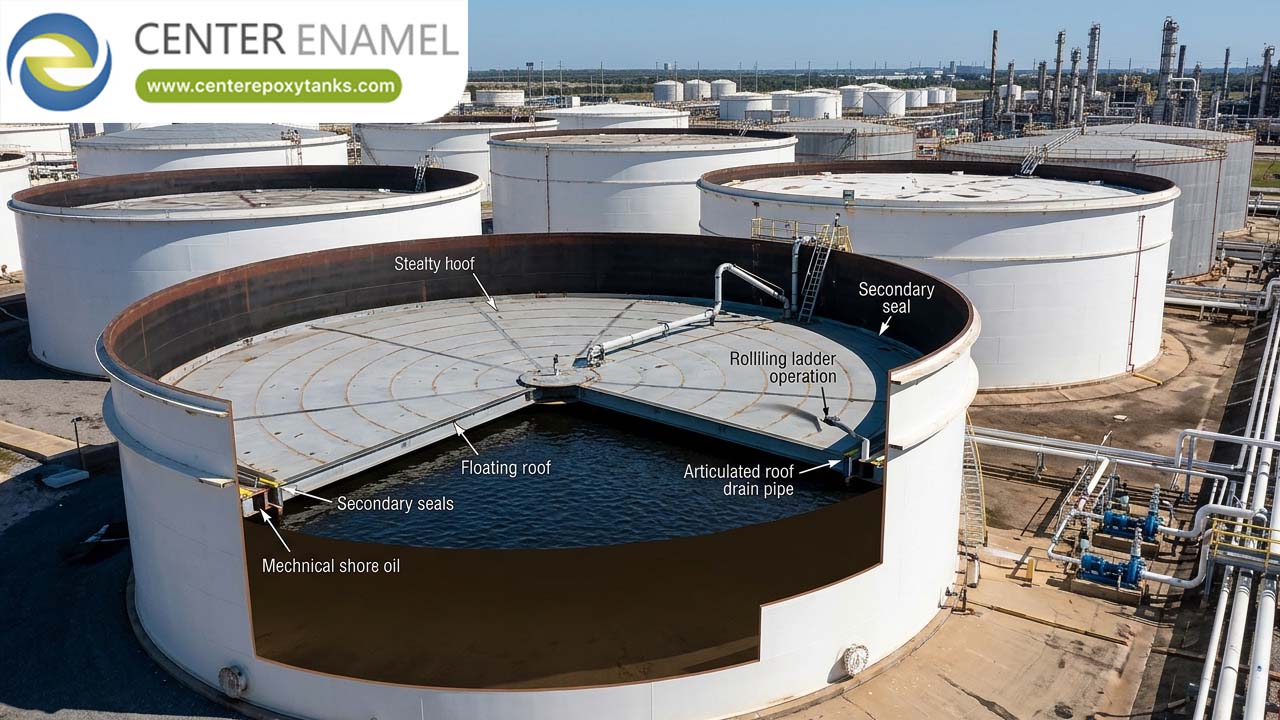
API 650 Floating Roofs: Engineering Standards for Safe Storage
In the global industrial landscape, the containment of volatile hydrocarbons and chemicals is governed by some of the most rigorous safety protocols in engineering. Among these, API 650—the Standard for Welded Tanks for Oil Storage—serves as the international benchmark. Specifically, API 650 Appendix H dictates the design, fabrication, and installation of Internal Floating Roofs (IFRs).
For facility operators and engineering procurement contractors (EPCs), understanding these standards is essential for achieving regulatory compliance, maximum emission suppression, and long-term asset safety.
What is API 650 Appendix H?
API 650 Appendix H provides the structural and mechanical requirements for the design of internal floating roofs installed within fixed-roof storage tanks. The standard is designed to ensure that the floating roof can:
1. Rise and fall smoothly with the liquid level without mechanical binding.
2. Maintain continuous contact with the stored product (in full-contact designs) or provide sufficient buoyancy to remain stable (in non-contact designs).
3. Minimize vapor space to the lowest possible level to prevent the accumulation of flammable gas mixtures.
Key Design Requirements for API 650 Compliance
Compliance with API 650 is not merely about structural integrity; it is about performance under extreme conditions. The standard mandates several critical performance criteria:
● Buoyancy Safety Factor: The IFR must have sufficient buoyancy to remain afloat with a reserve of at least twice (2.0x) the dead weight of the roof structure. This ensures the roof remains stable even if two adjacent pontoon compartments are flooded.
● Peripheral Seal Integrity: The rim seal system must be designed to accommodate the maximum and minimum expected annular gap between the roof edge and the tank shell, ensuring consistent emission containment.
● Electrical Grounding: To prevent static spark ignition—a primary cause of tank fires—API 650 requires electrical bonding of the roof to the tank shell using flexible, conductive shunts or cables.
The Role of Floating Roofs in Emission Control
The primary application of API 650-compliant roofs is the reduction of Volatile Organic Compound (VOC) emissions. By creating a physical barrier on the liquid surface, the IFR effectively acts as a "lid" that suppresses evaporation.
Engineering Note: Industry best practices now favor full-contact honeycomb panel designs over traditional non-contact pontoons for high-volatility products. Full-contact designs leave zero headspace, effectively reducing VOC emissions by up to 98% and removing the risk of localized vapor pockets.
Compliance and Performance Matrix
Design Parameter | API 650 Compliance Requirement | Operational Impact |
Floatation | 2.0x Dead Weight Minimum | Prevents sinking during emergency leaks |
Static Grounding | Continuous path to tank shell | Mitigates static spark fire risks |
Rim Seal | Flexible adaptation to shell gaps | Minimizes VOC release |
Leg Settings | Adjustable (Low & High position) | Facilitates maintenance & tank capacity |
Operational Excellence: The Clear-Span Advantage
A critical consideration for modern API 650 projects is the interaction between the floating roof and the fixed tank roof.
Traditional steel fixed roofs often require internal vertical support columns that pass through the floating deck. These columns necessitate complex cutouts and extra seals, which are common failure points. As a global leader in storage infrastructure, Shijiazhuang Zhengzhong Technology Co., Ltd (Center Enamel) recommends pairing API 650 IFRs with Aluminum Geodesic Dome Roofs (ADR).
By utilizing a column-free, clear-span dome, the interior of the tank remains completely unobstructed. This allows the IFR to glide smoothly along the tank shell, drastically reducing mechanical wear on the rim seals and maximizing the service life of the roofing system.
Partnering for Compliance
Achieving API 650 compliance requires more than just high-quality materials; it requires precise engineering and a deep understanding of storage dynamics. Whether you are managing petrochemical feedstocks, industrial wastewater, or municipal water reserves, selecting an IFR system that adheres to these international standards is the foundation of a safe, compliant facility.
Center Enamel combines automated factory manufacturing with decades of engineering experience to design API 650-compliant tank and roofing systems tailored to your site's specific requirements.


