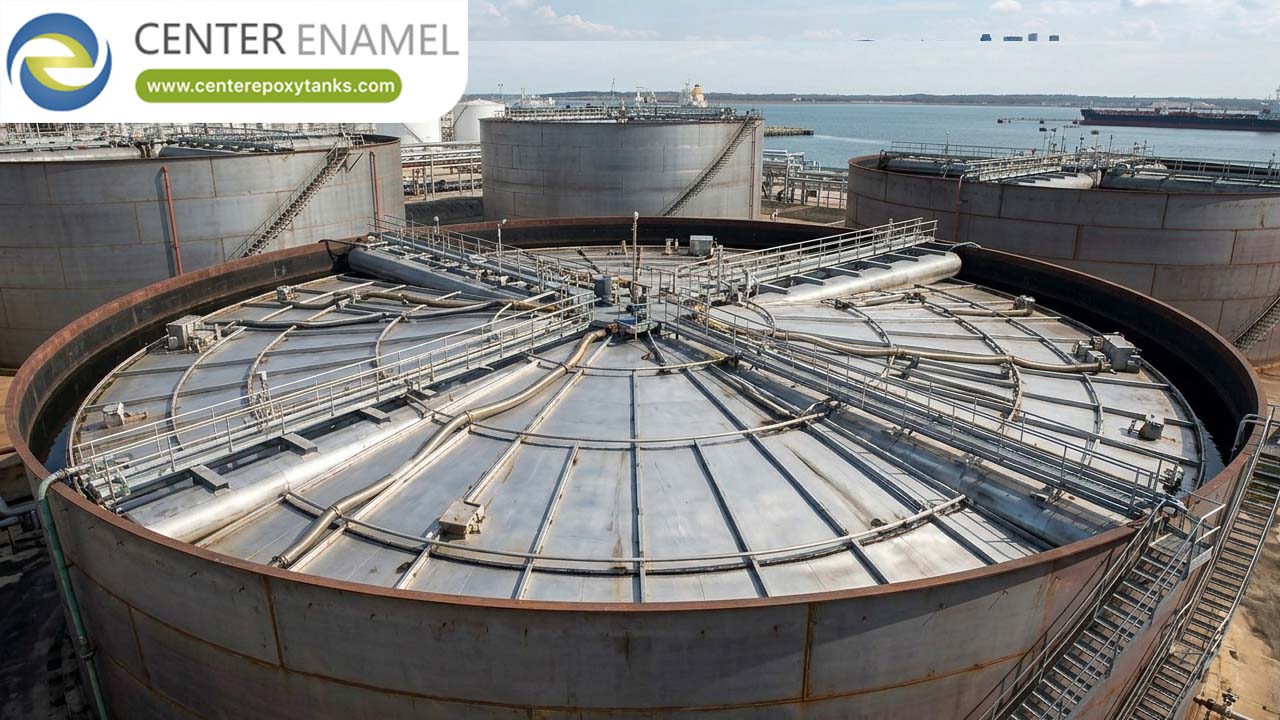
API 650 Floating Roof Tank: Engineering, Architecture, and Design Standards
In bulk liquid storage infrastructure, managing high-volume, volatile fluids requires advanced mechanical design. The API 650 Floating Roof Tank (FRT) represents the global engineering standard for storing volatile organic compounds (VOCs), crude oil, and refined petroleum products. By featuring a roof that floats directly on the liquid surface, this specialized tank eliminates the vapor headspace, drastically lowering evaporative loss and reducing explosion hazards.
As a leading global provider of industrial containment and integrated roofing solutions since 2008, Shijiazhuang Zhengzhong Technology Co., Ltd (Center Enamel) specializes in delivering advanced, code-compliant storage infrastructure. This comprehensive guide analyzes the structural variations, core benefits, and critical design parameters of API 650 floating roof tanks.
1. Core Architectures: EFRT vs. IFRT
API 650 classifies floating roof tanks into two primary configurations based on environmental exposure and chemical volatility:
External Floating Roof Tanks (EFRT)
Regulated under API 650 Appendix C, an EFRT consists of an open-top cylindrical shell equipped with a deck that floats exposed to the atmosphere. It is typical for massive-diameter tanks storing crude oil or heavy feedstocks.
● Design Formats: Available as economical Pontoon-type single decks or heavy-duty Double-Deck systems.
● Considerations: While highly effective for massive capacities, EFRTs require continuous monitoring of rainwater accumulation, weather-driven seal degradation, and primary roof drainage networks.
Internal Floating Roof Tanks (IFRT)
Regulated under API 650 Appendix H, an IFRT pairs a floating deck with a permanent, fixed roof shell cover. This configuration shields the floating deck entirely from weather elements.
● Design Formats: Available as lightweight non-contact skin-and-pontoon systems or high-efficiency full-contact honeycomb panels.
● Considerations: IFRTs completely eliminate rainwater contamination and wind-driven vapor losses, making them the preferred choice for ultra-volatile light hydrocarbons, aviation fuels, and strict urban emission zones.
Technical Performance Profile Matrix
Feature / Metric | Fixed-Roof Tank (No Floating Deck) | API 650 External Floating Roof (EFRT) | API 650 Internal Floating Roof (IFRT) |
Vapor Space (Headspace) | Large, combustible ullage | None (Suppressed at surface) | None (Suppressed at surface) |
VOC Emission Reduction | 0% (Baseline) | 90% to 95% Suppression | 95% to 98% Suppression |
Weather Vulnerability | Low (Fully enclosed) | High (Rain, snow, UV exposure) | Low (Shielded by fixed cover) |
Primary Drainage Needed | No | Yes (Articulated pipe or hose) | No |
Typical Product Stored | Heavy oils, water, chemicals | Large-scale crude oil, gasoline | Refined fuels, solvents, chemicals |
2. Critical Engineering Design Parameters
To secure an API 650 compliance stamp, a floating roof tank must satisfy rigorous structural physics calculations during the Front-End Engineering Design (FEED) phase:
● Buoyancy Safety Factors: API 650 mandates that floating roofs must possess a flotation reserve capable of supporting at least twice (2.0x) the total dead weight of the roof assembly. For safety contingencies, the roof must remain fully buoyant even if the center deck and any two adjacent pontoon compartments suffer structural punctures.
● Perimeter Sealing Systems: The annular gap between the floating deck edge and the tank shell (typically 100 mm to 200 mm) must be sealed using primary mechanical shoe seals or resilient liquid-filled logs, often paired with secondary elastomeric wiper seals to scrape the shell clean during vertical travel.
● Static Dissipation & Grounding: High-velocity fluid pumping generates substantial static electricity. To prevent spark ignition within the tank shell, API 650 requires the installation of flexible, conductive stainless steel shunts or bonding cables connecting the floating roof directly to the tank shell.
● Adjustable Support Leg Layouts: Floating roofs feature structural pipe legs adjustable to two positions: a low-leg setting for normal operations to maximize net usable tank capacity, and a high-leg setting (typically 2 meters) to provide safe clearance for maintenance personnel during out-of-service floor inspections.
3. Optimizing Longevity via Clear-Span Synergy
A primary operational challenge for internal floating roof tanks is mechanical binding or seal abrasion caused by internal vertical support columns. Traditional fixed steel roofs require an internal column grid that penetrates through the floating deck, creating extra friction points and potential vapor leak paths.
To eliminate this mechanical vulnerability, modern tank terminal designs combine the IFR with a column-free, clear-span Aluminum Geodesic Dome Roof (ADR). Removing internal structural obstructions enables the floating roof to glide smoothly up and down the tank shell, minimizing perimeter rim seal wear, simplifying installation, and optimizing long-term asset availability.
Engineering for Total Cost of Ownership
Investing in an API 650 Floating Roof Tank is a decisive strategy for operators targeting strict environmental compliance, enhanced site safety, and minimal inventory loss. Whether deploying an open-top EFRT for primary crude storage or an enclosed IFRT for refined products, adhering to rigorous design and material standards ensures reliable asset performance over a multi-decade operational lifecycle.
Center Enamel combines advanced manufacturing automation with precise engineering to deliver integrated, code-compliant storage tank and roofing solutions worldwide. Contact our specialized engineering team today to review your project's technical specifications and storage layout.


