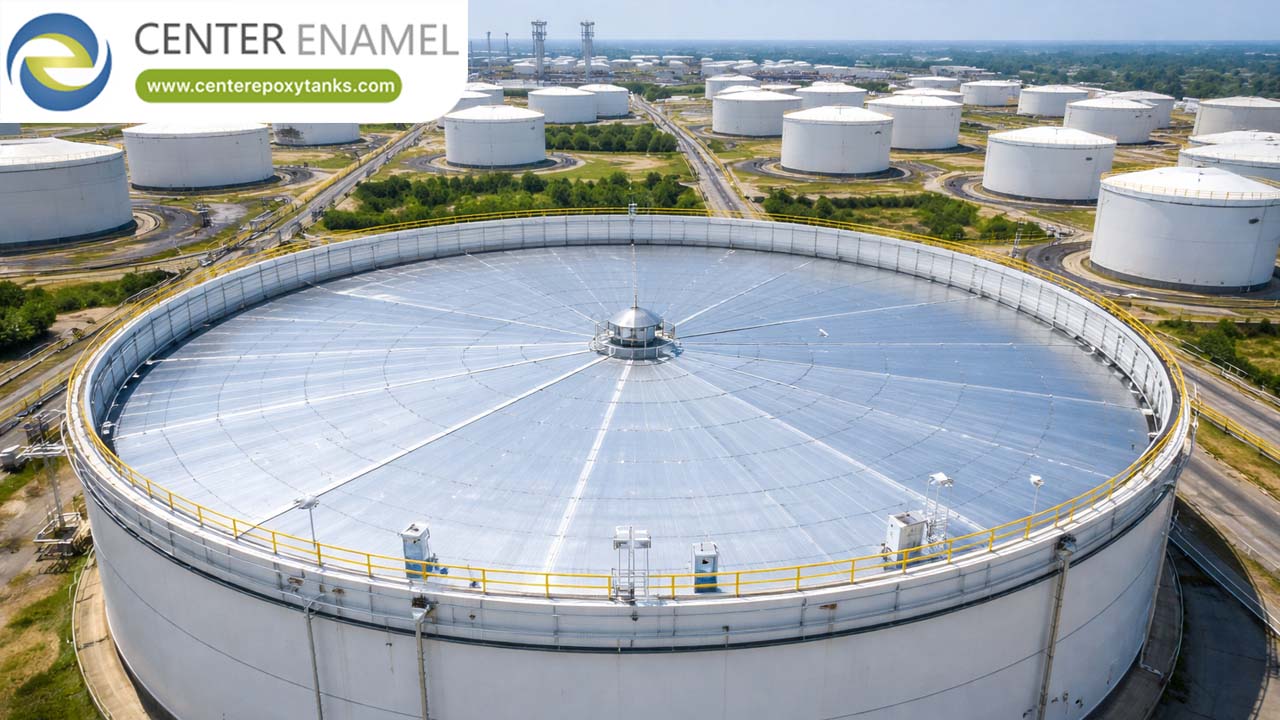
API 650 External Floating Roofs: Structural Engineering and Design Standards
In high-volume downstream and midstream oil and gas operations, storing volatile petroleum products like crude oil and gasoline requires infrastructure that can safely manage high vapor pressures. The API 650 External Floating Roof (EFR) is the industry-standard design for large-diameter, open-top storage tanks.
Regulated globally under API 650 Appendix C, an EFR floats directly on the surface of the stored liquid. By rising and falling alongside the fluid level, the roof eliminates the volatile vapor headspace (ullage) where hazardous gases typically accumulate, minimizing both product evaporation and flash fire risks.
As a premier global manufacturer of industrial containment and modular roofing solutions since 2008, Shijiazhuang Zhengzhong Technology Co., Ltd (Center Enamel) delivers engineered tank systems across more than 100 countries. This technical guide examines the critical engineering metrics, structural configurations, and accessory requirements specified by API 650 Appendix C for external floating roofs.
1. Structural Configurations per Appendix C
API 650 Appendix C limits permissible external floating roof designs to two primary categories based on the tank's diameter and the stability required for the application:
Pontoon-Type Single-Deck Roofs
Designed with a continuous, liquid-tight center deck sheet bordered by a ring of compartmentalized, air-tight outer pontoons. The pontoons provide the necessary concentrated buoyancy, while the center deck handles structural flex during fluid movement. This configuration is highly economical and commonly used for tanks up to 91.5 meters (300 feet) in diameter.
Double-Deck Floating Roofs
Mandated by API 650 for massive diameters exceeding 91.5 meters, double-deck roofs feature upper and lower steel membranes separated by an internal air gap. Circumferential and radial bulkheads form an interconnected matrix of closed flotation compartments across the entire surface area. This design offers exceptional structural rigidity, superior load distribution, and insulates the stored product from solar heat gain.
API 650 Regulation Note: Simple pan-type single-deck roofs without peripheral flotation chambers are strictly prohibited for external configurations. They lack the necessary reserve buoyancy to withstand severe environmental loads or localized punctures.
2. Critical Engineering Physics & Buoyancy Requirements
Because an EFR is exposed to ambient weather conditions, it must be engineered to resist extreme environmental loads without sinking or listing.
● The Two-Compartment Sinking Criteria: API 650 mandates strict safety factors for emergency flotation. The roof must be structurally calculated to remain afloat even if the primary center deck and any two adjacent pontoon compartments are completely breached and flooded with the stored liquid.
● Rainwater and Snow Accumulation: The floating structure must support heavy live loads without losing stability. Appendix C specifies that the roof must withstand up to 10 inches (250 mm) of accumulated rainfall over a 24-hour period while retaining its structural integrity and buoyancy profile.
● Adjustable Support Legs: When a tank is completely drained for cleaning or mechanical inspection, the EFR rests on a grid of heavy-duty steel pipe legs. In compliance with API standards, these legs are adjustable to two settings: a low-leg position for normal low-level operations to maximize tank capacity, and a high-leg position providing a minimum of 2 meters of clearance for maintenance crews entering the tank floor.
3. Essential Sealing and Drainage Accessories
Because the roof is open to the sky, it requires specialized mechanical systems to manage rainfall and control emissions along the moving perimeter gap.
Primary and Secondary Seal Systems
The annular space between the outer floating rim and the interior tank shell wall (typically 200 mm) must be sealed to prevent volatile vapor release.
● Mechanical Shoe Seals: Utilizing overlapping galvanized or stainless steel shoes pressed against the shell by spring-loaded pantograph mechanisms, shoe seals offer excellent resistance to aromatic hydrocarbons and withstand rough weld seams on the tank interior.
● Secondary Wiper Seals: Mounted directly above the primary seal, secondary elastomeric wipers scrape against the shell during vertical travel. They act as a backup barrier against wind currents, ensuring strict compliance with local environmental VOC emission regulations.
Primary Roof Drainage Networks
Accumulated rainwater on an EFR can cause structural overloading. Tanks must include a primary drainage system—typically using either a multi-layered, flexible high-strength hose system or an articulated steel pipe drain equipped with leak-proof mechanical swivel joints. This system funnels rainwater from the top of the floating deck down through the liquid phase and out of the tank via a shell nozzle, keeping the rainwater isolated from the stored medium.
External Floating Roof Performance Profile
Design Metric | Single-Deck Pontoon EFR | Double-Deck EFR |
API 650 Classification | Appendix C Standard | Appendix C Standard (>91.5m Tanks) |
Buoyancy Reserve | High (Outer Ring Pontoons) | Maximum (Full Surface Matrix) |
Weather Vulnerability | High (Rain/Snow loading on center deck) | Moderate (Better drainage distribution) |
Solar Heat Shielding | Minimal | High (Insulating air gap reduces product boiling) |
Static Grounding | Required (Perimeter shunts to shell) | Required (Perimeter shunts to shell) |
4. Converting EFR to IFR: The Strategic Dome Upgrade
While API 650 External Floating Roofs are highly effective for massive crude oil storage vessels, their open-top configuration exposes them to operational challenges, including seal degradation from UV exposure, rainwater accumulation in the drainage network, and snow-load imbalances.
To eliminate these weather risks and achieve maximum environmental compliance, operators frequently modify their storage architecture by installing a column-free, clear-span Aluminum Geodesic Dome Roof over an existing or new EFR.
By covering the open tank, the external floating roof is transformed into an internal floating system shielded from the elements. This configuration eliminates rainwater drainage failures, stops solar-induced vapor boiling, and removes wind-driven vapor loss, significantly extending the service life of the perimeter rim seals.
Engineering for Long-Term Asset Integrity
Designing and manufacturing an API 650 Appendix C External Floating Roof requires careful calculation of fluid properties, buoyancy reserves, and localized weather factors. Adhering to these international design rules ensures asset safety, environmental compliance, and inventory preservation over a multi-decade operational lifespan.
Center Enamel delivers specialized engineering support, precision manufacturing, and advanced modular roofing integrations to ensure your bulk liquid terminal functions with maximum safety and efficiency.


