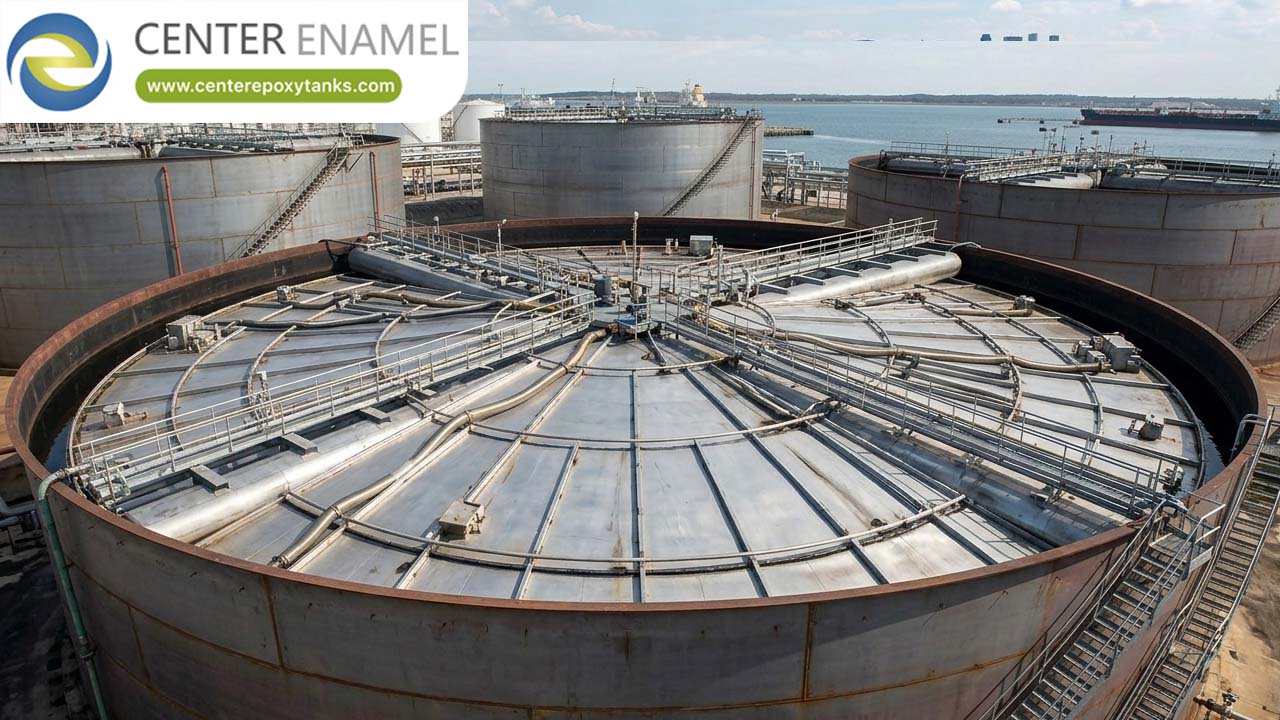
Engineering Guide to API 650 Full Contact Internal Floating Roofs
In modern bulk liquid terminals, chemical refineries, and environmental engineering facilities, controlling atmospheric emissions while protecting product purity is a paramount technical objective. As environmental regulations grow increasingly stringent worldwide, the API 650 Full Contact Internal Floating Roof (IFR) has emerged as the definitive standard for storing volatile hydrocarbons, refined fuels, and aggressive chemical feedstocks.
Regulated strictly under API 650 Appendix H, full contact internal floating roofs represent a major evolutionary leap over legacy non-contact pontoon roofs. By addressing the root cause of evaporative loss—the open vapor workspace above the liquid—this technology provides maximum safety, emission compliance, and financial return via product preservation.
1. Mechanics of Full Contact vs. Non-Contact Designs
Understanding the structural distinction between non-contact and full-contact configurations is essential for front-end engineering design (FEED) teams:
Non-Contact Floating Roofs
These designs use a thin metallic deck sheet clamped or bolted to a framework of raised tubular pontoons. While cost-effective, this layout suspends the deck skin several inches above the liquid line. The resulting air gaps create saturated vapor pockets under the deck panels, allowing volatile organic compounds (VOCs) to accumulate and exert pressure against joint seams.
Full Contact Floating Roofs
A full contact internal floating roof leaves zero headspace between the underside of the deck and the liquid surface. The roof establishes complete, flush contact across the entire surface area of the tank. Because there is no vapor workspace where liquids can convert to gas, vaporization is blocked at the interface, lowering VOC emissions to the absolute mechanical minimum.
2. Structural Configurations and Materials
Full contact internal floating roofs are typically fabricated in two primary structural formats, chosen based on the chemical compatibility and thermal profile of the stored medium:
Aluminum Honeycomb Panel Matrix
Constructed using an internal grid of high-strength aluminum honeycomb hex-cells sandwiched between marine-grade aluminum top and bottom skins (such as 3000 or 6000 series alloys). The panels are perimeter-sealed and bonded using chemical-resistant adhesives or factory seal-welds to form an airtight, highly buoyant panel matrix. This configuration is exceptionally lightweight, corrosion-resistant, and ideal for refined petroleum, aviation fuels, and solvents.
Welded Stainless Steel Compartments
For high-temperature processing, sour crude oil containing high concentrations of Hydrogen Sulfide (H2S), or highly acidic chemicals, engineers deploy full contact stainless steel floating roofs (utilizing AISI 304L, 316L, or Duplex alloys). These decks consist of heavy metallic plate modules continuously seal-welded in the field or factory to form a monolithic, liquid-tight floor. They provide unparalleled chemical resilience without requiring sacrificial internal linings or protective coatings.
3. Key API 650 Appendix H Regulatory Requirements
To secure an engineering code stamp and maintain plant safety, full contact internal floating roofs must satisfy rigorous mechanical design parameters:
● 2.0x Buoyancy Safety Factor: The floating deck must possess a calculated flotation reserve capable of supporting at least twice (2.0x) the total combined dead weight of the roof assembly—including perimeter rim seals, mechanical attachments, and instrumentation—under the lowest design specific gravity of the product.
● Two-Compartment Puncture Contingency: Flotation calculations must mathematically prove that the roof will remain level, stable, and fully buoyant even if the outer rim region and any two adjacent internal floating compartments or honeycomb panels suffer physical breaches and flood with product.
● Static Charge Dissipation & Grounding: High-velocity fluid pumping generates massive static electricity. API 650 requires full contact decks to integrate flexible stainless steel bonding cables or perimeter grounding shunts that maintain constant contact with the tank shell, safely bleeding off static charges to eliminate spark-ignition risks.
● Adjustable Dual-Setting Legs: The deck is outfitted with heavy-duty pipe support legs. These feature an adjustable low-leg setting for standard operations to maximize net usable tank capacity, and a high-leg setting (typically 2 meters or 7 feet) to provide safe vertical clearance for maintenance personnel during out-of-service floor inspections.
Technical Performance Profile Matrix
Engineering Metric | Non-Contact Skin & Pontoon IFR | Full Contact Aluminum Honeycomb IFR | Full Contact Welded Stainless Steel IFR |
API 650 Classification | Appendix H Standard | Appendix H Standard | Appendix H Standard |
Interface Layout | Suspended above liquid | Flush contact (Zero headspace) | Flush contact (Zero headspace) |
VOC Suppression Rate | 90% to 95% Efficiency | 95% to 98%+ Efficiency | 98% to 99%+ Efficiency |
Corrosion Resilience | Variable | Excellent (Refined products) | Maximum (H2S, Acids, Sour Crude) |
Thermal Threshold | Moderate | Moderate | High Temperature (Up to 500°F) |
Fire Foam Target Area | Full liquid surface area | Perimeter rim seal area only | Perimeter rim seal area only |
4. Sealing and Emission Control Dynamics
While the full contact deck eliminates emissions across the main liquid surface, the annular space between the outer rim of the floating deck and the interior tank shell (typically 100 mm to 200 mm) remains a critical path for potential vapor escape.
To address this, full contact designs are paired with high-performance perimeter seal networks:
● Primary Mechanical Shoe Seals: Utilizing overlapping metallic plates held against the tank shell by spring-loaded pantograph mechanisms, shoe seals offer exceptional durability against rough weld seams and survive decades of vertical travel.
● Secondary Elastomeric Wiper Seals: Mounted directly above the primary shoe, secondary wipers scrape the shell clean as the roof descends, providing a secondary barrier against wind currents and localized vapor migration.
5. Clear-Span Synergy: Maximizing System Lifespan
A primary operational vulnerability for any internal floating roof is mechanical binding or seal abrasion caused by internal vertical support columns. Traditional fixed steel roofs require an internal column grid that penetrates through the floating deck, necessitating complex cutouts, extra seals, and creating potential friction points.
To eliminate this operational risk, modern tank terminals combine the full contact IFR with a column-free, clear-span Aluminum Geodesic Dome Roof (ADR).
Removing internal vertical columns allows the floating deck to glide completely unobstructed up and down the tank shell. This column-free integration eliminates penetration leak paths, drastically minimizes mechanical wear on perimeter rim seals, simplifies field construction, and extends the asset’s trouble-free service life to over 30 years.
Strategic Value and Return on Investment
Investing in an API 650 Full Contact Internal Floating Roof is a decisive strategy for operators targeting strict environmental compliance, enhanced site safety, and minimal inventory loss. Whether deploying an aluminum honeycomb design for refined fuels or a robust stainless steel structure for aggressive chemical environments, selecting a full-contact configuration transforms storage assets into high-efficiency containment systems built for multi-decade reliability.


