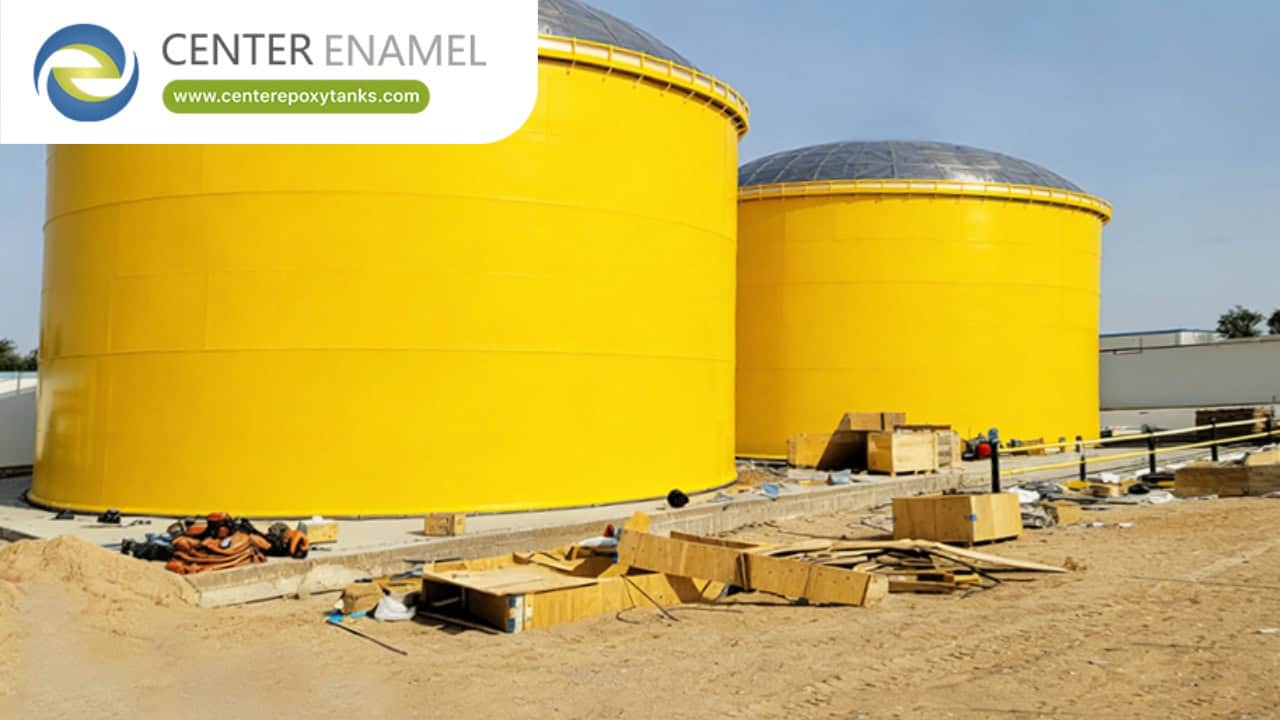
Types of Oil Storage Tanks: A Complete Engineering Guide
When designing industrial liquid storage, selecting the right tank architecture is the foundation of operational safety, environmental compliance, and cost control. The vast majority of vertical, flat-bottomed oil storage tanks are engineered to the API 650 standard, which dictates the design, fabrication, and erection requirements for tanks operating at low internal pressures.
Choosing the wrong tank configuration can lead to rapid product evaporation, dangerous volatile organic compound (VOC) emissions, or structural vulnerability in harsh weather. Depending on the vapor pressure of the stored fluid and specific facility requirements, oil storage tanks are categorized into four primary designs.
1. Fixed-Roof Tanks
A fixed-roof tank consists of a cylindrical steel shell with a permanently affixed roof—typically cone-shaped or dome-shaped. These tanks can be engineered from a variety of robust materials, including Glass-Fused-to-Steel, Fusion Bonded Epoxy (FBE), or welded carbon steel, depending on the corrosivity of the application.
How it works: The roof is welded or bolted directly to the shell, creating a sealed environment. A breather valve (pressure-vacuum valve) is installed on the roof to safely manage slight internal pressure changes as ambient temperatures fluctuate.
Best for: Heavy oils, diesel, wastewater, and non-volatile liquids.
Limitation: Because the roof is static, a vapor space (ullage) always exists above the liquid level. If used for highly volatile liquids, this space can accumulate explosive vapors and lead to significant evaporation losses.
2. External Floating Roof Tanks (EFRT)
To combat the evaporation and safety risks associated with volatile liquids, the external floating roof tank eliminates the fixed top cover entirely.
How it works: The roof deck (usually a buoyant pontoon or double-deck design) floats directly on the surface of the oil. As the tank is filled or emptied, the roof rises and falls in lockstep with the liquid level, effectively eliminating the vapor space. A mechanical rim seal system bridges the gap between the floating deck and the tank shell to prevent vapors from escaping.
Best for: High-capacity, large-diameter storage of highly volatile liquids like crude oil and gasoline.
Limitation: The roof is completely exposed to the elements. Heavy rainfall or snow accumulation can overwhelm the roof's mechanical drainage system and threaten the deck's buoyancy.
3. Internal Floating Roof Tanks (IFRT)
This design combines the heavy-duty weather protection of a fixed roof with the superior vapor control of a floating roof.
How it works: A fixed roof (often a clear-span aluminum geodesic dome or a traditional steel cone) covers the tank, while a buoyant deck floats on the liquid inside the tank.
Best for: Highly volatile petrochemicals, aviation fuel, and operational environments where heavy rain, snow, or debris would compromise a standard EFRT.
Advantage: Reduces product evaporation by up to 98% while protecting the internal mechanics and rim seals from weather-induced wear and UV degradation.
4. Domed External Floating Roof Tanks
Often utilized as a hybrid or retrofit solution, this involves adding a self-supporting fixed roof (typically a geodesic dome) over an existing external floating roof tank.
Tank Selection Matrix
Tank Type | Primary Function | Ideal Stored Product | Relative Cost |
Fixed Roof | Basic containment and weather protection | Diesel, Heavy Oil, Wastewater | Lowest |
EFRT | Vapor loss reduction at massive capacities | Crude Oil, Gasoline | Moderate |
IFRT | Maximum VOC control & weather defense | Light Crudes, Jet Fuel, Solvents | High |
Domed EFRT | Upgrading existing assets for compliance | Volatile hydrocarbons in harsh climates | Highest (Retrofit) |
Frequently Asked Questions (FAQ)
Q: Why is the API 650 standard so important for oil tanks?
A: API 650 is the globally recognized standard from the American Petroleum Institute that governs the design, fabrication, and erection of welded, flat-bottomed vertical tanks. Designing to this standard ensures the tank can safely handle the fluid's specific gravity, environmental wind and snow loads, seismic activity, and operating pressures up to 2.5 PSI.
Q: Can I store gasoline in a fixed-roof tank?
A: It is highly discouraged and often restricted by environmental regulations. Gasoline has a high vapor pressure. In a standard fixed-roof tank, the product will continuously evaporate into the empty space above the liquid, creating a severe fire hazard and resulting in costly product loss. An IFRT or EFRT is standard practice for gasoline.
Q: What is the exact purpose of the rim seal on a floating roof?
A: The rim seal is a flexible mechanical barrier (often utilizing metal shoes, foam, or liquid-filled tubes) that closes the annular gap between the outer edge of the floating deck and the inner wall of the steel tank shell. It serves as the primary physical defense against VOC emissions escaping into the atmosphere.
Q: How do internal support columns affect an IFRT design?
A: Traditional steel fixed roofs often require vertical columns inside the tank to support their weight. However, these columns must pierce the internal floating roof deck, creating additional penetrations where vapor can leak out. Utilizing clear-span aluminum geodesic dome roofs eliminates the need for these internal columns, providing a cleaner tank interior, easier maintenance, and superior emission control.


