Types of Gasholders for Biogas Plants: Design, Architecture, and Selection Guide
In any commercial anaerobic digestion (AD) facility, a gasholder is a critical infrastructural asset. It serves as the plant's operational "lung," buffering the discrepancy between continuous biological biogas production and fluctuating energy consumption by downstream Combined Heat and Power (CHP) engines or upgrading skids.
Selecting the correct gasholder architecture directly impacts plant safety, gas delivery stability, capital expenditure, and long-term maintenance overhead. Modern renewable gas facilities utilize several distinct gasholder designs, each tailored to specific volumetric, spatial, and pressure requirements.
Primary Types of Biogas Gasholders
1. Top-Mounted Double-Membrane Gasholders (Roof-Integrated)
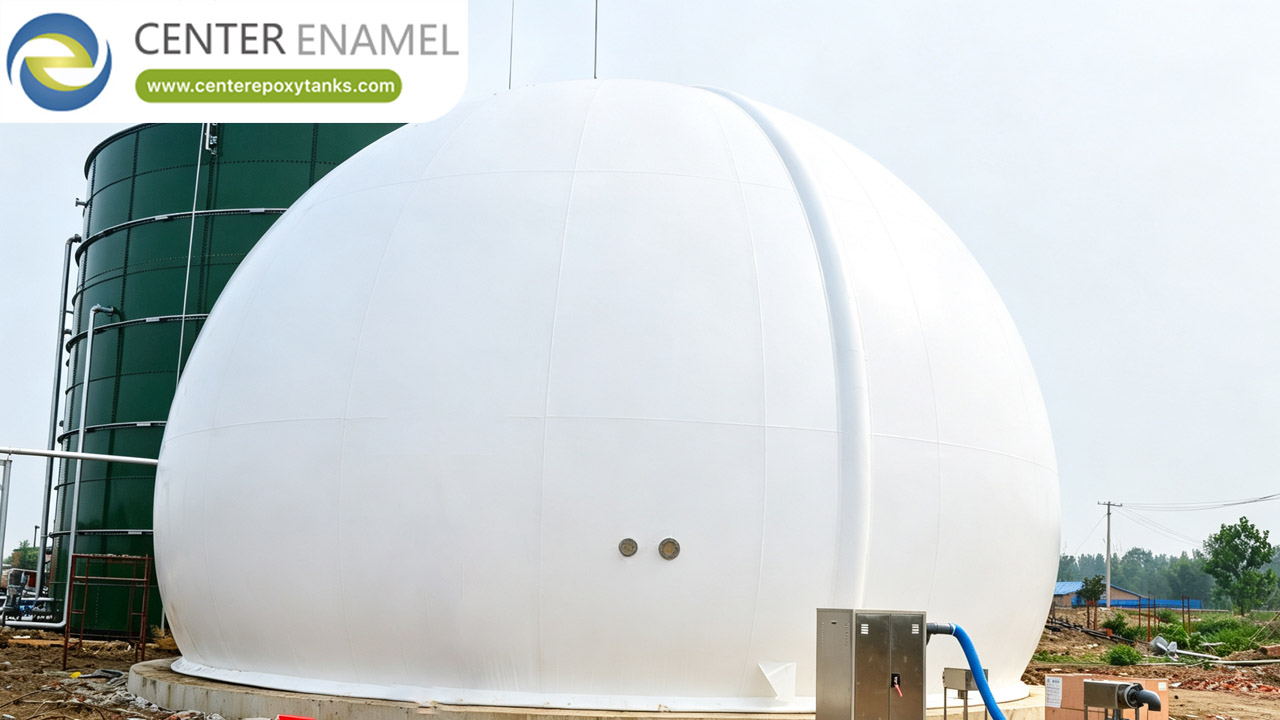
Top-mounted double-membrane gasholders are the most widely adopted storage solution in modern municipal and agricultural biogas plants. Installed directly on top of anaerobic digester tanks—most notably bolted Glass-Fused-to-Steel (GFS) or concrete tanks—they combine reactor sealing with active gas storage into a single structural footprint.
Design: Features an inner gas-containment membrane and an outer protective weather shell continuously inflated by an explosion-proof air support blower.
Advantage: Eliminates the need for a separate civil foundation, optimizes land use, and provides constant delivery pressure (2 mbar to 20 mbar) while thermally insulating the digester slurry.
2. Ground-Mounted / Standalone Double-Membrane Gasholders
When a biogas plant requires massive buffer storage capacity that exceeds the volume of the digester tanks, or when existing digesters cannot bear additional roof loads, standalone ground-mounted gasholders are deployed.
Design: These structures incorporate a third bottom membrane anchored to a concrete slab foundation, creating an independent sphere or ¾-sphere dome completely separate from the reactor.
Advantage: Offers high-capacity modular gas storage (ranging from 500 m3 to over 10,000 m3) positioned strategically anywhere within the plant layout.
3. Fixed Roof Systems with External Gasholders
Traditional wastewater treatment and industrial digestion plants occasionally utilize rigid fixed roofs (concrete domes or structural steel plates) for primary gas containment, paired with low-pressure bell-type or water-sealed gasholders.
Design: The rigid roof seals the tank, while a separate mechanical holder manages gas storage.
Advantage: Extremely high structural rigidity against heavy external loads, though prone to biogenic sulfuric acid corrosion and lacking active volumetric flexibility.
4. Membrane-Based Balloon / Cylindrical Holders
Compact, flexible fabric bladders housed inside protective chain-link or steel mesh cages are frequently utilized in smaller agricultural biogas setups or containerized packaged anaerobic systems.
Design: A simple cylindrical or spherical polymer envelope that expands radially as gas accumulates.
Advantage: Low entry cost, highly portable, and ideal for decentralized or pilot-scale renewable energy projects.
Data Table: Comparison of Biogas Gasholder Types
Gasholder Type | Mounting Location | Volume Capacity | Pressure Regulation | Primary Engineering Use Case |
Top-Mounted Double-Membrane | Directly on Digester / GFS Tank | Small to Medium (100--5,000 m3) | Constant (2--20 mbar) | Integrated digestion & active buffering in commercial AD plants |
Ground-Mounted Standalone | Concrete Slab Foundation | Large to Massive (1,000--15,000+ m3) | Constant (3--25 mbar) | Centralized multi-digester plants requiring high RNG storage |
Fixed Roof + External Holder | Tank Top + Separate Foundation | Variable | Low / Variable | Traditional industrial wastewater and municipal sludge plants |
Cylindrical Mesh Bladder | Ground / Packaged Skid | Compact (50--500 m3) | Low Pressure | Small-scale agricultural digesters & modular biogas units |
Frequently Asked Questions (FAQ)
Q: What is the main advantage of a double-membrane gasholder over traditional steel tanks?
A: Double-membrane gasholders are constructed from chemical-resistant technical fabrics that are 100% immune to hydrogen sulfide (H2S) corrosion, whereas traditional steel gasholders require frequent anti-corrosion maintenance and protective coatings. They also offer dynamic volumetric expansion.
Q: How do ground-mounted standalone gasholders differ from top-mounted domes?
A: Standalone gasholders sit on their own dedicated concrete foundation and feature a bottom membrane, making them completely independent units. Top-mounted domes use the upper rim of the digester tank as their base, saving significant land area and piping costs.
Q: How is safety managed in high-capacity biogas gasholders?
A: Certified gasholders feature multi-layered safety infrastructure, including mechanical hydraulic safety relief valves (water seals), pressure monitoring sensors, automated emergency flare activation triggers, and explosion-proof air support blowers.
Q: What is the expected service life of a modern membrane gasholder?
A: With routine scheduled inspections and proper operational maintenance, a high-tensile PVC/PVDF membrane gasholder typically achieves an operational lifespan of 15 to 20 years.


