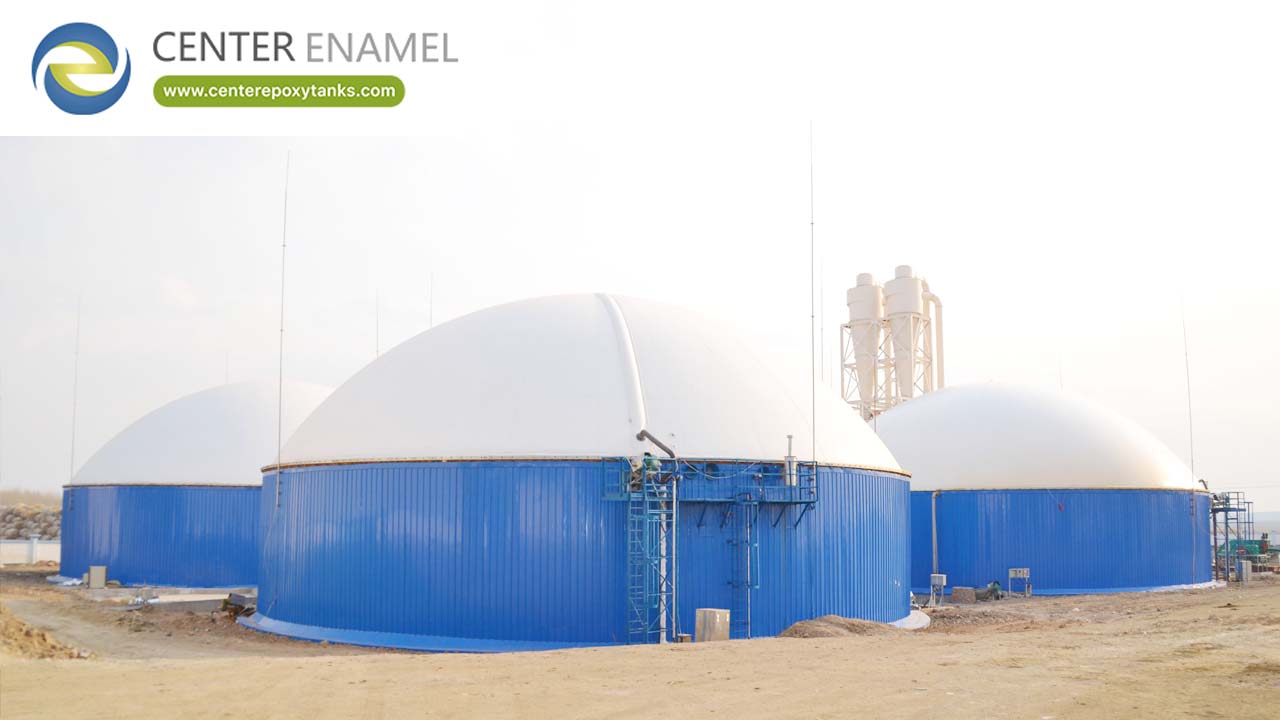
Membrane Roofs for CSTR Tanks: Optimizing Biogas Storage and Reactor Efficiency
In modern anaerobic digestion (AD) plants, the Continuous Stirred-Tank Reactor (CSTR) serves as the biological heart of the operation, breaking down organic waste, agricultural slurry, and industrial wastewater into clean renewable energy. To maintain optimal microbial activity, strict anaerobic conditions, and efficient gas collection, CSTR tanks require robust, gas-tight covering systems.
Membrane roofs—particularly advanced double-membrane gas holders—have become the industry standard for CSTR tanks. Replacing traditional static concrete or heavy steel slab covers, flexible membrane roofs provide dynamic volumetric storage, flawless odor containment, and constant-pressure gas delivery for downstream Combined Heat and Power (CHP) engines.
The Role of Membrane Roofs in CSTR Operations
A CSTR tank relies on continuous mechanical mixing and precise thermal regulation (typically mesophilic or thermophilic ranges) to maximize methane production. Membrane roofs support this biological process through several key engineering mechanisms:
Dynamic Gas Buffering: Unlike rigid roofs that offer zero active storage, a double-membrane CSTR roof features a variable-volume inner gas liner. It expands and contracts seamlessly between 0% and 100% capacity in response to daily production spikes and engine consumption cycles.
Absolute Odor and Emission Control: High-frequency (HF) welded synthetic fabrics create a 100% hermetic seal over the reactor headspace, trapping hydrogen sulfide and ammonia emissions completely while preventing oxygen intrusion.
Corrosion Resilience: High-tensile polyester fabrics coated with specialized PVC or PVDF layers are completely immune to biogenic sulfuric acid attack, avoiding the rapid spalling and degradation that plagues traditional concrete digester ceilings.
Single vs. Double Membrane Roofs for CSTR Systems
When specifying a CSTR tank cover, engineering teams generally choose between two configurations:
Single Membrane Roofs: Consisting of a single reinforced fabric layer stretched across a central support column and radial tension straps, these are deployed primarily for odor control, emission prevention, and low-pressure gas collection where active buffer storage is handled elsewhere.
Double Membrane Biogas Domes: Featuring an inner gas-containment layer and a continuously pressurized outer protective shell, these act as integrated gasholders. An explosion-proof support blower maintains constant positive pressure in the outer chamber, ensuring steady biogas delivery to CHP engines without secondary boosters.
Data Table: CSTR Tank Membrane Roof Configurations
Technical Parameter | Single Membrane CSTR Roof | Double Membrane CSTR Roof |
Primary Engineering Goal | Odor abatement & low-pressure sealing | Active gas buffering & constant-pressure delivery |
Membrane Layers | Single reinforced fabric layer | Dual layers (Inner gas liner + Outer pressurized dome) |
Operating Pressure | Ambient / Unpressurized baseline | Constant positive pressure (2 mbar to 20 mbar) |
Internal Support | Central column and radial tension strap grid | Air-inflated self-supporting outer dome structure |
Tank Compatibility | GFS tanks, concrete CSTRs, wastewater silos | Commercial CSTR anaerobic digesters, RNG plants |
Thermal Insulation | Standard fabric baseline | High (interstitial air buffer functions as insulation) |
Frequently Asked Questions (FAQ)
Q: Are membrane roofs compatible with bolted Glass-Fused-to-Steel (GFS) CSTR tanks?
A: Yes. Membrane roofs are engineered to clamp directly onto the top flange of bolted GFS CSTR tanks using heavy-duty stainless steel tension profiles and EPDM sealing gaskets, creating a unified, corrosion-resistant asset.
Q: How does a double-membrane roof maintain constant gas pressure for a CHP engine?
A: An explosion-proof centrifugal blower continuously supplies ambient air to the space between the inner and outer membranes. This air cushion presses downward uniformly on the inner gas chamber, pushing biogas into the supply piping at a steady, reliable pressure.
Q: What is the typical operational lifespan of a CSTR membrane roof?
A: A professionally designed and maintained membrane roof typically lasts between 15 and 20 years. The outer membrane features specialized UV-blocking and self-cleaning topcoats, while the inner membrane remains shielded from direct solar degradation.
Q: How do membrane roofs handle severe weather like heavy snow or wind?
A: In double-membrane systems, the air-supported outer dome acts as a rigid aerodynamic shell that naturally sheds snow and resists high wind shear. Interstitial air pressure can also be adjusted upward via automated control systems during extreme storms.


