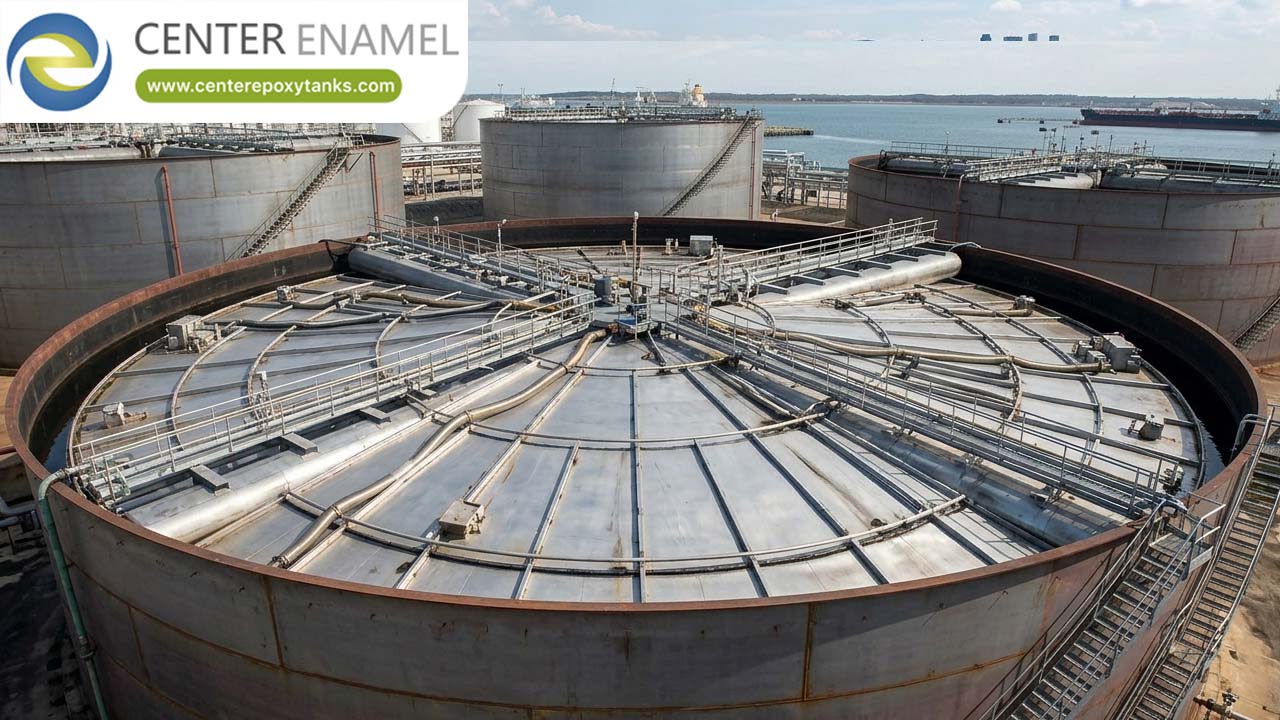
External Floating Roof Tanks: A Transformative Innovation for Oil & Gas Storage Infrastructure
In the global oil and gas industry, safe and efficient bulk liquid containment is vital for operational continuity and environmental compliance. External Floating Roof Tanks (EFRTs) represent one of the most significant engineering innovations in petroleum storage, designed specifically to store volatile crude oil, refined products, and liquid chemicals while drastically minimizing vapor loss and fire hazards.
Unlike traditional fixed-roof tanks that leave a large vapor space (ullage) between the liquid surface and the roof—increasing the risk of explosive vapor accumulation and volatile organic compound (VOC) emissions—an external floating roof rests directly on top of the stored liquid, rising and falling dynamically with inventory levels.
How External Floating Roof Tanks Work
The fundamental mechanic of an EFRT is the elimination of the vapor space inside the tank cylinder:
Direct Surface Contact: The steel or aluminum deck floats directly on the liquid product, leaving virtually no air gap. This suppresses evaporation and prevents volatile hydrocarbons from accumulating in the tank headspace.
Rim Seal Systems: A flexible mechanical or liquid-mounted rim seal spans the narrow gap between the outer edge of the floating deck and the interior wall of the tank shell. This continuous seal prevents vapors from escaping while accommodating minor shell irregularities as the roof moves.
Rolling Ladder and Drainage Architecture: EFRTs are equipped with articulated rolling ladders or flexible drainage hoses that allow operators to access the roof safely at any liquid level, alongside engineered roof drains and emergency overflow vents to manage heavy rainwater accumulation.
Core Operational Advantages in Oil & Gas Facilities
1. Massive VOC Emission Reduction
In the oil and gas sector, evaporative losses (breathing and working losses) represent both economic waste and severe environmental non-compliance. By resting directly on the liquid surface, EFRTs cut volatile organic compound (VOC) emissions by up to 90% compared to standard fixed-roof tanks.
2. Enhanced Fire Safety
Fire safety in petroleum terminals relies heavily on vapor suppression. Because EFRTs eliminate the flammable vapor-air mixture layer that typically exists in fixed-roof tanks, the probability of lightning-induced or static spark explosions in the headspace is virtually eradicated.
3. Scalability for High-Volume Crude Storage
EFRTs are constructed in massive diameters (often exceeding 100 meters) to handle millions of barrels of crude oil at refineries, marine terminals, and pipeline storage depots, complying strictly with global engineering standards like API 650 and EN 14015.
Data Table: External Floating Roof Tanks vs. Fixed Roof Tanks
Engineering Parameter | External Floating Roof Tank (EFRT) | Traditional Fixed-Roof Tank |
Vapor Space (Ullage) | None (Roof rests directly on liquid) | Large air space between liquid and roof |
VOC / Evaporative Loss | Extremely low (Suppressed by deck and rim seals) | High (Vulnerable to breathing and working losses) |
Explosion / Fire Risk | Minimized (No flammable headspace vapor mix) | Higher (Requires continuous blanketing or inerting) |
Rainwater Management | Requires dedicated roof drainage systems | Direct shed via fixed conical or domed roof |
Primary Application | Large-scale volatile crude oil & petroleum storage | Low-volatility liquids, water, heavy fuel oils |
Capital & Maintenance Cost | Moderate to High (Includes seals and rolling ladders) | Lower initial cost, but higher environmental compliance overhead |
Frequently Asked Questions (FAQ)
Q: How do external floating roof tanks prevent rainwater from mixing with the stored crude oil?
A: EFRTs feature a network of internal roof drains connected to flexible piping or articulated swing-joint pipes that channel rainwater off the deck and discharge it outside the tank shell, keeping the stored product uncontaminated.
Q: What materials are used to construct the floating roof deck?
A: Modern floating roofs are typically constructed using high-strength welded steel (pontoon or double-deck designs) or lightweight, corrosion-resistant aluminum internal pontoon structures to maximize buoyancy and structural stability.
Q: What type of rim seals are used on EFRTs to prevent vapor leaks?
A: Facilities typically use primary seals (such as metallic shoe seals or liquid-filled tube seals) combined with secondary wiper seals made of resilient elastomers or Teflon-coated fabrics to ensure a tight, redundant barrier against VOC emissions.
Q: Are EFRTs compliant with modern environmental regulations?
A: Yes. When equipped with advanced secondary rim seals and continuous emission monitoring, EFRTs comply strictly with stringent global environmental standards, including EPA, Clean Air Act guidelines, and international VOC abatement mandates.


