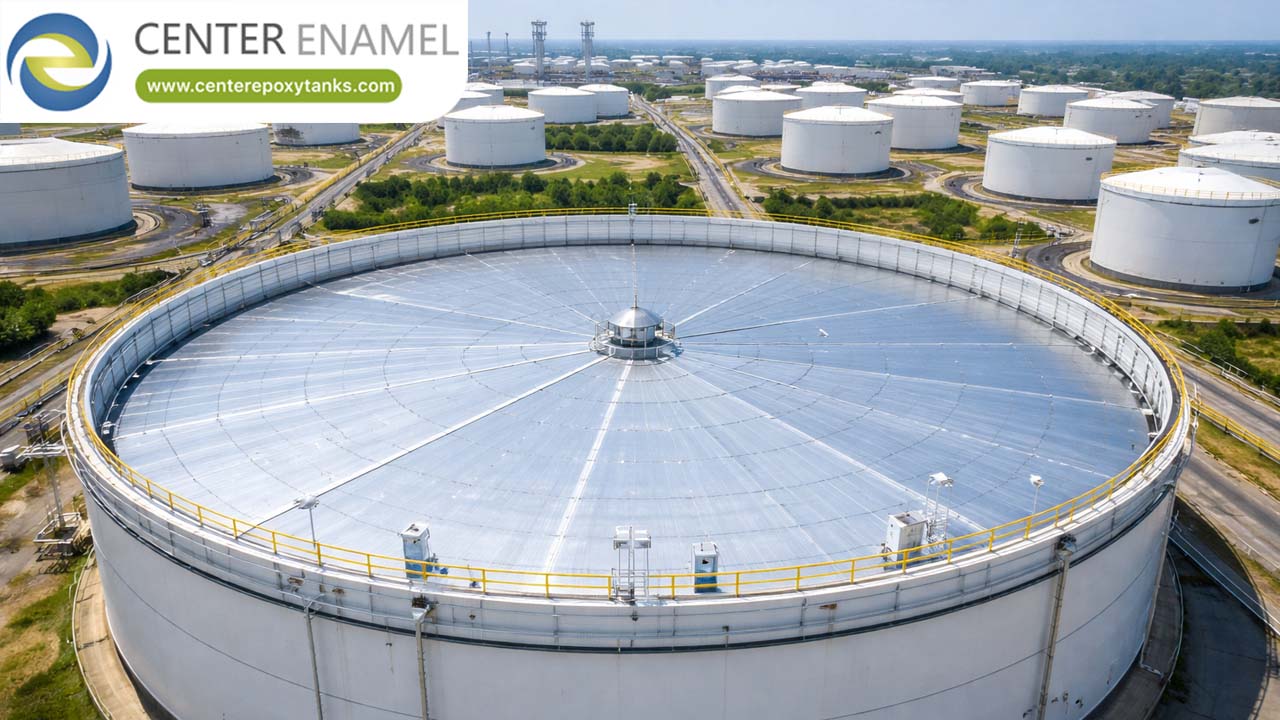
External Floating Roof vs. Internal Floating Roof with Aluminum Dome Roof: The Ultimate Storage Comparison
In modern bulk liquid storage infrastructure, selecting the right tank configuration is vital for environmental compliance, emission control, and long-term asset integrity. When storing volatile organic liquids, crude oil, and refined petroleum products, engineers traditionally rely on External Floating Roof Tanks (EFRTs). However, an increasingly dominant industry standard is the Internal Floating Roof (IFR) encased by a geodesic aluminum dome roof.
Comparing these two high-performance architectures clarifies why industrial asset owners are shifting toward aluminum-domed hybrid systems for superior weather resilience and vapor suppression.
1. External Floating Roof Tanks (EFRTs): Overview and Mechanics
An External Floating Roof Tank consists of an open-top cylindrical steel shell housing a heavy pontoon or double-deck roof that floats directly on the liquid surface.
·
Atmospheric Exposure: Because the tank lacks a fixed roof, the floating deck is fully exposed to sun, wind, rain, and snow.
·
·
Rainwater Management: To prevent water from pooling and sinking the deck, EFRTs require articulated rolling ladders, roof sumps, and flexible internal drainage piping.
·
·
Rim Seal Systems: A primary and secondary seal mechanism spans the gap between the deck and the tank wall to minimize volatile organic compound (VOC) emissions.
·
2. Internal Floating Roofs with Aluminum Dome Roofs: The Modern Hybrid Standard
The Internal Floating Roof with an Aluminum Dome Roof represents a major engineering evolution. It combines a lightweight internal floating deck with a clear-span, geodesic aluminum dome bolted securely across the top of the tank shell.
·
Total Weather Shielding: The geodesic aluminum dome acts as a permanent fixed roof that completely seals out precipitation, wind, and direct solar radiation, eliminating the need for complex rainwater drainage systems on the floating deck.
·
·
Corrosion-Resistant Space Frame: Manufactured from high-strength structural aluminum alloys (such as 6061-T6), the dome is entirely non-sparking, lightweight, and maintenance-free, offering exceptional resistance to aggressive industrial environments.
·
·
Vapor Suppression Optimization: With the aluminum dome blocking solar heat gain, liquid vaporization rates drop significantly, keeping VOC emissions near zero.
·
Data Table: External Floating Roof vs. IFR with Aluminum Dome
Engineering Parameter | External Floating Roof Tank (EFRT) | IFR with Geodesic Aluminum Dome Roof |
Weather Exposure | Fully exposed to rain, snow, and solar radiation | Completely protected by the fixed aluminum dome |
Rainwater Management | Requires rolling ladders, sumps, and drain hoses | Not required (Dome prevents precipitation ingress) |
Solar Heat Gain & VOC Loss | Higher (Direct sunlight heats the floating deck) | Minimized (Aluminum dome reflects sunlight and insulates headspace) |
Maintenance Overhead | Moderate to High (Regular seal inspections, drain clearing) | Very Low (Corrosion-free aluminum framing, sealed environment) |
Wind & Snow Load Impact | Vulnerable to wind-induced rim seal damage and water pooling | Excellent aerodynamic dome shape naturally sheds snow and wind |
Structural Lifespan | 15–20 Years (Requires frequent repainting and seal upkeep) | 30+ Years (Inert aluminum and durable deck components) |
Frequently Asked Questions (FAQ)
Q: Why is an aluminum dome roof preferred over a traditional steel fixed roof?
A: Geodesic aluminum domes are lightweight, require no internal support columns (clear-span design), and are naturally corrosion-resistant without requiring protective paint coatings. Their lightweight construction places minimal dead load on the underlying tank shell.
Q: How do internal floating roofs with aluminum domes handle VOC emissions?
A: They provide a two-stage barrier: the internal floating deck rests directly on the liquid surface, while the aluminum dome traps any minor vapors that escape the rim seals. This dual containment reduces VOC emissions by up to 99%, easily satisfying strict environmental regulations.
Q: Do internal floating roofs with aluminum domes require roof drainage systems?
A: No. Because the geodesic aluminum dome completely seals the top of the tank, precipitation cannot enter. Therefore, internal floating decks do not require complex articulated drain pipes, sumps, or rolling ladders.
Q: Can an aluminum dome roof be retrofitted onto an existing external floating roof tank?
A: Yes. Many industrial facilities convert existing EFRTs into domed internal floating roof tanks by erecting a clear-span aluminum dome over the top shell and installing a lightweight internal floating deck inside, eliminating ongoing rainwater management issues.


