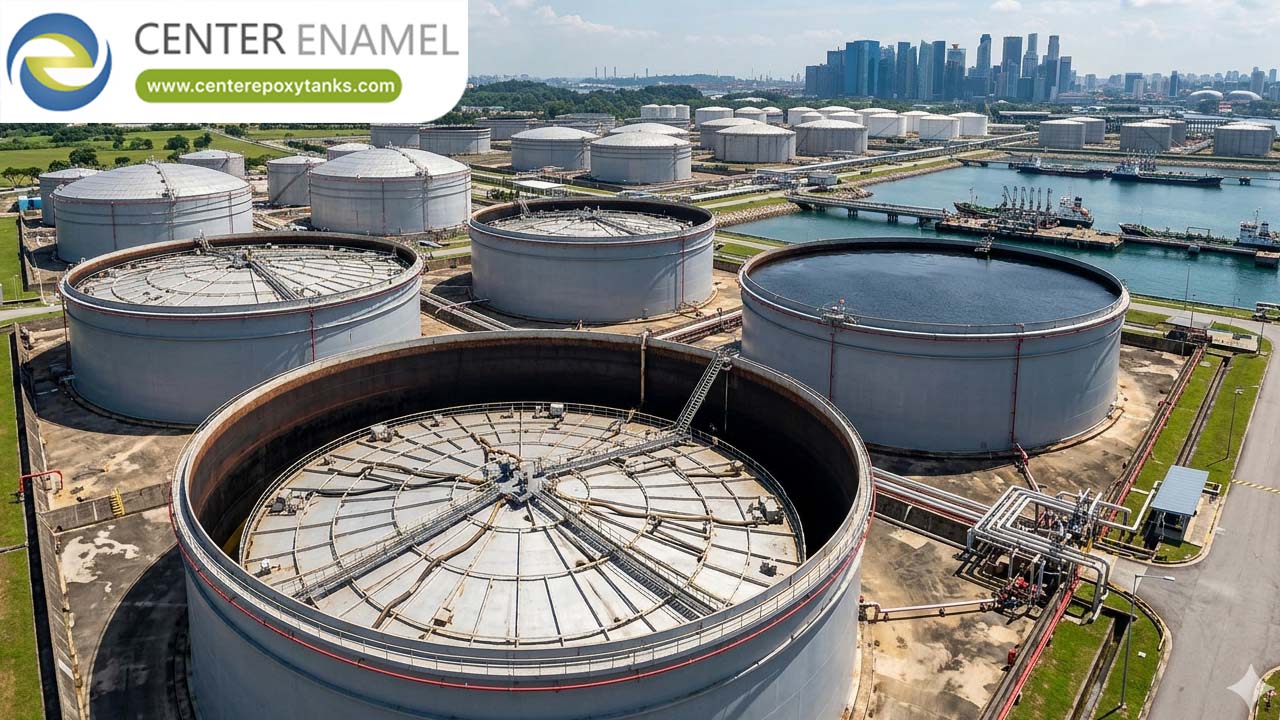
Types of Floating Roof Tanks: Classification, Design, and Industrial Applications
In the global oil, gas, and chemical processing sectors, safe containment of volatile liquids requires specialized engineering to prevent evaporative product loss and explosive vapor accumulation. A floating roof tank is an industrial storage vessel featuring a movable deck that rests directly on the surface of the stored liquid. As inventory levels rise and fall, the roof moves vertically, eliminating the hazardous vapor space (ullage) characteristic of fixed-roof tanks.
Depending on climatic conditions, chemical volatility, and terminal capacity requirements, industrial engineering standards categorize floating roof tanks into three primary structural types.
1. External Floating Roof Tanks (EFRTs)
An External Floating Roof Tank features an open-top cylindrical steel shell housing a heavy pontoon or double-deck floating roof that remains fully exposed to the atmosphere.
·
Design & Operation: The roof floats directly on the liquid product, utilizing a continuous primary and secondary rim seal system to close the gap between the deck edge and the tank wall. Because there is no fixed roof, EFRTs require engineered internal roof drains and flexible piping or rolling ladders to safely evacuate rainwater.
·
·
Primary Application: Massive crude oil storage terminals, marine bunkering depots, and large-scale petroleum tank farms where tank diameters frequently exceed 50 to 100 meters.
·
2. Internal Floating Roof Tanks (IFRs)
An Internal Floating Roof Tank combines the emission-reduction benefits of a floating deck with the structural protection of a permanent fixed outer roof (such as a welded conical steel roof).
·
Design & Operation: A lightweight aluminum, steel, or composite floating deck operates inside a closed-top tank shell. Because the permanent outer roof completely shields the interior, precipitation cannot reach the floating deck, eliminating the need for complex rolling ladders or deck drainage systems.
·
·
Primary Application: Storing highly volatile refined petroleum products, aviation jet fuels, and industrial chemical solvents where weather protection and strict emission control are mandatory.
·
3. Domed Floating Roof Tanks (IFR with Geodesic Aluminum Domes)
A modern advancement in tank design, the domed floating roof tank pairs an internal floating deck with a clear-span, geodesic aluminum dome roof erected across the top of the tank shell.
·
Design & Operation: The lightweight, non-sparking aluminum space frame acts as a fixed roof while providing superior corrosion resistance and thermal insulation. The aluminum panels reflect solar radiation, significantly lowering internal temperatures and minimizing vapor expansion.
·
·
Primary Application: Premium refined product terminals, modern chemical storage facilities, and upgraded legacy tanks seeking maximum VOC abatement and zero rainwater maintenance overhead.
·
Data Table: Comparison of Floating Roof Tank Types
Tank Type | Shell Architecture | Weather Exposure & Protection | Rainwater Management | Primary Stored Products |
External Floating Roof (EFRT) | Open-top cylinder | Fully exposed to sun, rain, and snow | Required (Roof drains, sumps, rolling ladders) | Crude oil, heavy petroleum distillates, bunker fuel |
Traditional Internal Floating Roof (IFR) | Closed-top (Fixed steel roof) | Fully protected by permanent fixed outer roof | Not required | Refined fuels, diesel, volatile industrial chemicals |
Domed Floating Roof (Aluminum Dome) | Closed-top (Geodesic aluminum dome) | Superior protection via insulated aluminum space frame | Not required | High-purity chemicals, aviation fuel, gasoline |
Frequently Asked Questions (FAQ)
Q: What is the main structural difference between an internal and external floating roof tank?
A: An external floating roof tank (EFRT) has an open top with the floating deck exposed directly to the weather, whereas an internal floating roof tank features a permanent fixed outer roof (steel or aluminum dome) shielding the floating deck underneath.
Q: Why are geodesic aluminum domes frequently chosen for internal floating roof tanks?
A: Geodesic aluminum domes are lightweight, clear-span structures that require no internal support columns. They are completely corrosion-resistant, reflect solar radiation to reduce product evaporation, and eliminate rainwater accumulation issues on the floating deck.
Q: How do floating roof tanks control volatile organic compound (VOC) emissions?
A: By resting directly on the surface of the liquid, floating roofs eliminate the flammable vapor space (ullage) inside the tank. Combined with primary and secondary rim seals, this suppresses evaporation, reducing VOC emissions by up to 99%.
Q: Do internal floating roofs require roof drainage systems?
A: No. Because the permanent fixed outer roof or aluminum dome prevents rain and snow from entering the tank, internal floating decks do not require articulated drain pipes, sumps, or rolling ladders.


