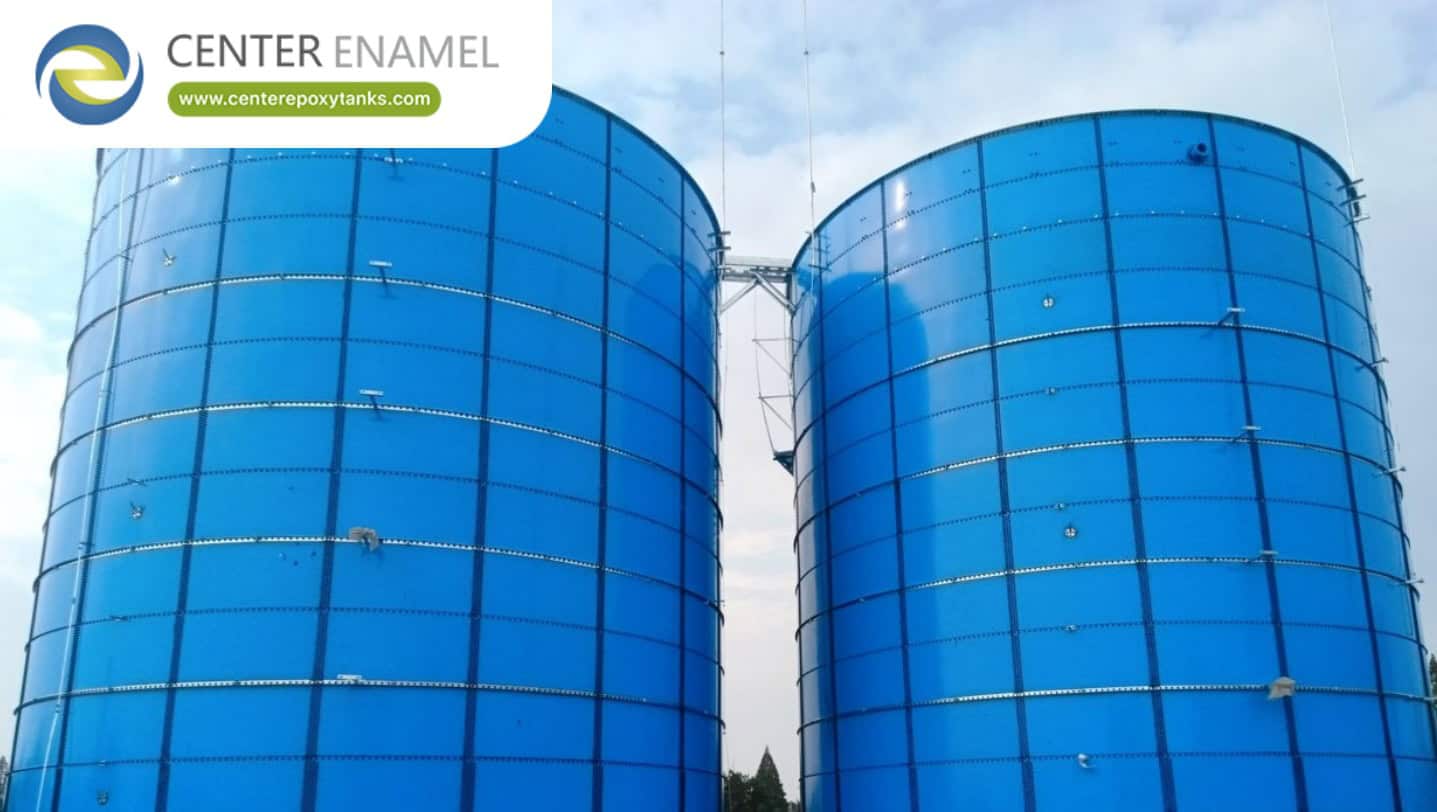
The Molecular Shield: Technical Analysis of Fusion Bonded Epoxy (FBE) Tank Technology
In the realm of industrial storage, the difference between a tank that lasts five years and one that lasts thirty is found at the microscopic level. Shijiazhuang Zhengzhong Technology Co., Ltd. (Center Enamel) utilizes Fusion Bonded Epoxy (FBE)—a technology that transcends traditional "paint." By leveraging the physics of electrostatic attraction and the chemistry of thermoset polymerization, we create a monolithic, chemically inert barrier that is fused to the steel substrate.
1. The Electrostatic Spraying Process: Precision Deposition
The journey of an FBE-coated panel begins not with manual application, but with controlled electrostatic deposition. This process is the foundation for achieving the uniform, defect-free coverage required for mission-critical infrastructure.
● Surface Preparation (The Mechanical Anchor): Before coating, steel panels are grit-blasted to a specific profile (typically Near-White Metal/SSPC-SP10). This creates a "peaks and valleys" micro-topography on the steel surface. This roughness is vital, as it provides the physical surface area for the epoxy to mechanically interlock with the steel.
● Electrostatic Charge: The dry FBE powder (a homogeneous mix of epoxy resin and hardening agents) passes through a high-voltage electrostatic field. This imparts a strong positive charge to the powder particles.
● The "Wrap-Around" Effect: Because the steel panel is grounded (carrying a negative charge), the charged powder is pulled toward the metal with magnetic-like precision. This is the electrostatic deposition principle: the powder is pulled not just to the flat surfaces, but into edges, bolt holes, and complex geometries, ensuring a guaranteed dry film thickness (DFT) across the entire component.
2. Molecular-Level Thermal Melting & Curing (Fusion Bonding)
Once the powder is deposited, the tank panel moves into the curing oven. This is where the term "Fusion Bonded" is realized through two distinct chemical phases:
Phase A: Thermal Melting (Fusion)
As the panel reaches the required temperature (typically 180°C–250°C), the solid powder particles undergo a phase change from solid to liquid. Because the steel is hot, the epoxy melts on contact, flowing into the microscopic grooves created during the grit-blasting phase. This "wetting" of the surface is the first step in creating a bond that is inseparable from the substrate.
Phase B: Thermoset Cross-Linking
This is the critical differentiator between FBE and standard liquid paints. FBE is a thermoset polymer.
● Chemical Cross-Linking: During the "bake" cycle, the resin and the hardening agents undergo a chemical reaction where polymer chains link together into a complex, three-dimensional network.
● The Result: This reaction is irreversible. Once cured, the coating cannot be re-melted. It becomes a monolithic, chemically inert, and highly dense shield. This cross-linked network prevents moisture, oxygen, and corrosive ions from reaching the steel—a feat liquid paints (which are often porous after solvent evaporation) cannot achieve.
3. Why This Technology Matters for Industrial Storage
By mastering these principles, Center Enamel delivers performance metrics that set the benchmark for the bolted tank industry:
Technical Property | Principle | Outcome |
Coating Uniformity | Electrostatic deposition | No "sags" or "runs"; uniform thickness at edges. |
Substrate Adhesion | Mechanical anchor + polar bonding | Resists delamination and peeling. |
Barrier Integrity | Thermoset cross-linking | Zero porosity; prevents ion permeability. |
Mechanical Toughness | High-density polymer matrix | Exceptional resistance to abrasion and impact. |
Engineering Certainty for Your Project
For environmental and structural engineers, the FBE process represents a shift from "applied" protection to "fused" protection. Because our entire application sequence is automated within a controlled factory environment, we eliminate the variables of field-application (such as humidity, wind, or human error).
If your project requires storage that is chemically inert, structurally flexible, and validated for long-term service in harsh environments, FBE technology provides the proven reliability your infrastructure deserves.
Are you currently comparing coating technologies for a mission-critical infrastructure project, or would you like to request our certified testing data for FBE holiday-free verification?


