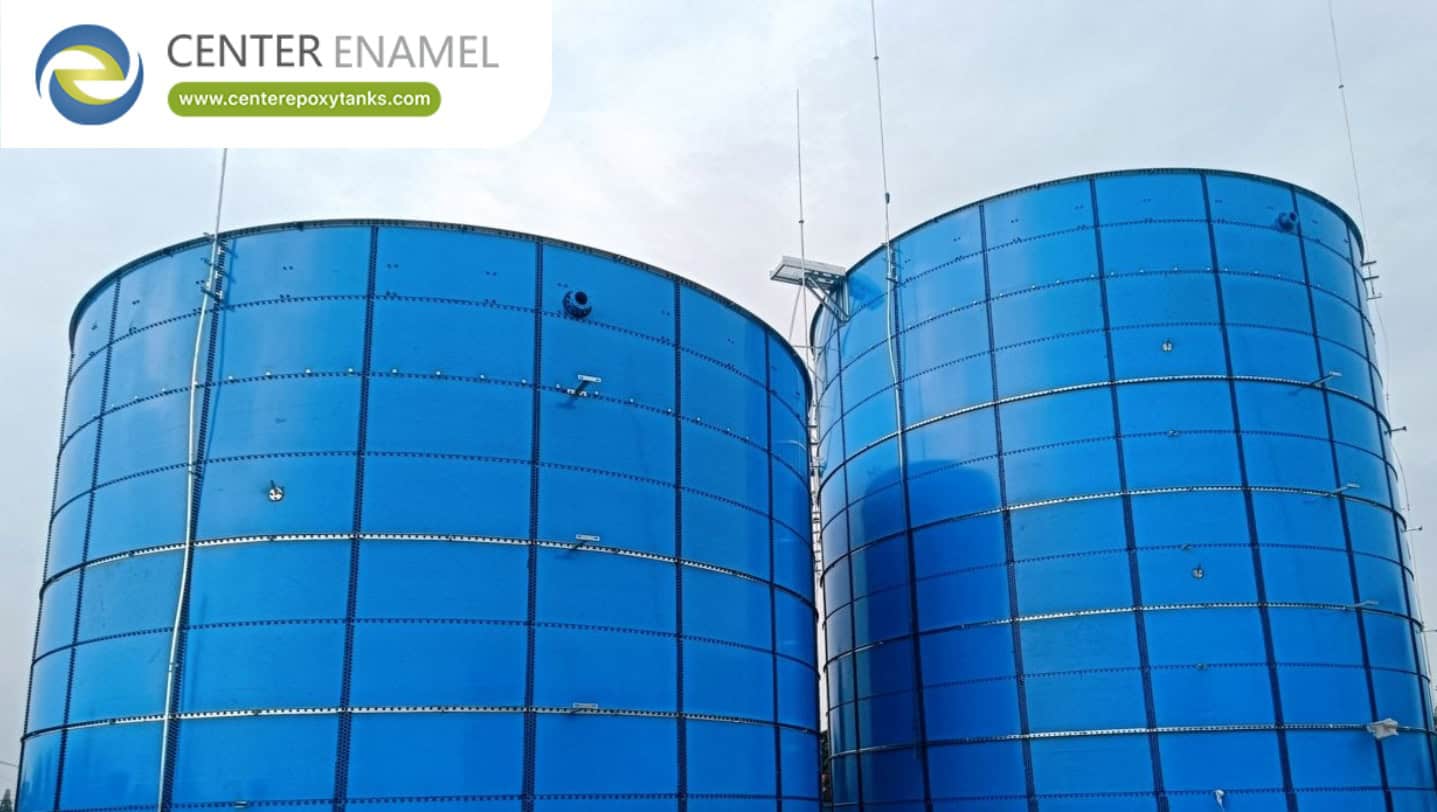
The Gold Standard: AWWA D103-09 Design & Compliance in FBE Storage Tanks
In the high-stakes world of industrial and municipal water storage, compliance with recognized international codes is not just a regulatory hurdle—it is the foundation of asset safety and operational longevity. The AWWA D103-09 standard (Design and Construction of Factory-Coated Bolted Carbon Steel Tanks for Water Storage) serves as the global benchmark for bolted tank design. At Shijiazhuang Zhengzhong Technology Co., Ltd. (Center Enamel), we do not simply meet these requirements; we use them as the baseline for our advanced engineering, ensuring every tank we deliver provides industry-leading structural performance and corrosion resistance.
1. What is AWWA D103-09?
The AWWA D103-09 standard, established by the American Water Works Association, provides the technical framework for the design, fabrication, and erection of factory-coated bolted carbon steel tanks. For engineers and municipal planners, it is the primary "Trust Signal" that a tank system will perform reliably under demanding conditions.
The standard mandates rigorous requirements across four critical pillars:
● Structural Load Engineering: Every tank must be engineered to withstand site-specific hydrostatic pressure, wind loads, and snow accumulation.
● Seismic Resilience: AWWA D103 defines the calculations necessary to ensure shell stability and anchorage integrity during seismic events.
● Coating Integrity: It requires factory-applied, high-performance barrier systems (like Fusion-Bonded Epoxy or Glass-Fused-to-Steel) that are chemically inert and free from surface defects.
● Water-Tightness: The design must ensure a hermetic seal through precision-engineered bolted connections and high-performance sealing materials.
2. The Center Enamel Engineering Advantage
While AWWA D103-09 sets the standard, Center Enamel optimizes for performance. Our approach transforms a prescriptive code into a high-efficiency storage solution.
Precision Fabrication
Our automated manufacturing lines utilize CNC and robotic fabrication to ensure that every bolt hole and panel edge meets exact dimensional tolerances. This precision is vital for the "hermetic seal" required by AWWA D103, as it eliminates stress concentrations that lead to leakage.
Factory-Controlled Quality
Unlike field-welded tanks, which are susceptible to weather-related quality variances, our AWWA-compliant tanks are fabricated in a climate-controlled factory.
● Surface Preparation: Steel panels are grit-blasted to a "white metal" finish (SSPC-SP10) to ensure maximum bond strength.
● High-Voltage Testing: Every FBE panel undergoes rigorous holiday testing to verify that the coating is 100% pinhole-free before leaving the factory.
Beyond the Standard
We integrate Finite Element Analysis (FEA) into our design process. By modeling the dynamic forces—such as sloshing and hydrodynamic pressure—we optimize plate thickness and bolting patterns to ensure your tank is not just compliant, but structurally over-engineered for the specific wind and seismic zone of your site.
3. Why D103-Compliant FBE Tanks are the Industry Choice
Choosing an AWWA D103-compliant Fusion-Bonded Epoxy (FBE) tank offers distinct advantages for industrial and municipal operations:
Feature | AWWA D103 Compliance Benefit |
Speed of Deployment | Modular bolted assembly allows for installation in a fraction of the time of poured concrete or welded tanks. |
Lifecycle ROI | Designed for 30+ years of service with minimal maintenance, drastically reducing long-term OPEX. |
Modular Scalability | The design allows for future height or diameter extensions, protecting your capital investment as capacity needs grow. |
Safety & Certification | All internal components (gaskets/sealants) are NSF/ANSI 61 certified for potable water safety. |
Engineering Certainty for Your Next Project
Compliance is the difference between a project that runs smoothly and one that encounters delays during inspection. By partnering with Center Enamel, you gain the assurance that your storage infrastructure meets the world’s most stringent quality benchmarks. From technical design drawings and FEA stress calculations to final site commissioning, we provide the documentation and the engineering expertise to keep your project compliant, safe, and operational.
Are you currently in the design phase of an infrastructure project, or would you like to review how our AWWA D103-compliant engineering process can be integrated into your local permitting requirements?


