Stratified Chilled Water Storage Tanks: Thermocline Control and Diffuser Design
A 'stratified' chilled water storage tank earns its name from a stable density layering of cold-below-warm water. The entire performance of the tank hinges on preserving that layering during charge and discharge. This article explains the diffuser and control science behind a sharp thermocline.
Stratified chilled water storage tanks keep cold water beneath warm water using low-velocity diffusers that introduce and extract flow without entraining the layers. The design target is a low Froude number (typically below ~1), achieved with many small ports spread over the tank cross-section. Multi-height temperature sensing then confirms the thermocline stays thin and stable through cycles.
Why Stratification Works
Cold water is denser than warm water, so a stable density gradient naturally holds the layers apart. The enemy of stratification is momentum: a fast jet punches through the thermocline and mixes the layers, destroying usable storage.
Diffusers exist to kill that momentum at the source, spreading flow gently across the full tank area.
Diffuser Design Fundamentals
A good diffuser has many ports at low velocity, often arranged as a manifold with perforated headers or nozzles near the tank floor (cold) and ceiling (warm). Port velocity and spacing set the local Froude number; keeping it low prevents plume penetration.
Symmetric, balanced flow distribution matters more than any single port detail - uneven distribution creates local mixing that degrades the whole tank.
Verification and Operation
Install temperature sensors at several heights to track the thermocline. During commissioning, dye or thermal tests confirm the diffuser performs; in operation, the BMS uses the profile to switch modes before warm water reaches the outlet.
Technical Specifications
Parameter | Specification |
Layer order | Cold below, warm above |
Design goal | Low Froude (<~1) |
Diffuser type | Multi-port manifold |
Port velocity | Low (momentum control) |
Thermocline | 0.5-1.5 m target |
Sensing | Multi-height RTD |
Mixing risk | High-velocity jets |
Shell | Atmospheric |
Material | GFS / stainless |
Standard | AWWA D103 |
Verified Tank Engineering Reference
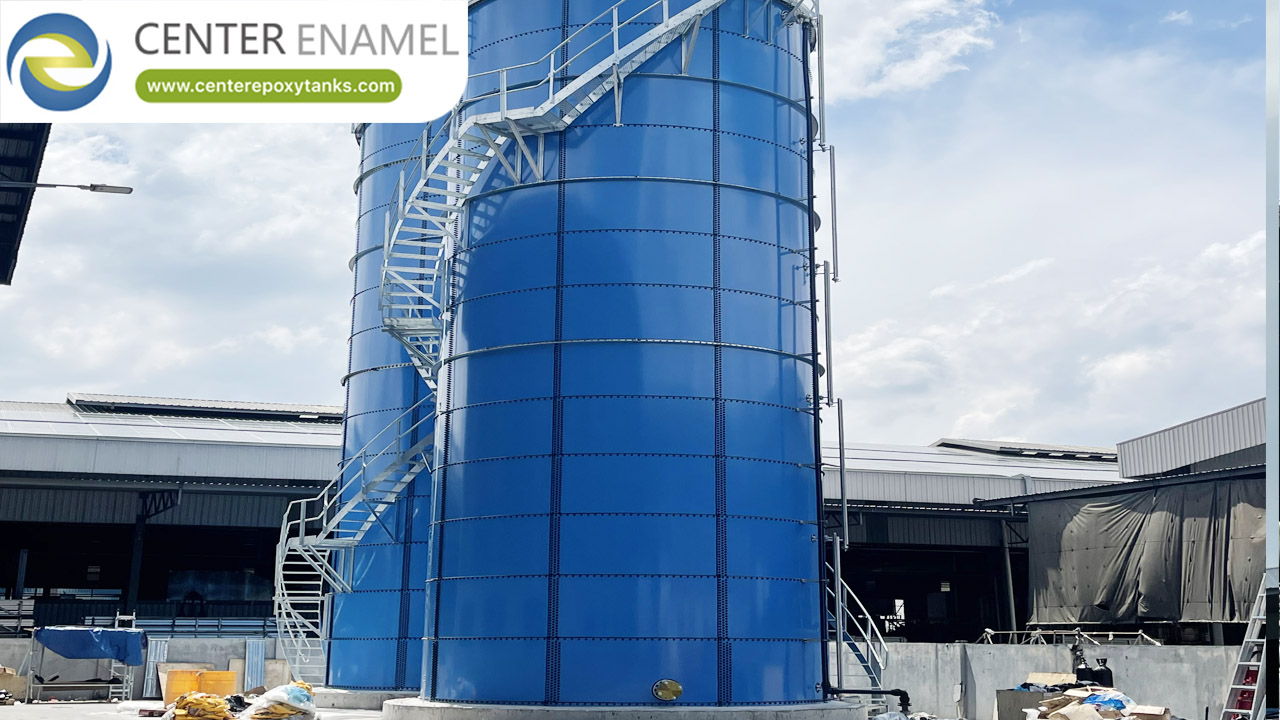
Center Enamel's ability to deliver large, dimensionally precise bolted shells - such as a 2025 Indonesian tank at 42.04 m diameter and 21,099 m3 - matters for stratification because diffuser performance depends on accurate tank geometry. Capability evidence only, not a DC project.
Project location | Indonesia (印度尼西亚) |
Application | Drinking water (饮用水) |
Tank type | GFS (Glass-Fused-to-Steel) bolted tank |
Scale | 1 unit(s), φ42.04*15.2米(H) 1座 |
Total volume | 21,099 m3 |
Year | 2025-06 |
Note | Cited as manufacturing-capability evidence, not a data-center project. |
Center Enamel Capability
Center Enamel supplies bolted GFS and stainless tanks with the geometric accuracy diffuser design assumes. Panel firing and QA under ISO 9001, construction to AWWA D103 and ISO 28765, support consistent shell roundness and flatness.
The same quality system extends to ASME Section VIII vessels for pressurized buffer and expansion duties on the cooling loop.
Frequently Asked Questions
Q: What keeps the thermocline stable?
A: Density (cold water is denser) plus low-momentum diffusers that prevent jets from mixing the layers.
Q: What is the Froude number in this context?
A: A ratio of flow momentum to buoyancy; keeping it low (around 1 or below) avoids penetrating the thermocline.
Q: How many diffuser ports are needed?
A: Enough to spread flow evenly across the tank cross-section at low velocity - design is about distribution, not a fixed count.
Q: How is stratification verified?
A: Multi-height temperature sensors track the thermocline; commissioning may use thermal or dye tests.
Q: Can a poorly designed diffuser ruin storage?
A: Yes - excessive jet momentum mixes layers and can cut usable capacity by 20% or more.
Q: Does tank shape affect stratification?
A: Moderate aspect ratios help; extreme tall or shallow shapes can complicate stable layering.
Stratified chilled water storage is a fluid-mechanics problem solved at the diffuser. Low-Froude, well-distributed flow plus multi-height sensing preserves a thin thermocline and therefore the usable cold storage the whole TES strategy depends on.
Suggested Next Step
Have your process engineer share tank geometry and flow rates - we will advise diffuser configuration compatible with our bolted shell dimensions.


