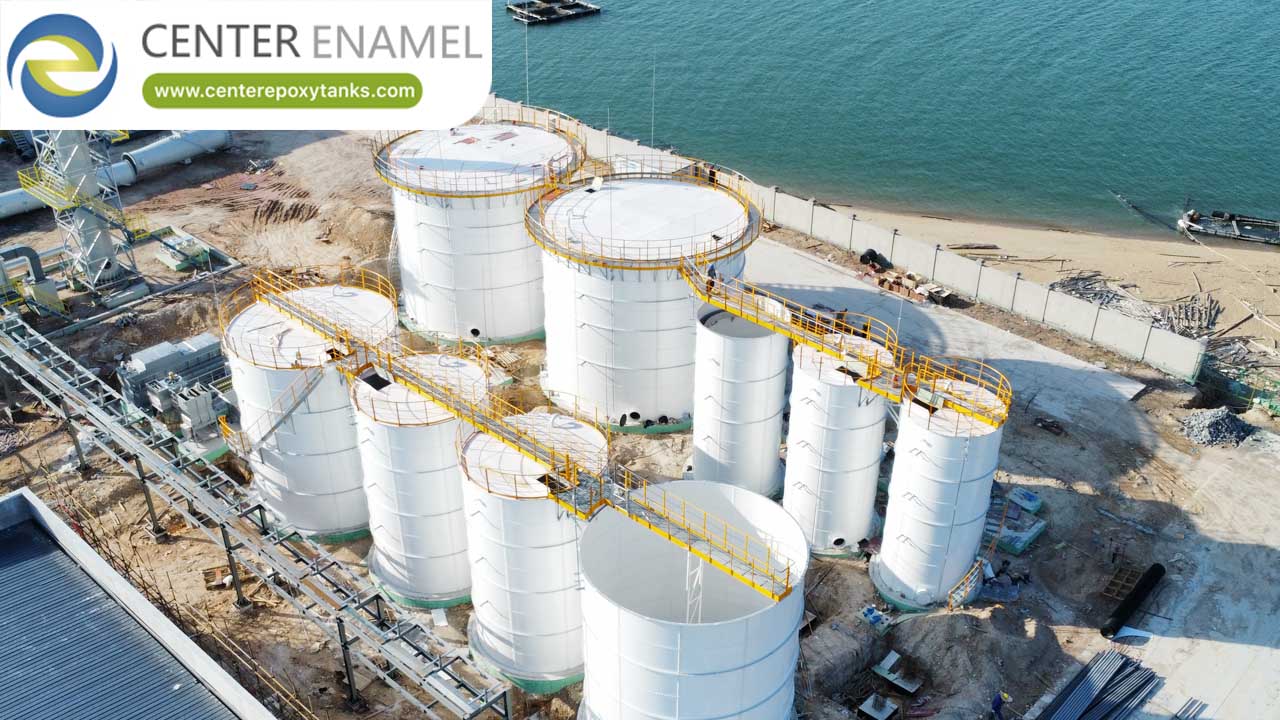
Storage Tanks for Drinking Water Treatment Plants: Materials, Standards, and Engineering Design
In municipal water purification, ensuring that water is safely processed, sanitized, and stored before public distribution is a matter of critical public health. Unlike standard industrial fluid containment, tanks holding drinking water are subject to some of the most rigorous material and structural regulations in global engineering.
A drinking water storage tank (or potable water reservoir) is a highly regulated structural vessel engineered to hold raw source water, chemical treatment reagents, filter backwash, or fully treated finished water across the various stages of a municipal Water Treatment Plant (WTP).
1. Key Roles of Storage Tanks in a Drinking Water Plant
Water treatment is a multi-stage process, and different types of tanks are utilized at each phase of the purification train:
Raw Water Intake Reservoirs: Large ground-level tanks that hold untreated surface water or groundwater pumped from lakes, rivers, or aquifers prior to the initial treatment phases.
Process and Equalization Tanks: These include flocculation chambers and settling basins designed to optimize the mixing of coagulants and maximize detention time for suspended solid removal.
Filter Backwash Holding Tanks: Designed to temporarily hold the high volumes of water used to clean out plant filtration media. Solids are allowed to settle before the water is decanted and returned to the head of the plant.
Clearwells (Finished Water Storage): The final and most critical holding vessels in a WTP. Clearwells provide the necessary contact time for disinfectants (like chlorine) to neutralize pathogens before the finished potable water is pumped into the municipal distribution grid.
2. Regulatory Compliance: The Non-Negotiable Standards
Designing and fabricating potable water storage requires strict adherence to specialized public health and structural standards:
NSF/ANSI/CAN 61 & 600 (Health Effects): This is the definitive North American standard governing the health effects of drinking water system components. It ensures that the tank materials, interior coatings, and sealants do not leach harmful contaminants or heavy metals into the water supply. The recently enforced NSF 600 update further restricts allowable extraction levels for solvents, effectively mandating 100% solid, zero-VOC coatings for interior tank surfaces.
AWWA Structural Standards: The American Water Works Association sets the primary structural engineering codes for municipal tanks based on their material:
AWWA D100: Specifications for field-welded carbon steel tanks.
AWWA D103: Specifications for factory-coated bolted steel tanks.
AWWA D110 / D115: Specifications for wire- and strand-wound circular prestressed concrete water tanks.
3. Industry-Standard Materials of Construction
Selecting the correct tank material determines the facility's capital lifecycle, maintenance frequency, and structural integrity:
Glass-Fused-to-Steel (GFS) / Bolted Steel: Highly popular for modern municipal plants, offering rapid modular bolt-together construction. GFS tanks fuse high-strength steel with inert glass enamel, offering exceptional corrosion resistance and a naturally NSF 61-compliant interior that does not require periodic recoating.
Field-Welded Carbon Steel: Traditional heavy-duty reservoirs capable of holding millions of gallons. The interiors must be lined with rigorously tested NSF 61/600-certified epoxy coatings formulated for continuous immersion.
Reinforced and Prestressed Concrete: The long-standing standard for massive underground clearwells and multi-million-gallon reservoirs. Concrete tanks minimize visual impact and provide decades of service.
Stainless Steel (Grade 304/316L): Often considered a "gold standard" for highly pure applications. The metal's passive chromium oxide layer is inherently inert and fully compliant with NSF 61 without the need for supplementary chemical coatings.
High-Density Polyethylene (HDPE): Utilized for smaller-scale supplementary needs—such as chemical storage tanks for sodium hypochlorite or coagulants used to treat the water—often capped around 20,000 gallons.
Data Table: Drinking Water Plant Storage Tank Matrix
Tank Material Type | Typical Capacity Range | Governing Structural Standard | Primary WTP Applications | NSF 61 Compliance Method |
Glass-Fused-to-Steel | 20,000 to 3,000,000+ gal | AWWA D103 | Treated water reservoirs, raw water, backwash | Inherently inert glass enamel |
Field-Welded Steel | 100,000 to 5,000,000+ gal | AWWA D100 | Clearwells, main distribution storage | Certified 100% solid epoxy coating |
Prestressed Concrete | 50,000 to 10,000,000+ gal | AWWA D110 / D115 | Buried clearwells, high-volume ground storage | Concrete admixture / Approved liners |
Stainless Steel | 10,000 to 1,000,000+ gal | AWWA D100 / API 650 | Chemical dosing, high-purity finishing | Inherently inert metal passive layer |
Polyethylene (HDPE) | 500 to 20,000 gal | ASTM D1998 | Reagent storage, small day tanks | Certified virgin polymer resin |
Frequently Asked Questions (FAQ)
Q: What is a clearwell in a drinking water treatment plant?
A: A clearwell is a large storage tank or underground reservoir at the end of the water treatment process. It stores the fully treated, filtered water and provides the necessary contact time for chemical disinfectants to neutralize remaining pathogens before distribution.
Q: Why is NSF/ANSI 61 certification critical for drinking water tanks?
A: NSF/ANSI 61 is a legally mandated public health standard that ensures the base materials, sealants, and interior protective coatings of a tank will not leach toxic heavy metals, VOCs, or chemical impurities into the potable water supply.
Q: What is the difference between AWWA D100 and AWWA D103 standards?
A: AWWA D100 dictates the engineering, welding, and structural requirements for field-welded carbon steel tanks, whereas AWWA D103 governs the design and erection of factory-coated, bolted steel tanks.
Q: Can stainless steel tanks be used for drinking water storage without a coating?
A: Yes. High-grade stainless steel relies on an invisible, self-healing passive layer of chromium oxide that is inherently inert, corrosion-resistant, and completely safe for drinking water contact without requiring supplemental protective coatings.


