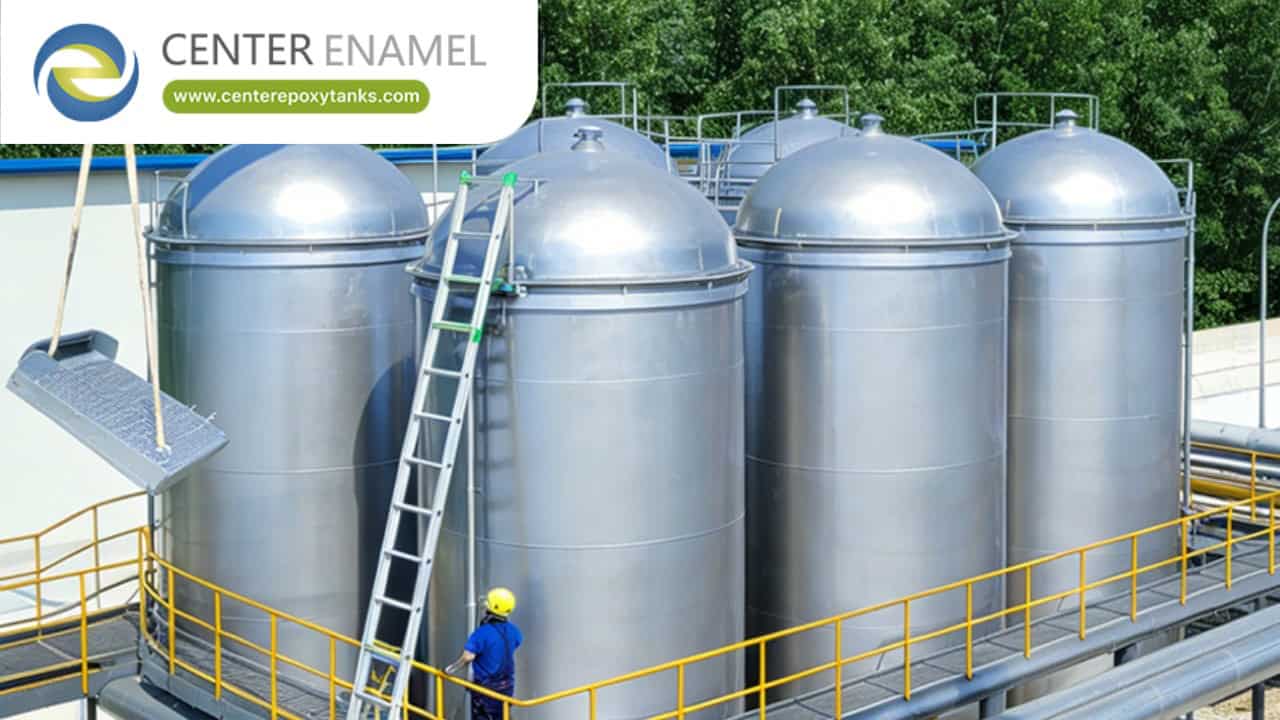
Stainless Steel Oil Storage Tank Roofs - Alloy Roofs for Corrosive Vapour Space
The underside of an oil tank roof is the least inspectable and often the most corrosive surface on the tank. Warm, humid, sometimes sulphide-bearing vapour condenses on it continuously, and coating applied there cannot be inspected or renewed without emptying the tank. When coating life becomes the constraint on the tank's inspection interval, the roof material is the lever worth pulling.
Engineered by Shijiazhuang Zhengzhong Technology Co., Ltd. (Center Enamel), stainless oil tank roofs are fabricated in 304L or 316L to qualified procedures, with every weld pickled and passivated and a transition detail that lets them connect safely to a carbon steel shell.
1. When Is a Stainless Roof Worth Specifying?
When the vapour space would consume a coating faster than the operator can maintain it - high sulphur content, elevated temperature, chloride exposure, or a tank that cannot be taken out of service for recoating.
· Sour or Heated Service: Hydrogen sulphide and warmth attack both coating and steel from the underside.
· Coastal or Chloride Exposure: Chlorides drive pitting once a coating is breached.
· Long Inspection Intervals: Where the tank will not be opened for years, removing the coating dependence is valuable.
· All-Stainless Tanks: A carbon steel roof on a stainless shell creates a galvanic couple and an obvious weak point.
· High Consequence of Failure: Where a roof repair outage would be disproportionately expensive.
2. Which Grade and Finish Suit a Roof?
304L for general duty, 316L where chlorides are present or the vapour is aggressive. Finish matters less on a roof than on a product contact surface, but weld quality and passivation matter just as much.
· 304L: Standard austenitic grade for general oil vapour service.
· 316L: Molybdenum-bearing for improved pitting resistance in chloride-bearing or aggressive vapour.
· Low Carbon: The L grades prevent sensitisation in the heat-affected zone of welds.
· Weld Finish and Passivation: Every weld is pickled and passivated so the heat-affected zone does not corrode first.
· External Finish: Specified where appearance, cleanability or coastal exposure matters.
3. How Does It Connect to a Carbon Steel Shell?
Through a transition detail. A stainless transition ring is welded to the top shell course so the roof is welded stainless-to-stainless, and any remaining dissimilar interface is isolated with compatible gaskets, sleeves and fasteners.
· Transition Ring: Gives a stainless-to-stainless weld and breaks the galvanic circuit.
· Galvanic Isolation: Gaskets, sleeves and fasteners interrupt any remaining couple.
· Compression Ring Check: The shell and ring are verified for the roof's thrust.
· Dissimilar Weld Procedure: Used and recorded where a direct dissimilar weld is unavoidable.
· Compatible Ancillaries: Hatches, platforms and handrails are supplied in compatible material.
Evaluation Criterion | Stainless Roof | Coated Carbon Steel Roof |
Underside corrosion | Resistant by alloy | Depends entirely on coating |
Recoating over tank life | Not required | Two to three campaigns |
Chloride resistance | High with 316L | Low once coating is breached |
Initial cost | Higher | Lower |
Suitability for long intervals | Excellent | Poor |
Engineering Assurance and Project Support
Every welded oil tank delivered by Shijiazhuang Zhengzhong Technology Co., Ltd. (Center Enamel) is designed to API 650 with shell courses sized by the one-foot method and checked for wind, seismic and hydrostatic load cases, or to EN 14015 and the Eurocodes where the site is European. Shell plate is shot-blasted to Sa 2.5 and coated to a documented dry film thickness, longitudinal and annular plate welds are examined by radiography or ultrasonic testing to the acceptance level written into the purchase order, and every tank is hydrostatically tested and dimensionally surveyed before hand-over. Stainless roofs are supplied with mill certificates, welding procedure and qualification records, weld maps, pickling and passivation records, examination of critical joints and the transition ring detail for the shell connection.
"If you cannot inspect the underside, buy a material that does not need inspecting. That is the whole case for a stainless roof."
Frequently Asked Questions (FAQ)
Is a stainless roof worth the extra cost?
Where the vapour space is aggressive or the inspection interval is long, yes. A coated carbon steel roof's life is governed by a coating nobody can inspect or renew without emptying the tank. Stainless removes that dependence, and the premium is recovered through avoided recoating campaigns and avoided outages.
Which stainless grade should a tank roof use?
304L for general oil vapour service with low chloride exposure, and 316L where chlorides are present, the vapour is aggressive, or the site is coastal. Both are low-carbon grades so welds are not sensitised, and every weld is pickled and passivated regardless of grade.
Can a stainless roof be fitted to an existing carbon steel tank?
Yes, using a transition detail. A stainless transition ring is welded to the top shell course so the roof is welded stainless-to-stainless, and any remaining carbon-to-stainless interface is isolated with compatible gaskets, sleeves and fasteners. The shell and compression ring are checked for the roof's thrust first.
Can the roof be customised for our tank?
Yes. Geometry, grade and thickness, surface finish, insulation, vents, manways, gauging platforms, walkways, handrails, lightning protection and the transition detail are all engineered to your tank, product and site loads.


