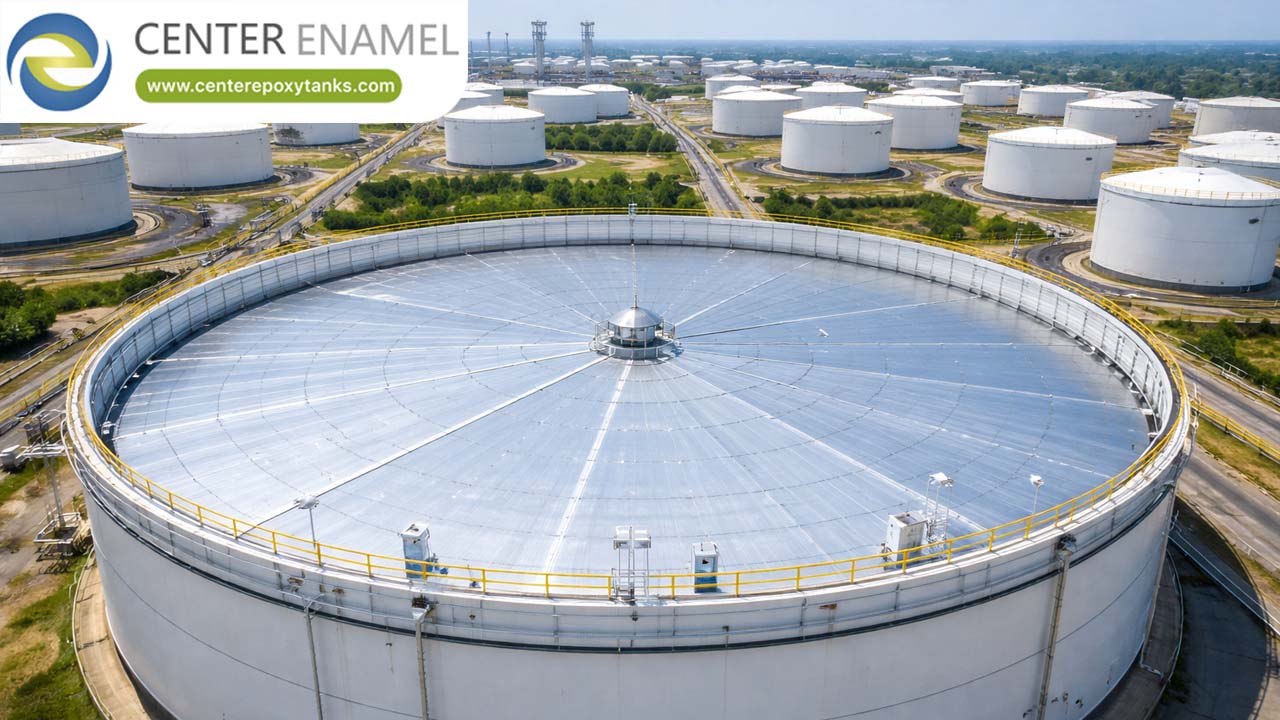
Stainless Steel Oil Storage Tank Floating Roofs - Clean Contact for Sensitive Streams
Most floating roofs are carbon steel, and most of the time that is the correct answer. But there are streams where the deck itself becomes a product-quality problem: edible and specialty oils that pick up iron contamination, corrosive recovered streams that pit carbon steel, and high-purity process oils where even minor corrosion product is unacceptable. On those services the deck material is the process decision, not a procurement detail.
Stainless is the answer, and the grade matters. Engineered by Shijiazhuang Zhengzhong Technology Co., Ltd. (Center Enamel), stainless floating roofs are fabricated in 304L or 316L to qualified welding procedures, with pickling and passivation of every weld so the heat-affected zone does not become the corrosion site.
1. When Is a Stainless Floating Roof Worth the Cost?
When the product is purity-sensitive, when the stream is corrosive enough to pit carbon steel, or when the tank's inspection interval is long enough that a coated carbon steel deck would need attention first. The premium is justified by avoided contamination and avoided outage.
· Purity-Sensitive Products: Edible oils, specialty process oils and high-purity streams cannot tolerate iron pick-up from a corroding deck.
· Corrosive Recovered Streams: Slop and recovered oils with water and chlorides pit carbon steel from the underside.
· Long Inspection Intervals: Where the tank will not be opened for years, a deck that does not depend on coating integrity is safer.
· Cleanability: Stainless is cleaned and verified far more easily than a coated surface.
· Product Colour and Odour: Iron contamination affects colour, odour and oxidative stability in sensitive oils.
2. Which Grade, and How Is It Fabricated?
304L for general service, 316L where chlorides are present, and duplex where both strength and chloride resistance are needed. Fabrication follows stainless practice: qualified procedures, controlled heat input, correct filler, and pickling and passivation of all welds.
· 304L: The standard austenitic grade for general oil service with low chloride exposure.
· 316L: Molybdenum-bearing; the default where chlorides, brine carry-over or coastal exposure is expected.
· Duplex: Considered where higher strength and chloride resistance are both required, subject to procedure qualification.
· Welding Control: Qualified procedures, controlled heat input and distortion management preserve corrosion resistance.
· Pickling and Passivation: Every weld is treated to restore the chromium oxide film; without this the heat-affected zone corrodes first.
3. How Is a Stainless Deck Cleaned and Maintained?
With compatible cleaning agents, verification of the passive film, and attention to the seal and gasket materials, which usually remain non-metallic and are the real wear items.
· Compatible Cleaning Agents: Chloride-free cleaning agents and rinsing with clean water, followed by drying where the specification requires it.
· Passive Film Verification: Where the specification calls for it, the passive layer is verified after fabrication and after major cleaning.
· Seal Material Selection: Seals and gaskets are selected for the product and the cleaning regime, since they remain the wear items.
· Avoiding Contamination: Dedicated tools and chloride-free water prevent introducing the problem the stainless was chosen to avoid.
· Inspection Records: Weld condition and any pitting are recorded so trends are visible.
Evaluation Criterion | Stainless Steel Deck | Coated Carbon Steel Deck |
Iron contamination risk | None from the deck | Present if coating is breached |
Dependence on coating | None | Complete |
Chloride pitting resistance | High with 316L | Low once coating is breached |
Cleanability | Excellent | Good while coating is sound |
Initial cost | Higher | Lower |
Engineering Assurance and Project Support
Every welded oil tank delivered by Shijiazhuang Zhengzhong Technology Co., Ltd. (Center Enamel) is designed to API 650 with shell courses sized by the one-foot method and checked for wind, seismic and hydrostatic load cases, or to EN 14015 and the Eurocodes where the site is European. Shell plate is shot-blasted to Sa 2.5 and coated to a documented dry film thickness, longitudinal and annular plate welds are examined by radiography or ultrasonic testing to the acceptance level written into the purchase order, and every tank is hydrostatically tested and dimensionally surveyed before hand-over. Stainless floating roofs are delivered with mill certificates, welding procedure specifications and qualification records, weld maps, pickling and passivation records and non-destructive examination of critical joints.
"On a purity-sensitive stream the deck is part of the product contact surface. You would not specify a coated carbon steel pipe for that duty, and the same logic applies here."
Frequently Asked Questions (FAQ)
Is a stainless floating roof worth the extra cost?
It is when the deck would otherwise become a product-quality or maintenance problem. For edible oils, specialty process oils and corrosive recovered streams, the alloy premium is usually recovered through avoided contamination, avoided coating maintenance and longer intervals between internal examinations. For ordinary crude or fuel oil it is difficult to justify.
Which stainless grade is right for our tank?
304L is the standard for general oil service with low chloride exposure. Where the product carries chlorides, where brine carry-over is possible, or where the site is coastal, 316L is the safer default because molybdenum improves pitting resistance. Duplex grades are considered where both high strength and high chloride resistance are needed.
Does a stainless deck need coating or painting?
No. Corrosion resistance is inherent in the alloy, so there is no coating to inspect, maintain or renew. The maintenance focus moves to the seal and gasket materials, which are non-metallic and remain the wear items, and to periodic weld and surface inspection.
Can the deck be customised for our tank?
Yes. Grade and thickness, deck type and buoyancy, seal and gasket material, fittings, support leg landing height, shunts and grounding, surface finish and the fixed-roof venting arrangement are all engineered to your tank, product and operating pattern.


