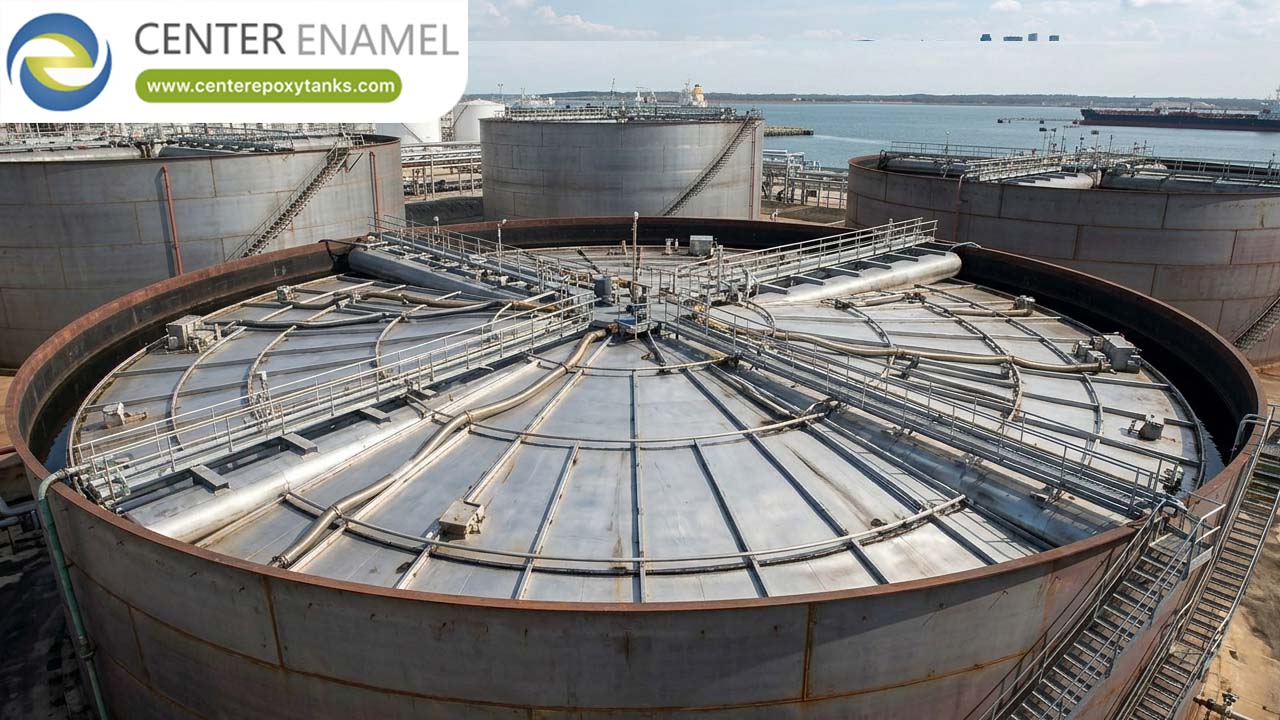
Slovakia Oil Tank Floating Roofs - Vapour Control in a Central European Climate
Central European oil storage operates in a climate that tests a floating roof twice a year: snow and ice in winter, and warm days that drive vapour generation in summer. An external floating roof has to shed snow without ponding and keep its drains working through freeze-thaw, while still delivering the vapour control that the site's permit requires. That dual demand is what makes roof selection a local question rather than a generic one.
Engineered by Shijiazhuang Zhengzhong Technology Co., Ltd. (Center Enamel), floating roofs for Slovak projects are designed to the site's own snow, wind and seismic values under the applicable code, with drainage and seals specified for freeze-thaw as well as for summer heat.
1. Which Codes Apply in Slovakia?
Tanks are typically designed to EN 14015 with Eurocode load combinations and the Slovak national annex; the floating roof follows API 650 Appendix C, or an equivalent Eurocode treatment where the project specification requires it.
· EN 14015: The common European specification for site-built welded steel storage tanks.
· Eurocode with National Annex: Snow, wind and seismic values taken for the specific locality.
· API 650 Appendix C: The usual reference for the external floating roof itself.
· Permit Conditions: The site's permit fixes the emission requirements that the roof must meet.
· Documentation: Calculations and records needed for the project's technical file.
2. How Do Snow and Ice Affect a Floating Roof?
Snow adds a load the deck must carry, and ice blocks the drains that keep it afloat. Both are design issues: drainage sized for the locality, arranged to keep working through freeze-thaw, and drains cleared at every outage.
· Snow Load: Applied from the locality's characteristic value, combined with other load cases.
· Ice Blockage: Frozen drains are the mechanism behind most winter deck flooding.
· Drain Design: Arranged so water cannot pond and ice cannot isolate the drain completely.
· Emergency Drain: Provides a second path if the primary drain is overwhelmed by snow melt.
· Winter Inspection: Drains are checked before and during the cold season.
3. When Is an Internal Roof Preferred Here?
Where winter maintenance burden or emission limits justify a covered deck. An internal floating roof has no snow load and no rainwater to drain, which removes the two hardest winter problems on an external roof.
· No Snow Load: The fixed roof carries snow, so the deck only has to float.
· No Roof Drainage: Rainwater never reaches the deck, removing the dominant external deck failure mode.
· Longer Seal Life: Shielded from weather, seals degrade far more slowly.
· Better Loss Control: A protected deck and seal system typically achieves higher loss reduction.
· Trade-Off: Internal inspection requires emptying, cleaning and gas-freeing, so intervals are planned carefully.
Evaluation Criterion | External Floating Roof | Internal Floating Roof |
Snow load on deck | Applied and designed for | Carried by the fixed roof |
Winter drainage burden | High - drains can ice | None |
Seal life | Shorter - weather exposed | Longer - protected |
Loss reduction | High | Very high |
Internal inspection | Deck visible from above | Requires emptying and gas-freeing |
Engineering Assurance and Project Support
Every welded oil tank delivered by Shijiazhuang Zhengzhong Technology Co., Ltd. (Center Enamel) is designed to API 650 with shell courses sized by the one-foot method and checked for wind, seismic and hydrostatic load cases, or to EN 14015 and the Eurocodes where the site is European. Shell plate is shot-blasted to Sa 2.5 and coated to a documented dry film thickness, longitudinal and annular plate welds are examined by radiography or ultrasonic testing to the acceptance level written into the purchase order, and every tank is hydrostatically tested and dimensionally surveyed before hand-over. Roofs are supplied with buoyancy calculations, snow and wind values from the locality, drainage sized for freeze-thaw, seals selected for the seasonal range, and an inspection schedule aligned to the operator's programme.
"In Central Europe the question is not whether the roof controls vapour - it is whether it survives winter without becoming a maintenance problem."
Frequently Asked Questions (FAQ)
Does a floating roof work in a Central European winter?
Yes, provided drainage is designed for it. Snow load is applied from the locality's own value and combined with other load cases, and drains are arranged so they keep working through freeze-thaw. Frozen drains are the mechanism behind most winter deck flooding, so an emergency drain and pre-winter checks are standard precautions.
Which is better for Slovakia - external or internal floating roof?
It depends on the product, the emission limits and the maintenance philosophy. An external roof is proven and inspectable from above. An internal roof carries no snow load, has no rainwater to drain and gives better loss control and longer seal life, but internal inspection requires emptying and gas-freeing. Where winter maintenance burden is a concern, the internal roof often wins.
Which standards apply to the tank and roof?
Tanks are normally designed to EN 14015 with Eurocode load combinations and the Slovak national annex. The floating roof follows API 650 Appendix C, or an equivalent Eurocode treatment where the project specification requires it. The site's permit then fixes the emission requirements the roof must satisfy.
Can the roof be customised for our tank?
Yes. Deck type and buoyancy, seal specification, drainage sized for freeze-thaw, support leg landing height, fittings, rolling ladder, gauging platform, grounding and anti-rotation arrangement are all engineered to your tank, product and the snow, wind and seismic values of your locality.


