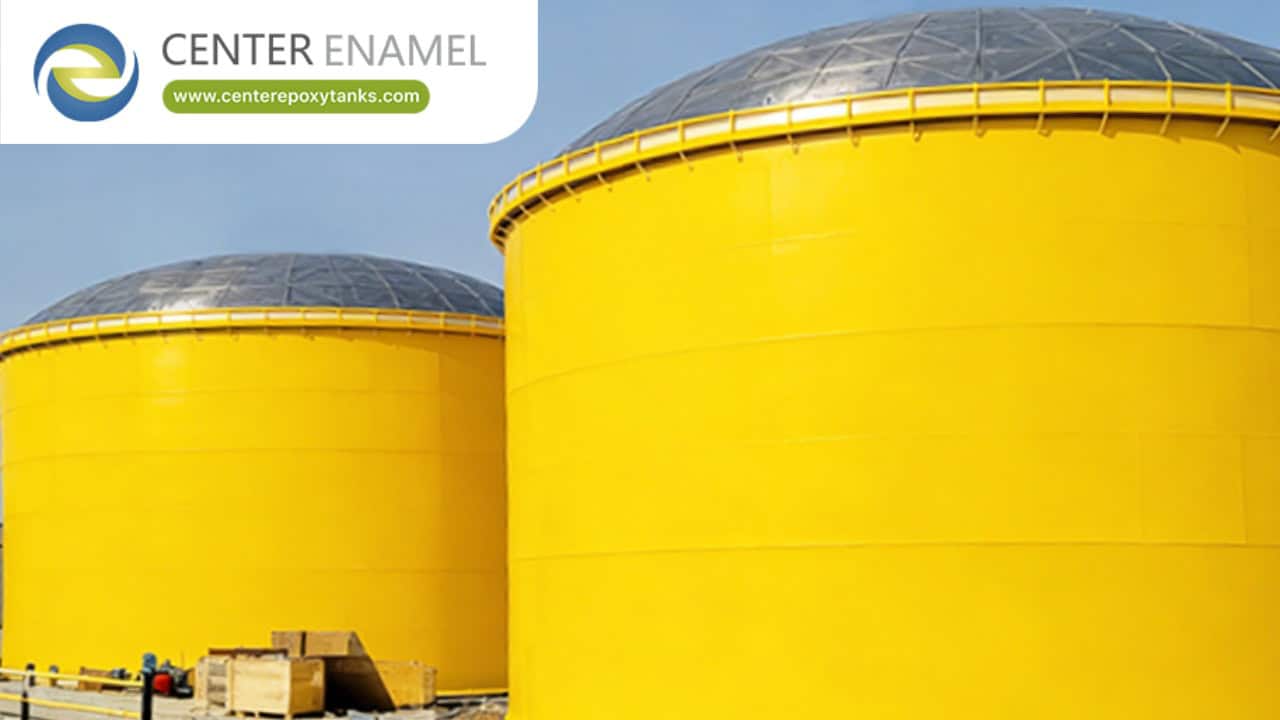
Self-Bunded Crude Oil and Gasoline Tanks - Integral Containment for Distributed Storage
Gasoline and light crude are the two streams where a release does the most immediate harm: they are volatile, mobile in soil, and hazardous to anyone nearby. For distributed storage - fleet depots, construction sites, mining operations, standby generation - building a conventional bund is often impractical, and a single-skin tank in that setting is a risk that is hard to justify.
Self-bunded construction solves it by making the containment part of the tank. Engineered by Shijiazhuang Zhengzhong Technology Co., Ltd. (Center Enamel), a self-bunded tank is a primary vessel inside an outer shell, with the interstitial space monitored so a breach is found long before fuel reaches the ground.
1. What Is a Self-Bunded Tank?
A tank within a tank. The primary vessel holds the fuel, the outer shell provides secondary containment, and the space between them is monitored for any sign of leakage from the primary.
· Primary and Secondary Shells: Both are factory-built and tested as a single unit.
· Interstitial Space: The annular space is monitored continuously or on a defined schedule.
· Integrated Fittings: Fill, draw-off, vent, gauge and overfill protection are supplied and located within the bunded envelope where possible.
· Factory Testing: Both shells and the monitoring provision are tested before delivery.
· Transportable Design: Units are designed to be moved as site requirements change.
2. How Is a Leak Between the Walls Detected?
Through the interstitial space - by a sensor, by a float switch, by pressure or vacuum decay, or by routine manual inspection of the space, depending on the monitoring level specified.
· Liquid Sensing: A probe in the interstitial space detects product or water entering it.
· Float Switch: A simple, robust device that alarms when liquid collects between the walls.
· Pressure or Vacuum Decay: A monitored atmosphere in the annulus reveals loss of integrity.
· Visual Inspection Point: A dip point or inspection port allows manual confirmation.
· Alarm Integration: Detection is connected to the site's alarm system so a leak is acted on immediately.
3. Where Can Self-Bunded Tanks Be Installed?
Wherever their containment is recognised as equivalent to a bund and the siting rules for flammable liquid storage are met. That typically includes fleet depots, construction and mining sites, standby generation, and remote facilities without permanent civil works.
· Separation Distances: Flammable liquid storage still requires separation from buildings, boundaries and ignition sources.
· Fire Considerations: Venting, earthing and access for emergency response are provided.
· Ground Conditions: A level, competent base is required so the unit sits true and its containment performs.
· Local Acceptance: Whether integral containment is accepted in place of a bund should be confirmed with the authority having jurisdiction.
· Anchorage: Units are anchored for wind and, where applicable, seismic exposure.
Evaluation Criterion | Self-Bunded Tank | Single-Skin Tank with Remote Bund |
Containment | Integral | Separate civil works |
Leak detection | Interstitial monitoring | Often none |
Installation programme | Fast | Slow - civils first |
Relocatability | Yes | No |
Suitability for remote sites | Excellent | Poor |
Engineering Assurance and Project Support
Every welded oil tank delivered by Shijiazhuang Zhengzhong Technology Co., Ltd. (Center Enamel) is designed to API 650 with shell courses sized by the one-foot method and checked for wind, seismic and hydrostatic load cases, or to EN 14015 and the Eurocodes where the site is European. Shell plate is shot-blasted to Sa 2.5 and coated to a documented dry film thickness, longitudinal and annular plate welds are examined by radiography or ultrasonic testing to the acceptance level written into the purchase order, and every tank is hydrostatically tested and dimensionally surveyed before hand-over. Self-bunded units are delivered factory-tested with both shells, interstitial monitoring, fill and draw-off fittings within the bunded envelope where possible, overfill protection, gauging, vents and anchorage details.
"With gasoline the question is not whether you have containment, but how fast you will know if the primary wall fails. Integral monitoring answers that immediately."
Frequently Asked Questions (FAQ)
What does self-bunded mean on a fuel tank?
It means the secondary containment is built into the unit: a primary tank inside an outer shell, with the interstitial space monitored. No separate bund is required, which is what makes these units practical for remote, temporary or space-constrained sites where civil works are impractical.
How do you know if the inner tank has leaked?
Through the interstitial space. Depending on the monitoring level specified, that space is fitted with a liquid sensor, a float switch, or a monitored atmosphere that reveals pressure or vacuum decay, and an inspection port allows manual confirmation. Detection is connected to the site alarm so a breach is acted on immediately.
Can a self-bunded tank replace a bunded compound?
Often yes, and that is the point of the design - but it should be confirmed with the authority having jurisdiction for your location. Separation distances, fire provisions, ground conditions and anchorage all still apply, because integral containment addresses release containment rather than siting.
Can the tank be customised for our site?
Yes. Capacity, primary and secondary shell material and coating, monitoring method, fill and draw-off arrangement, overfill protection, gauging, vents and flame arresters, insulation, anchorage and lifting details are all engineered to your fuel, throughput and site conditions.


