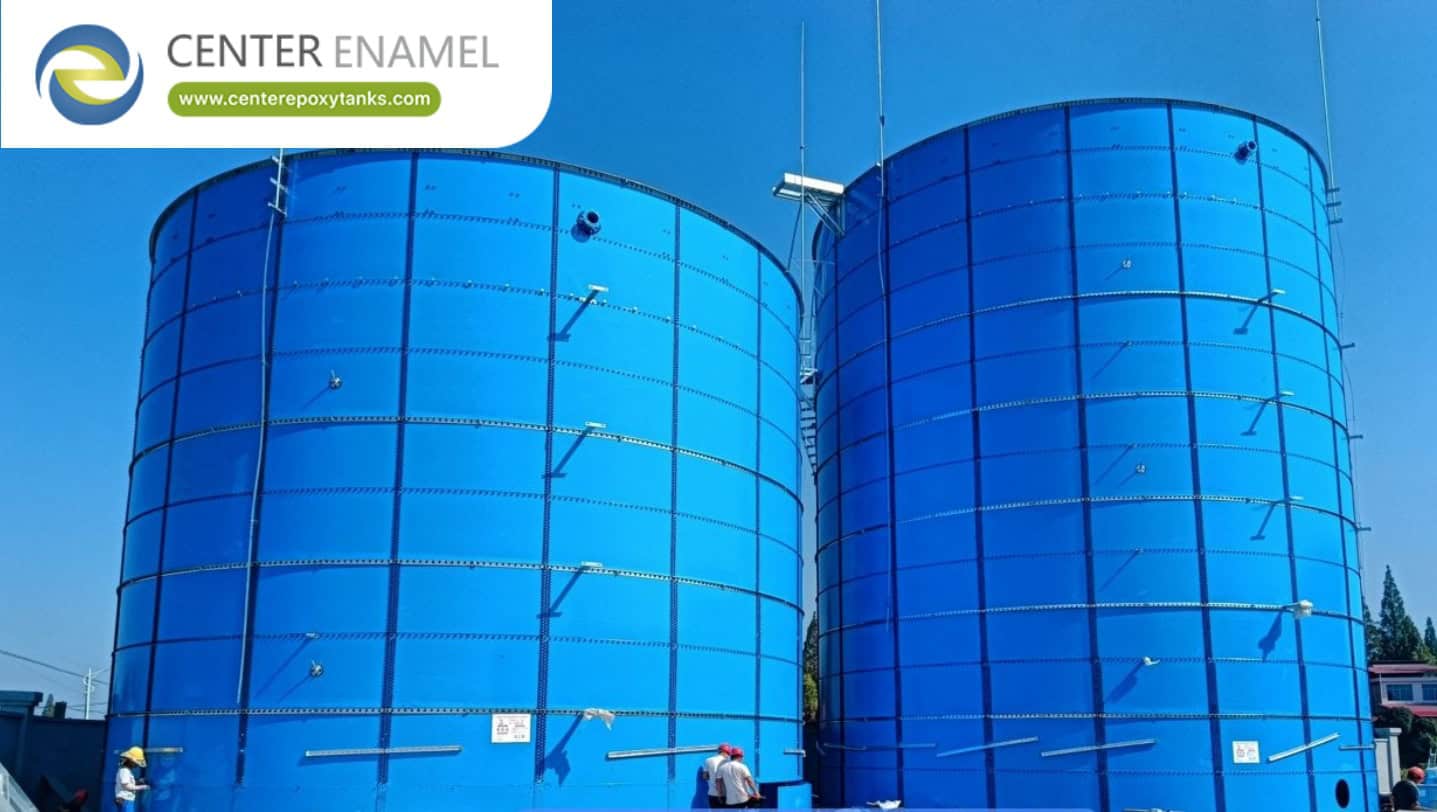
Seismic Performance of Fusion Bonded Epoxy (FBE) Tanks: Engineering & Design
For critical water and industrial storage infrastructure, seismic resilience is non-negotiable. Fusion Bonded Epoxy (FBE) bolted steel tanks are frequently selected for seismic zones not just for their corrosion resistance, but for their structural performance during earthquakes. Unlike rigid, monolithic welded tanks, FBE bolted tanks offer a unique "ductile" response to seismic activity, provided they are engineered according to the latest standards (such as AWWA D103 and ASCE 7). Understanding the interaction between liquid contents and tank structure is essential for ensuring asset survival.
1. The Physics of Seismic Loading in Tanks
When an earthquake occurs, the liquid inside a storage tank does not move as a single block. Engineers must calculate two distinct seismic force components to ensure the tank does not buckle or slide:
● Impulsive Force: This is the mass of the liquid that moves in synchronization with the tank shell. It exerts high pressure on the lower ring of the tank and the foundation.
● Convective Force (Sloshing): This is the "wave" motion of the liquid at the free surface. The sloshing creates localized, dynamic pressure on the upper shell and roof.
Properly designed FBE tanks incorporate "freeboard"—extra height above the maximum liquid level—to prevent sloshing waves from impacting the roof structure, which could lead to structural failure or shell buckling.
2. Why Bolted Construction Aids Seismic Resilience
There is a common misconception that "welded" is always stronger. However, in seismic engineering, ductility (the ability to deform without breaking) is often more valuable than raw stiffness.
● Energy Dissipation: The numerous bolted lap joints in an FBE tank act as microscopic energy absorbers. While the tank is essentially rigid, these joints allow for extremely slight, controlled movements that can dampen seismic energy better than a single, continuous welded seam which might be prone to brittle crack propagation.
● Modular Integrity: Because the tank is comprised of high-strength steel panels, if one area of the tank is stressed, the load is distributed across a grid of bolts rather than focusing all stress on a single weld bead.
● Coating Flexibility: High-quality Fusion Bonded Epoxy is engineered to flex. During a seismic event, as the steel shell undergoes deformation, the FBE coating stretches rather than cracking or flaking, maintaining the corrosion-resistant barrier even during the seismic event.
3. Critical Design Factors for Seismic Zones
To ensure an FBE tank survives a significant seismic event, the design phase must address three non-negotiable pillars:
A. Anchoring Systems
The tank must be physically connected to the foundation to prevent "uplift" (the tank tilting or rocking during the quake) or "sliding."
● Anchor Bolts: High-strength, corrosion-resistant anchor bolts must be embedded deep into a reinforced concrete ring wall or slab.
● Uplift Calculation: Engineers must calculate the overturning moment caused by the sloshing liquid and ensure the anchor bolts can counteract this force without pulling out of the concrete.
B. Shell Plate Thickness
In high seismic zones, the bottom rings of the tank (where the bending moments are highest) often require thicker steel plates than a non-seismic design would dictate. AWWA D103 provides the specific equations to determine these requirements based on the Seismic Design Category (SDC) of the site.
C. Foundation Stability
The foundation is the tank's anchor to the earth. In seismic zones, soil liquefaction is a major risk. A foundation design that is adequate for static loads may be insufficient if the ground loses its bearing capacity during a quake. Deep foundations or soil stabilization may be required to prevent the foundation from tilting, which would cause the tank to fail regardless of how strong the steel is.
4. Seismic Performance Comparison: Bolted vs. Welded
Feature | Bolted Steel Tank (FBE) | Field-Welded Steel Tank |
Failure Mode | Localized deformation/panel shifting | Brittle cracking or buckling |
Repairability | High (can replace individual panels) | Low (requires hot work/welding) |
Ductility | Higher (via joint interactions) | Lower (rigid, monolithic structure) |
Foundation Sensitivity | High (needs level tolerance) | Moderate (tolerates slight tilt) |
5. Inspection & Maintenance Post-Seismic Event
If a seismic event occurs, a visual inspection is not enough. Facility managers should follow this protocol:
1. Plumbness Check: Use a laser level to ensure the tank has not shifted out of vertical alignment (plumb).
2. Anchor Bolt Inspection: Inspect the concrete around the anchor bolts for "cracking" or "spalling," which indicates the bolt was under significant tension during the quake.
3. Coating Integrity: Perform a visual inspection of the lap joints. While FBE is flexible, a violent quake can cause slight panel deformation that might create microscopic stress points in the coating.
4. Leak Check: Monitor the perimeter for any signs of weeping, which would indicate a compromise in the joint sealant.
The seismic performance of a Fusion Bonded Epoxy tank is not a matter of chance; it is a matter of precise, code-compliant engineering. By correctly calculating impulsive and convective loads, utilizing properly rated anchor systems, and ensuring the foundation is seismically stable, these tanks provide a durable, energy-dissipating solution for liquid storage. Their modular nature allows them to absorb seismic energy efficiently, and when built to AWWA D103 standards, they remain among the most resilient storage assets in high-risk zones.
Are you currently working on a project in a high-seismic zone, and would you like to discuss the specific load calculations required to determine if your current tank design meets the necessary Seismic Design Category requirements?


