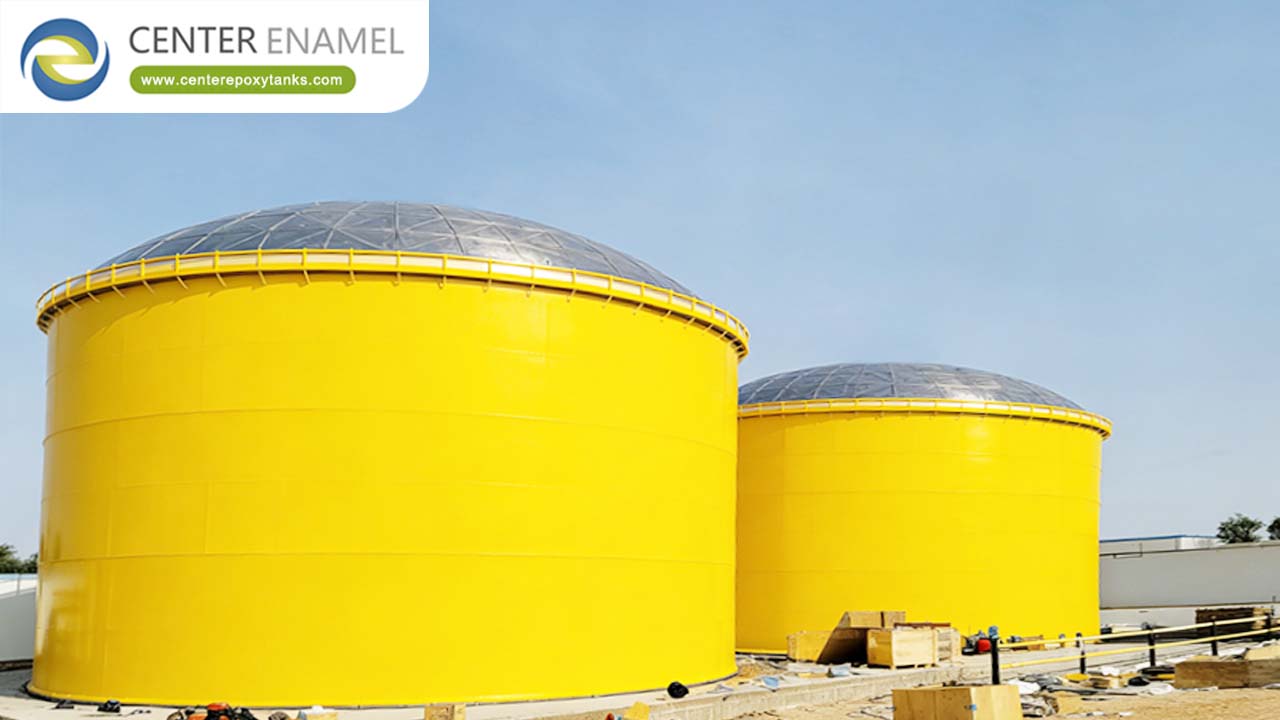
Roofs for Oil Storage Tanks - Choosing Between Cone, Dome and Floating Roofs
Target Sub-questions (Query Fan-out):
The roof is the part of an oil tank that most often governs the maintenance budget, and the part most often chosen by default. A cone roof is cheap and familiar; a dome is column-free and maintenance-free; a floating roof controls vapour but needs attention; an internal floating roof does both. The right choice depends on the product's volatility, the site's climate and how expensive an outage is.
Engineered by Shijiazhuang Zhengzhong Technology Co., Ltd. (Center Enamel), all four roof types are available, and the selection is made from the product's vapour pressure at storage temperature, the site's environmental loads and the operator's inspection philosophy.
1. What Roof Types Are Available?
Four in practice: a fixed cone roof, a self-supporting aluminium dome, an external floating roof, and a fixed roof with an internal floating deck. Each occupies a different position on the volatility and maintenance axes.
· Fixed Cone Roof: Plated steel on rafters, with columns on larger diameters; the cheapest option for low-volatility product.
· Aluminium Dome: Self-supporting clear span, no columns, no coating maintenance.
· External Floating Roof: A buoyant deck on the liquid; the vapour control standard for crude and volatile product.
· Internal Floating Roof: A deck inside a fixed roof; vapour control with weather protection.
· Combined Systems: A dome over an internal deck is a common high-performance configuration.
2. When Is a Fixed Cone Roof the Right Choice?
When the product's vapour pressure at storage temperature is low and emissions are not a concern. On heavy fuel oil, bitumen, water and low-volatility streams, a cone roof is the economical answer.
· Low Volatility Product: Little vapour to lose means little to control.
· Lowest Capital Cost: The cheapest roof to build where the duty permits.
· Simple Maintenance: Painting is straightforward because everything is accessible.
· Limitation: On larger diameters it needs internal columns, which corrode and obstruct cleaning.
· Not For Volatile Product: Breathing loss and emissions make it unsuitable for gasoline, naphtha or most crude.
3. When Does a Dome Roof Make Sense?
When you want a fixed roof without the column and coating penalties - on larger diameters, on corrosive vapour space, or where future recoating outages are expensive.
· Clear Span: No internal columns, so the interior is fully usable and inspectable.
· No Recoating: Aluminium never needs blast-and-recoat, removing the largest roof maintenance item.
· Corrosive Vapour Space: Ideal over crude, slop and recovered oil where a steel underside would corrode.
· Over an Internal Deck: The dome becomes the weather cover for an internal floating roof.
· Retrofit: A dome can replace a failing cone roof and remove the maintenance burden with it.
Evaluation Criterion | Cone Roof | Aluminium Dome | External Floating Roof | Internal Floating Roof |
Capital cost | Lowest | Moderate | Higher | Highest |
Vapour control | None | None alone | High | Very high |
Internal columns | On larger tanks | None | None | None |
Roof recoating | Required periodically | Never | Not applicable | Not applicable |
Maintenance focus | Coating | Gaskets and fasteners | Drains, seals, pontoons | Seals, vents, deck |
Engineering Assurance and Project Support
Every welded oil tank delivered by Shijiazhuang Zhengzhong Technology Co., Ltd. (Center Enamel) is designed to API 650 with shell courses sized by the one-foot method and checked for wind, seismic and hydrostatic load cases, or to EN 14015 and the Eurocodes where the site is European. Shell plate is shot-blasted to Sa 2.5 and coated to a documented dry film thickness, longitudinal and annular plate welds are examined by radiography or ultrasonic testing to the acceptance level written into the purchase order, and every tank is hydrostatically tested and dimensionally surveyed before hand-over. We supply all four roof types and select on your product's vapour pressure at storage temperature, the site's wind, snow and seismic loads, and how often you can realistically take the tank out of service.
"Choose the roof on volatility first, then on what an outage costs you. The capital difference is usually the smallest number in the calculation."
Frequently Asked Questions (FAQ)
Which roof is cheapest for an oil storage tank?
A fixed cone roof is the cheapest to build, and it is the right choice where the product's vapour pressure at storage temperature is low - heavy fuel oil, bitumen, water and similar streams. On volatile product or large diameters it becomes the most expensive option through emissions, columns and periodic recoating.
Can a cone roof be replaced with a dome?
Yes, and it is one of the most effective upgrades available. The existing shell is surveyed, the compression ring is checked or strengthened for the dome's thrust, and the old roof is removed or retained as a working platform. Members arrive factory-cut and drilled, so the retrofit is assembly work with no hot work.
Does a dome control emissions on its own?
Not by itself - a dome is a fixed roof, so it does not remove the vapour space. Its contribution is a sealed envelope, which is what allows an internal floating roof, vapour recovery or nitrogen blanketing to perform to their design basis. For direct emission control, a floating roof is needed.
Can the roof be customised for our tank?
Yes. Type and geometry, diameter and rise, material and coating, seal or blanketing provision, vents and flame arresters, manways, gauging platforms, walkways, handrails, lightning protection and access are all engineered to your tank, product and site loads.


