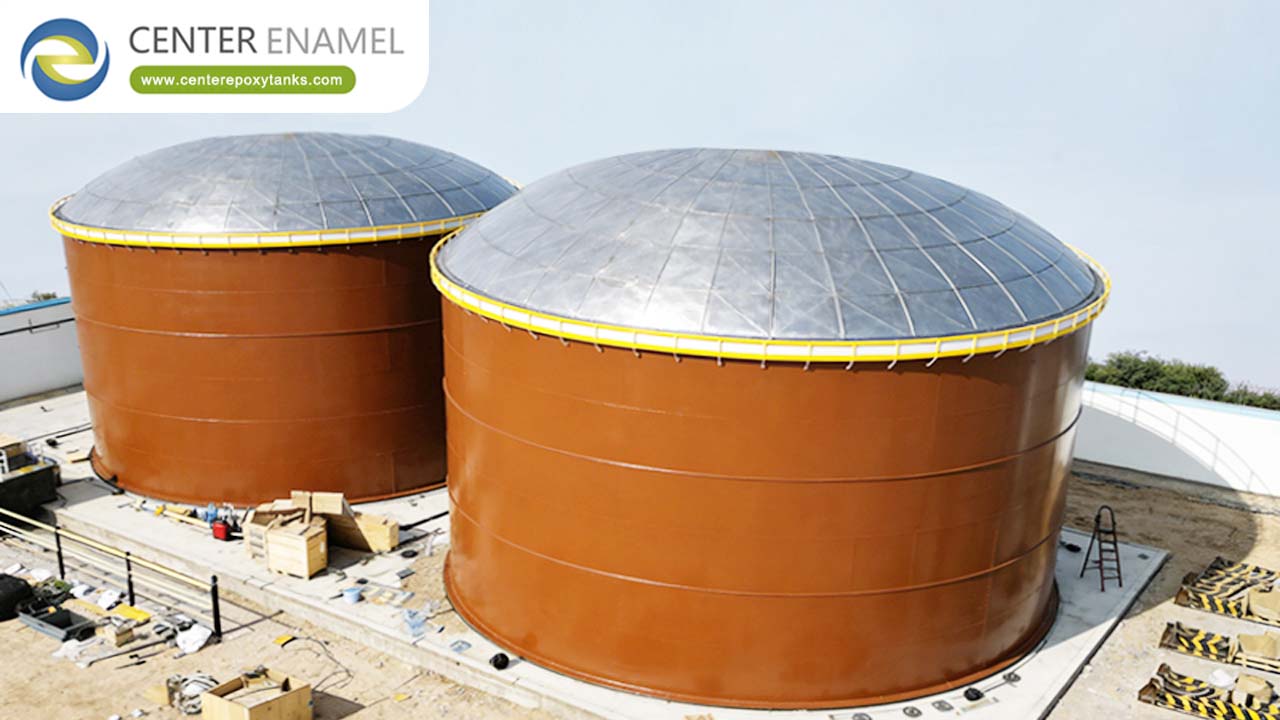
Refined Oil Storage Tank Covers - Keeping Finished Product in Specification
Refined product is where storage quality is worth the most and lost the easiest. Gasoline, diesel, jet fuel and naphtha are volatile, specification-critical and valuable; water ingress, evaporation of light ends and contamination from a rusting roof all show up directly in the product's test results. A crude tank that loses a little vapour is a commercial problem; a gasoline tank that does the same is a specification problem.
Engineered by Shijiazhuang Zhengzhong Technology Co., Ltd. (Center Enamel), refined oil tank covers are specified as systems - a fixed or dome cover with an internal floating deck, sealed fittings and controlled venting - because each element protects a different specification parameter.
1. Why Do Refined Products Need Better Covers?
Because volatility and specification sensitivity are both high. The cover has to control vapour loss, exclude water, and not contribute contamination - three jobs that a simple fixed roof does not do well.
· Volatility: Light products lose vapour readily, so an open vapour space is a continuous loss.
· Specification Sensitivity: Water and contamination show directly in test results.
· Product Value: Refined product is worth more per cubic metre than crude, so losses cost more.
· Odour and Emissions: Refined product vapour is more noticeable and more regulated than crude.
· Fire Considerations: Volatile product with a vapour space is a more serious fire scenario.
2. What Is the Best Cover for Gasoline and Diesel?
A fixed or dome cover with an internal floating roof for gasoline, and vapour control proportionate to volatility for diesel. The internal deck removes the vapour space; the cover keeps weather, dust and water out.
· Gasoline: An internal floating roof under a fixed or dome cover is the standard configuration.
· Diesel and Gasoil: Vapour control is justified on larger tanks and in warm climates; smaller or cooler installations may not need it.
· Jet Fuel: Water exclusion and cleanliness are as important as vapour control.
· Naphtha: High volatility makes vapour control the governing requirement.
· Dome Over Deck: A clear-span aluminium dome over an internal deck is a strong combination for refined service.
3. How Is Contamination From the Cover Prevented?
By excluding water and rust. A sealed cover keeps rain out, an internal deck stops condensation forming on a cool roof above the product, and corrosion-free or protected surfaces stop debris reaching the liquid.
· Sealed Roof Penetrations: Every hatch, vent and gauge point is sealed against water ingress.
· No Condensation Surface: An internal deck removes the cool surface where condensation would form and drip back.
· Corrosion-Free Structure: Aluminium or stainless avoids rust and coating debris entering the product.
· Water Draw-Off: Any water that does arrive is collected at the lowest point and drawn off.
· Filtration at Transfer: Where the specification requires it, product is filtered on transfer.
Evaluation Criterion | Cover with Internal Floating Roof | Fixed Roof Only |
Vapour loss | Very low | Continuous breathing loss |
Water ingress | Excluded | Through roof and penetrations |
Light ends retention | High | Lost to evaporation |
Fire scenario | Rim seal event | Vapour space fire |
Product specification | Held | At risk |
Engineering Assurance and Project Support
Every welded oil tank delivered by Shijiazhuang Zhengzhong Technology Co., Ltd. (Center Enamel) is designed to API 650 with shell courses sized by the one-foot method and checked for wind, seismic and hydrostatic load cases, or to EN 14015 and the Eurocodes where the site is European. Shell plate is shot-blasted to Sa 2.5 and coated to a documented dry film thickness, longitudinal and annular plate welds are examined by radiography or ultrasonic testing to the acceptance level written into the purchase order, and every tank is hydrostatically tested and dimensionally surveyed before hand-over. Refined product covers are supplied with the roof or dome, internal floating deck, seals, grounding, controlled venting sized to API 2000, sealed penetrations, water draw-off and an inspection schedule.
"On refined product the cover has to do three jobs at once: keep the vapour in, keep the water out, and keep itself out of the product."
Frequently Asked Questions (FAQ)
Do diesel tanks need floating roofs?
Larger diesel and gasoil tanks in warm climates generally do, because vapour control pays back through reduced loss and emissions. Smaller tanks, cooler climates and low-throughput installations often do not. The decision follows the product's vapour pressure at the site's storage temperature and the tank's size and turnover.
Why is an internal floating roof preferred for gasoline?
It removes the vapour space, which stops breathing loss, and it does so under a fixed or dome cover, which protects the deck and seal from weather. That combination gives better loss control and longer seal life than an exposed external deck, which matters on high-value volatile product.
How does water get into a refined product tank?
Mainly through breathing and condensation, and through roof penetrations that are not sealed. Condensation is the most underestimated route: moist air condenses on the cool underside of the roof and drains back into the product. An internal deck removes that surface, and a water draw-off removes whatever still arrives.
Can the cover be customised for our product?
Yes. Roof or dome type, internal deck type and material, seal specification, grounding and bonding, venting sized to API 2000, sealed penetrations, water draw-off, instrumentation and access are all engineered to your product, tank and site conditions.


