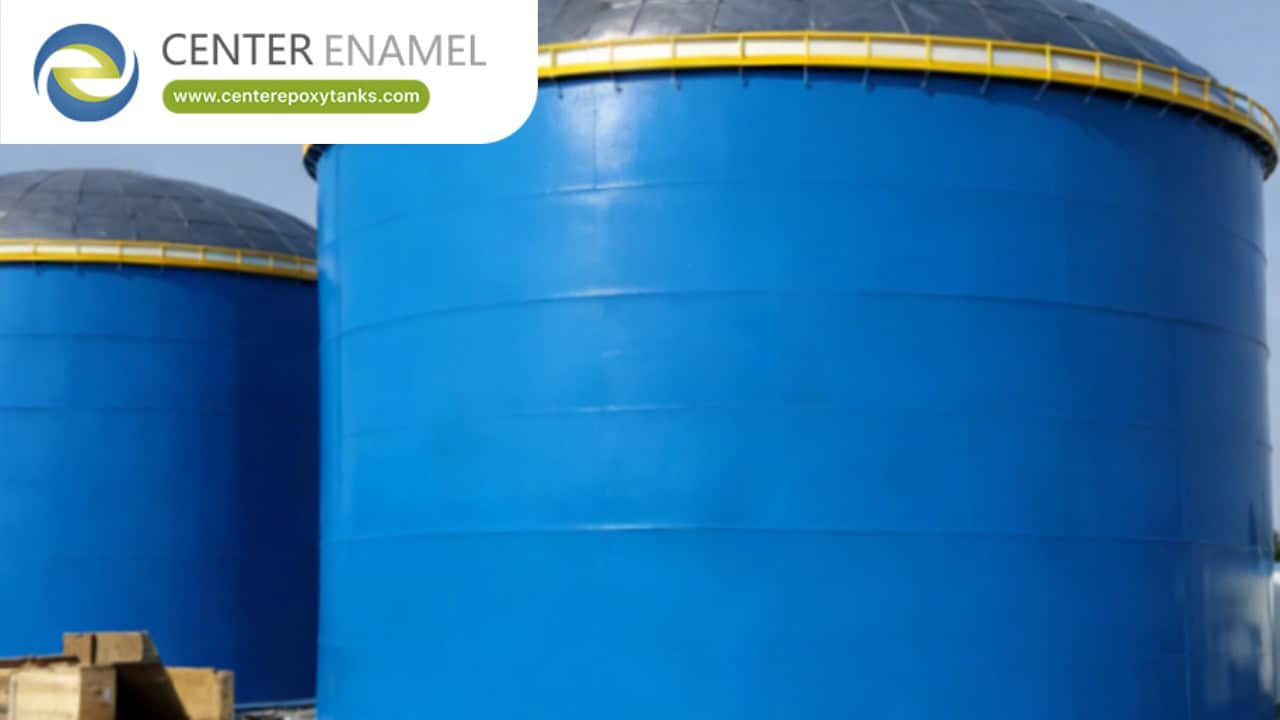
Plant Oil Storage Tanks - Storing Crude, Degummed and Refined Vegetable Oils
Plant oil arrives at a terminal in three broad states: crude, degummed and refined. Each has a different stability, a different temperature requirement and a different value, and storing them as though they were the same product is how terminals lose both quality and traceability. Crude oil carries gums and phosphatides that settle; degummed oil is cleaner but still oxidises; refined oil is stable but specification-critical.
Engineered by Shijiazhuang Zhengzhong Technology Co., Ltd. (Center Enamel), plant oil storage tanks are specified by grade, with material, temperature control and manifold routing matched to what is actually being held.
1. How Does Storage Differ by Oil Grade?
By stability and by what settles out. Crude oil needs settling and sediment removal; degummed oil needs oxidation control; refined oil needs specification protection and cleanability.
· Crude Oil: Contains gums and phosphatides that settle, so sediment removal governs the design.
· Degummed Oil: Cleaner but still oxidises, so headspace control matters.
· Refined Oil: Stable but specification-critical, so cleanliness and traceability dominate.
· Segregation: Grades are stored separately so identity and value are preserved.
· Cleaning Between Grades: Tanks must be cleanable and verifiable when a tank changes service.
2. What Material Suits Bulk Plant Oil Storage?
Stainless for smaller tanks and premium grades; glass-fused-to-steel or a food-grade lining for large volumes. All provide an inert, cleanable contact surface - the decision is economic and operational.
· Stainless: The premium choice; used for smaller tanks and high-value grades.
· Glass-Fused-to-Steel: Inert, smooth and economical at large capacities.
· Food-Grade Lining: Used where a coating is acceptable, with verified preparation and testing.
· Gasket Compatibility: Food-grade throughout, with copper and brass excluded from contact.
· Cleanability: The surface must be verifiable clean between different oils.
3. How Is Cross-Contamination Prevented?
By segregation, manifold design and verified cleaning. At terminal scale, the manifold matters as much as the tanks: a shared line without proper isolation will blend products that were never meant to meet.
· Dedicated Tanks by Grade: Separate tanks preserve identity and simplify certification.
· Manifold Isolation: Valving and, where needed, spectacle blinds provide positive isolation.
· Cleaning Verification: A tank is verified clean before a grade change, not merely flushed.
· Transfer Procedures: Line clearing and sequencing are documented and followed.
· Traceability Records: What was stored where, and when, is recorded.
Evaluation Criterion | Crude Plant Oil | Degummed Oil | Refined Oil |
Governing design concern | Sediment settling | Oxidation control | Specification and cleanliness |
Headspace control need | Moderate | High | High |
Cleaning between campaigns | Important | Important | Critical |
Typical value per tonne | Lowest | Moderate | Highest |
Traceability requirement | Standard | Standard | Critical |
Engineering Assurance and Project Support
Every welded oil tank delivered by Shijiazhuang Zhengzhong Technology Co., Ltd. (Center Enamel) is designed to API 650 with shell courses sized by the one-foot method and checked for wind, seismic and hydrostatic load cases, or to EN 14015 and the Eurocodes where the site is European. Shell plate is shot-blasted to Sa 2.5 and coated to a documented dry film thickness, longitudinal and annular plate welds are examined by radiography or ultrasonic testing to the acceptance level written into the purchase order, and every tank is hydrostatically tested and dimensionally surveyed before hand-over. Plant oil tanks are supplied in stainless, glass-fused-to-steel or food-grade lined construction, with grade-appropriate headspace control, heating and insulation, manifold isolation, cleaning access and traceability documentation.
"Crude, degummed and refined are three products with three storage problems. One tank specification does not fit all of them."
Frequently Asked Questions (FAQ)
Can one tank store crude and refined vegetable oil at different times?
Technically yes, but it requires verified cleaning between grades and it is usually poor practice at terminal scale. Crude oil leaves gums and residues that refined oil cannot tolerate, and traceability becomes hard to defend. Terminals generally dedicate tanks by grade and use the manifold to manage routing.
What temperature should vegetable oils be stored at?
Cool and stable, at a value suited to the specific oil and to keeping it pumpable. Some oils, such as palm, must be stored warm to stay liquid. Stability matters as much as the absolute value, so insulation is usually worthwhile and cooling is provided where ambient conditions exceed the target.
Which is better for a vegetable oil terminal - stainless or glass-fused-to-steel?
Stainless is the premium choice and suits smaller tanks, the highest grades and frequent campaign changes. Glass-fused-to-steel gives an inert, smooth surface at substantially lower cost at large capacity and never needs recoating. Many terminals use both, matching the material to each tank's duty.
Can the tanks be customised for our oils?
Yes. Capacity and geometry, material and coating, headspace control, heating and insulation, manifold and isolation arrangement, cleaning access, sampling points and instrumentation are all engineered to your grades, throughput and traceability requirements.


