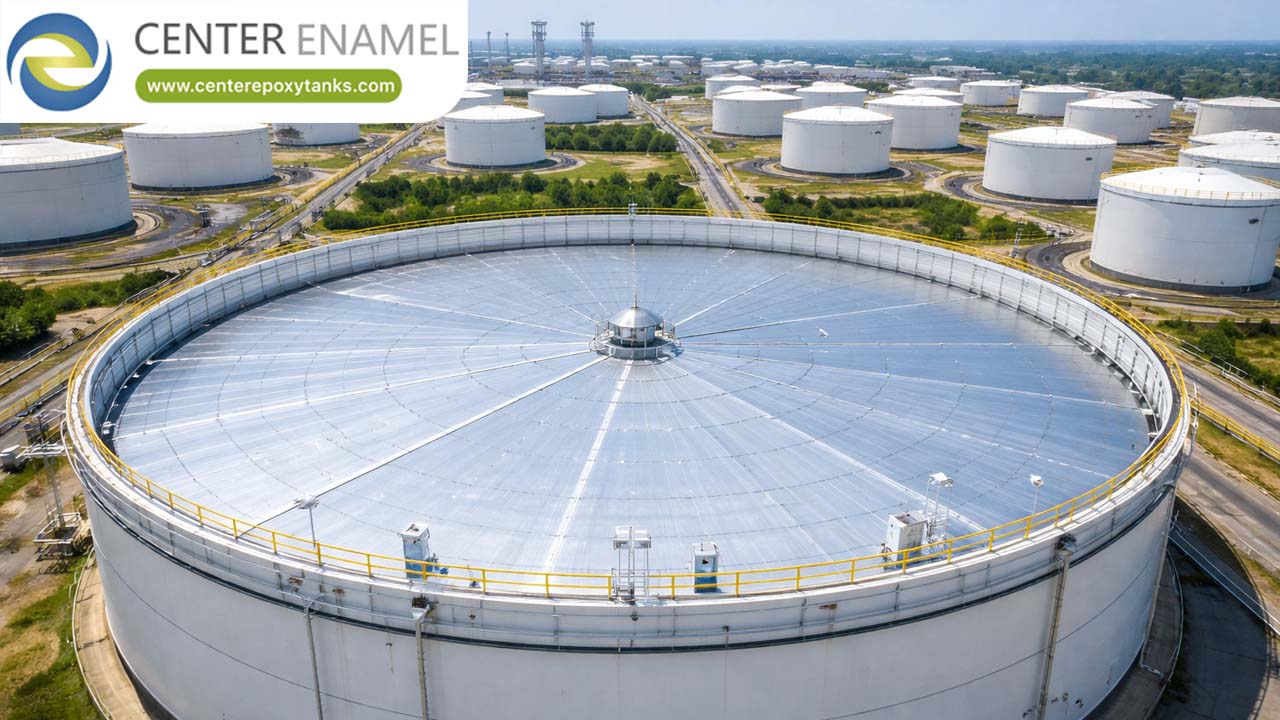
Petroleum Storage Tanks with External Floating Roofs: Engineering Large-Scale Crude Oil Containment and Vapor Control
In midstream oil logistics, refinery tank farms, and massive marine terminals, managing atmospheric emissions while protecting vast product inventories is a critical operational requirement. Storing high-volume crude oil and volatile petroleum intermediates requires robust containment structures capable of handling massive hydrostatic loads while curbing severe product evaporation.
For large-diameter vessels containing volatile organic liquids, static fixed-roof configurations are inefficient due to excessive breathing losses and hazardous vapor accumulation. To resolve these challenges, the petroleum industry standardizes on petroleum storage tanks with external floating roofs (EFRs). Governed by stringent international codes, these open-top cylindrical structures feature a dynamic deck that rests directly on the liquid surface, rising and falling seamlessly with operational inventory changes.
Engineering Design and Regulatory Framework: API 650 Annex C
The design, fabrication, and structural integrity of external floating roof tanks are governed globally by API Standard 650 (Welded Tanks for Oil Storage). Specifically, Annex C outlines the rigorous mechanical, buoyancy, and safety requirements dedicated to external floating roofs:
Buoyancy and Pontoon Integrity: The floating deck must maintain positive buoyancy and stability even if the outer pontoon compartment or dual adjacent compartments are accidentally punctured or flooded.
Continuous Rim Seal Systems: To bridge the annular space between the moving steel deck and the tank shell, EFRs utilize specialized primary and secondary seals. These seals minimize vapor loss, prevent wind-induced rim fires, and ensure smooth vertical travel without binding.
Environmental Load and Drainage Management: Because EFRs are open to the sky, their decks are directly exposed to rain, snow, and solar radiation. Engineered roof drains, swivel joints, and flexible drainage piping systems must be integrated to safely evacuate accumulated water off the deck and out of the tank.
Anti-Rotation and Rolling Ladders: Systems such as anti-rotation devices prevent the floating roof from spinning under wind shear, while articulated rolling ladders provide safe operator access from the top platform to the moving deck at any liquid level.
Technical Performance Matrix: Floating Roof Storage Options
Technical Parameter | External Floating Roof (EFR) Tanks | Internal Floating Roof (IFR) Tanks | Fixed Cone-Roof Tanks |
Primary Governing Standard | API 650 Annex C | API 650 Annex H | API 650 Core Sections |
Vapor & VOC Emission Control | High efficiency (~95% reduction); eliminates the primary vapor space above liquid | Superior; dual protection from inner deck and outer fixed roof | Poor for volatile liquids; prone to large breathing and working losses |
Weather & Climate Vulnerability | Exposed directly to rainfall, snow loading, and solar heat gain | Sheltered completely by the outer permanent fixed roof | Weather-tight fixed roof, but vulnerable to internal condensation |
Drainage & Maintenance Complexity | Requires active management of flexible deck drains and swivel joints | Minimal deck drainage required; maintenance focuses on internal vents and seals | Low operational complexity, but lacks vapor suppression capability |
Optimal Vessel Diameter Range | Best suited for large-diameter bulk crude storage (often exceeding 30 to 100 meters) | Ideal for small-to-large refined product terminals (gasoline, jet fuel) | Restricted to low-volatility products (diesel, heavy fuel oil, water) |
Frequently Asked Questions (FAQ)
Q: Why are external floating roofs preferred for large crude oil storage tanks?
A: For large-diameter bulk crude oil tanks, building a permanent fixed roof is structurally challenging and cost-prohibitive. External floating roofs eliminate the vapor space directly above the liquid, drastically reducing Volatile Organic Compound (VOC) emissions and preventing explosive vapor accumulation on massive scales.
Q: How do external floating roofs manage rainwater accumulation?
A: Because EFR tanks are open to the environment, rainwater collects on the deck surface. This water is channeled through engineered sumps on the deck into articulated or flexible drainage pipes that run down through the tank interior and exit safely through a shell nozzle at the base.
Q: What is the purpose of primary and secondary seals on an external floating roof?
A: The primary seal closes the annular gap between the outer edge of the floating deck and the tank shell to contain hydrocarbon vapors. The secondary seal is mounted above the primary seal to provide an extra layer of vapor suppression, protect against wind scouring, and minimize evaporative losses to meet environmental regulations.
Q: How do API standards regulate the inspection and maintenance of EFR tanks?
A: While API 650 governs the original design and construction of new EFR tanks, API 653 dictates the standards for in-service inspection, repair, alteration, and reconstruction. This includes routine visual checks of rim seals and deck drains, as well as periodic internal inspections.


