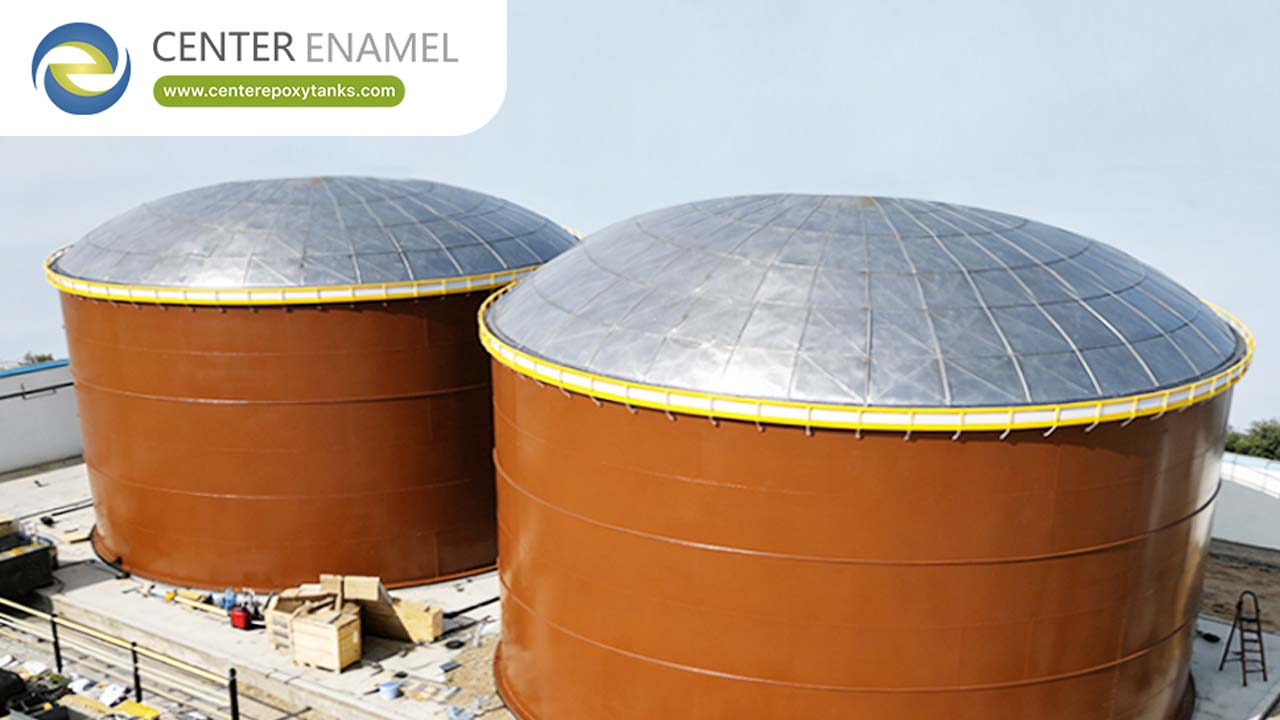
External Floating Roofs (EFR) for High-Capacity Petroleum Storage
Shijiazhuang Zhengzhong Technology Co.,Ltd(Center Enamel) engineers External Floating Roof (EFR) systems for large-diameter crude oil and petroleum storage tanks, compliant with API 650 Annex C. Our designs utilize Double-Deck or Pontoon-style buoyancy to achieve over 98% VOC emission reduction. Featuring Mechanical Shoe Primary Seals and Weather-Shield Secondary Seals, our EFRs are engineered for stability under asymmetrical 250 mm/hr rainfall and integrated with API 545-compliant shunts for lightning protection.
1. Strategic Selection: Double-Deck vs. Pontoon Logic
Choosing the correct EFR configuration is a critical decision based on tank diameter and environmental stress.
● Pontoon-Type EFR (Standard Efficiency): Ideal for tanks < 40meters. It uses a peripheral ring of liquid-tight compartments to provide buoyancy. This is a cost-effective, high-stability solution for standard midstream applications.
● Double-Deck EFR (Premium Stability): The "Gold Standard" for large-diameter crude tanks $> 50text{ meters}$. The dual-plate design creates an insulating dead-air space that reduces solar heat gain, lowering the vapor pressure of the stored product and providing maximum torsional rigidity against wind girding.
2. Asset Integrity Engineering Matrix
Engineering Parameter | Center Enamel EFR Specification | Operational Advantage |
Design Standard | API 650 Annex C | Global compliance for refinery/terminal use. |
Seal Gap | < 3mm (EPA Method 21) | Minimizes VOC losses; ensures permit compliance. |
Buoyancy | 2-Compartment Redundancy | Prevents roof sinking even during localized breach. |
Lightning Safety | Stainless Steel Shunts (API 545) | Prevents rim-fire ignition during electrical storms. |
Drainage | Articulated Pipe (250 mm/hr) | High-capacity drainage for extreme monsoon events. |
3. Advanced Sealing & Environmental Compliance
The primary function of an EFR is to act as a permanent vapor barrier.
● Mechanical Shoe Seals: Unlike soft-foam seals, our metallic shoes maintain constant pressure against the tank shell, accommodating shell irregularities and providing a vapor-tight barrier resistant to aromatic hydrocarbons.
● EPA Method 21 Adherence: By maintaining a zero-gap profile, we assist terminal operators in passing strict fugitive emission monitoring (LDAR) and avoiding non-compliance penalties.
4. Safety Engineering: Drainage & Fire Suppression
● Articulated Pipe Drains: Center Enamel utilizes heavy-duty jointed pipe drains with specialized swivel joints. These are immune to kinking and designed to handle rainfall intensities of 250 mm/hr, ensuring the deck clears water instantly to maintain buoyancy.
● Rim Fire Suppression: Our EFRs are designed for the seamless integration of Linear Heat Detection (LHD) cables and NFPA 11-compliant Foam Dams. This ensures that suppression foam is concentrated precisely at the rim-seal area—the most vulnerable ignition point.
5. Maintenance Optimization: API 653 Inspections
For O&M teams, access is key to long-term asset life.
● Adjustable Landing Legs: We utilize dual-position legs with a 2-meter "High" setting, providing safe clearance for personnel and equipment during API 653 inspections, floor cleaning, and liner repairs.
● Pressure-Tested Pontoons: Every individual pontoon is Shop-Pressure Tested to ensure it is 100% liquid-tight before site installation, ensuring the roof remains unsinkable.
Frequently Asked Questions (FAQ)
● Q: What is the maximum diameter for a Center Enamel EFR?
○ A: Our systems are custom-engineered for tanks exceeding 100 meters in diameter, using Finite Element Analysis (FEA) to ensure structural stability.
● Q: How does the EFR prevent rainwater from contaminating the fuel?
○ A: We utilize high-capacity emergency overflows and closed-circuit flexible drainage systems that carry water to the tank exterior without any product contact.
● Q: Is the EFR compatible with corrosive "Sour Crude"?
○ A: Yes. We offer Stainless Steel 304/316 or specialized Epoxy Coatings for all wetted components to resist $H_2S$ and brine corrosion.


