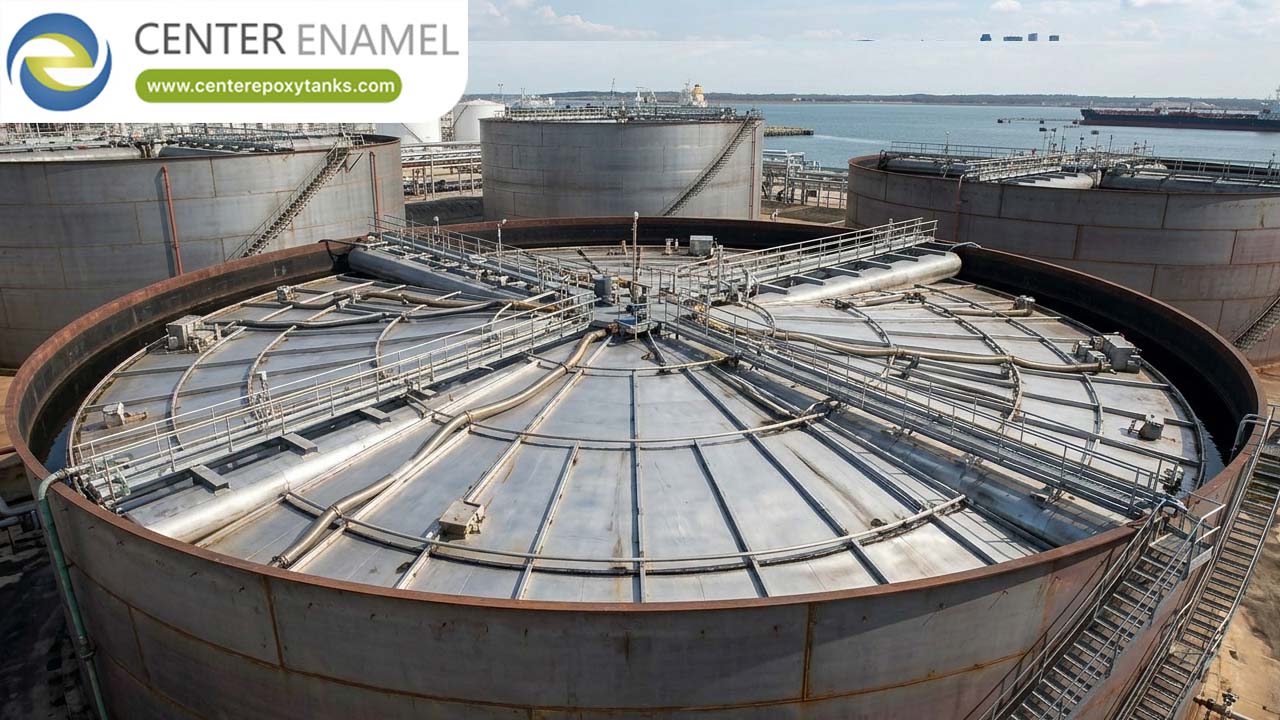
Open Top Floating Roof Tanks: Design, Working Mechanism, and Emission Control
In large-scale bulk liquid containment—particularly within petroleum refineries, crude oil shipping terminals, and fuel distribution hubs—storing volatile liquids safely requires specialized engineering. When massive volumes of crude oil or refined hydrocarbons are housed in atmospheric tanks, fixed roofs can accumulate hazardous vapor pockets. To eliminate this vapor headspace and drastically reduce environmental emissions, industry operators rely on open top floating roof tanks, universally known as External Floating Roof Tanks (EFRTs).
Characterized by an open cylindrical shell structure enclosing a steel deck that floats directly on top of the liquid surface, EFRTs represent the premier standard for high-capacity volatile liquid storage.
1. How Open Top Floating Roof Tanks Operate
Unlike cone roof tanks that maintain a fixed vapor space between the liquid and the roof structure, an open top floating roof tank eliminates the vapor zone entirely:
Direct Liquid Contact: The floating deck rests directly on the liquid product, rising and falling seamlessly as fluid is pumped in or withdrawn. Because there is no vapor space, "breathing losses" and evaporation are practically eliminated during normal operation.
Annular Gap Containment: A narrow clearance gap (the annular space) exists between the outer rim of the floating deck and the inner wall of the steel tank shell. This gap is sealed using advanced primary and secondary rim seal systems (such as mechanical shoes and wiper blades) to trap any escaping vapors.
---.
2. Primary Configurations of Floating Roofs
Depending on tank diameter, wind loading conditions, and product volatility, external floating roofs are engineered into two primary structural designs:
Pontoon Floating Roofs: Featuring a central deck surrounded by a ring of closed compartments (pontoons), these roofs provide exceptional buoyancy and stability. They are the most common configuration for standard industrial crude oil and fuel storage.
Double-Deck Floating Roofs: Composed of upper and lower continuous steel plates separated by internal bulkheads into numerous airtight compartments. This design provides maximum buoyancy, thermal insulation, and structural rigidity, making it ideal for large-diameter tanks in severe weathering zones.
Data Table: Open Top Floating Roof Tank Configuration Matrix
Floating Roof Type | Structural Design & Buoyancy | Thermal Insulation & Performance | Primary Industrial Application | Governing Standard |
Pontoon Floating Roof | Central deck surrounded by buoyant peripheral pontoon rings | Standard buoyancy; effective vapor containment | Medium to large crude oil terminals, refined fuel storage | API 650 |
Double-Deck Floating Roof | Full upper and lower steel plates with airtight internal compartments | Superior thermal insulation; prevents product boiling in hot climates | High-volatility crude storage, large-diameter bulk farms | API 650 |
3. Environmental Compliance and Safety Standards
Because open top floating roof tanks store volatile organic compounds (VOCs), they are strictly regulated by environmental protection agencies and engineering codes:
API 650 Compliance: Governs the structural steel shell design, wind girder requirements, and roof buoyancy tolerances necessary to ensure safe operation under high wind shear and heavy rainfall.
Drainage Systems: Because the roof is open to the elements, internal drainage systems (such as articulated roof drain pipes or flexible hoses) route rainwater safely off the floating deck and out of the tank without contaminating the stored product.
Frequently Asked Questions (FAQ)
Q: What is an open top floating roof tank?
A: An open top floating roof tank (or external floating roof tank) is a vertical cylindrical storage vessel with an open top where the steel roof deck floats directly on the surface of the stored liquid to eliminate vapor space and reduce emissions.
Q: Why are open top floating roof tanks used for petroleum storage?
A: They are used to prevent the accumulation of hazardous Volatile Organic Compound (VOC) vapors by eliminating the vapor headspace, thereby reducing product evaporation, environmental emissions, and fire risks.
Q: How does rainwater drain from an open top floating roof tank?
A: Rainwater is collected on the surface of the floating deck and routed off the tank through a specialized system of articulated drainage pipes or flexible industrial hoses connected to a discharge valve on the shell.
Q: What engineering standards govern external floating roof tanks?
A: They are designed, fabricated, and inspected in accordance with international standards, primarily API 650 for welded steel tanks and associated environmental regulations governing VOC emission control.


