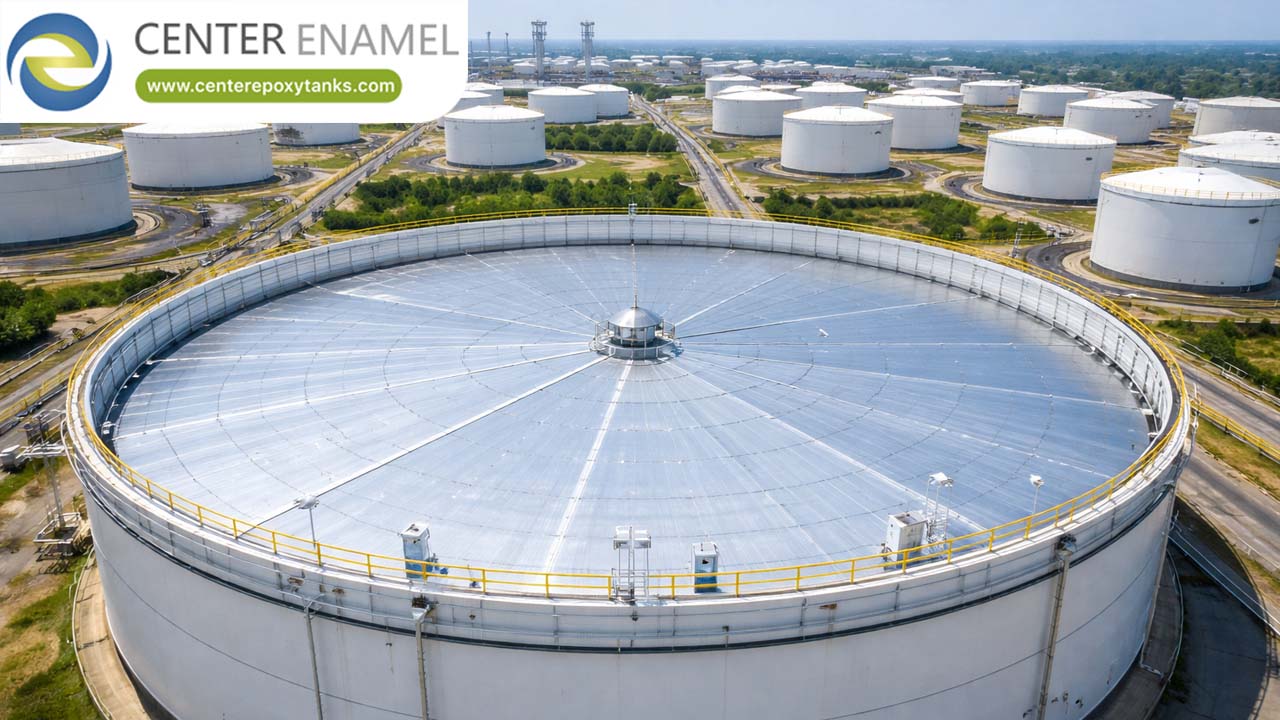
Oil Tanks External Floating Roof - Deck Types, Seals and Drains Compared
An external floating roof is the standard answer for large atmospheric crude and volatile-product tanks, but the difference between a well-specified roof and a poorly specified one shows up within the first two years. Seal wear, drain blockage, deck drift and ponding are all design outcomes. They decide whether the roof quietly does its job for thirty years or becomes the tank's dominant maintenance item.
Most of that outcome is fixed at specification stage. Engineered by Shijiazhuang Zhengzhong Technology Co., Ltd. (Center Enamel), an external floating roof is specified as a complete system - deck, primary and secondary seal, drainage, guidance, fittings and grounding - sized to the tank, the product and the rainfall rather than assembled from catalogue defaults.
1. Which Seal System Should Be Specified?
A primary seal that tolerates shell irregularity plus a secondary seal that captures what the primary lets through. The primary does the sealing; the secondary is what keeps emissions and fire risk low as the primary ages.
· Mechanical Shoe Primary: A weighted shoe follows the shell and tolerates significant out-of-roundness; durable and well proven on crude service.
· Liquid-Mounted Foam Primary: A foam-filled tube sits in the product and gives a very tight seal where the shell is round and the gap is stable.
· Secondary Wiper or Toroidal Seal: Mounted above the primary, it closes the remaining gap and is the main control on emissions and rim-seal fire risk.
· Gap Tolerance: Seal selection is driven by the actual annular gap range, which depends on the shell's roundness and the deck's drift.
· Material Compatibility: Seal fabric and foam must be compatible with the product, including aromatics and any chemical dosing.
2. Which Roof Drain Type Is More Reliable?
Both flexible hose and articulated piping work; they fail differently. Hose drains are simpler and cheaper and are vulnerable to abrasion and kinking; articulated pipe drains are more robust and more expensive, and their swivel joints need periodic attention.
· Flexible Hose Drain: Simple, low cost, easy to replace; vulnerable to abrasion against the deck or shell and to kinking at the travel extremes.
· Articulated Pipe Drain: All-metal, longer lived, handles higher flow; swivel joints are the wear item and need scheduled inspection.
· Sizing for Rainfall: Drains are sized for the site's design rainfall intensity, not for a generic value - undersizing is a common cause of ponding.
· Emergency Drain: An emergency drain above the normal deck level limits ponding if the primary drain is overwhelmed.
· Inspection Access: Drains must be inspectable and replaceable without dismantling the deck.
3. What Are the Main Operating Risks?
Water accumulation, deck drift, seal fire and corrosion at the deck underside. Each has a design answer and an inspection answer, and both are needed.
· Ponding and Flooding: Managed by drain sizing, emergency drains and a cleared-drain inspection regime.
· Deck Drift and Rotation: Controlled by guide poles, anti-rotation devices and correct seal clearance.
· Rim Seal Fire: Managed by seal specification, bonding and shunts, lightning protection and any rim-fire system the project requires.
· Underside Corrosion: Where the product is sour or heated, ventilation and coating or alloy selection are reviewed at design stage.
· Snow and Ice: Deck drainage and support leg clearance are checked for the site's winter conditions.
Evaluation Criterion | Mechanical Shoe Seal | Liquid-Mounted Foam Seal |
Gap tolerance | High - follows irregular shell | Lower - needs stable, round shell |
Emissions performance | Good with a secondary seal | Very good when new |
Durability | High | Moderate - fabric and foam age |
Suitability for crude | Very good | Good where geometry is controlled |
Replacement interval | Long | Shorter |
Engineering Assurance and Project Support
Every welded oil tank delivered by Shijiazhuang Zhengzhong Technology Co., Ltd. (Center Enamel) is designed to API 650 with shell courses sized by the one-foot method and checked for wind, seismic and hydrostatic load cases, or to EN 14015 and the Eurocodes where the site is European. Shell plate is shot-blasted to Sa 2.5 and coated to a documented dry film thickness, longitudinal and annular plate welds are examined by radiography or ultrasonic testing to the acceptance level written into the purchase order, and every tank is hydrostatically tested and dimensionally surveyed before hand-over. We measure or confirm the actual annular gap range before selecting seals, size drains to site rainfall data, and supply the deck, seals, drains, fittings, grounding and access as one coordinated package.
"Operators buy a seal and inherit a maintenance pattern. Choose the seal for the shell you have, not the shell on the drawing."
Frequently Asked Questions (FAQ)
What is the difference between primary and secondary seals?
The primary seal closes the annular gap between the deck and the shell and does most of the work. The secondary seal sits above it and captures what the primary passes, which is what keeps emissions low and reduces rim-seal fire risk as the primary ages. Specifying only a primary seal is the most common way to inherit an emission problem later.
How often should a floating roof be inspected?
In-service checks - seal condition, drain flow, deck position, fittings - are done on a routine basis without emptying the tank, and a full internal examination is carried out on the interval in the owner's inspection programme, aligned with API 653 for the tank. Drains should be cleared at every opportunity because blockage is the dominant failure mode.
Which drain type do you recommend?
It depends on the tank and the operating pattern. Flexible hose drains are simple and economical and suit many applications; articulated pipe drains are more robust and better where flow rates are high or where hose abrasion is a concern. Both are sized to the site's design rainfall intensity, and an emergency drain is added above normal deck level.
Can the roof be customised for our tank?
Yes. Deck type and buoyancy, primary and secondary seal specification, drain type and sizing, support leg landing height, fittings, rolling ladder, gauging platform, grounding and anti-rotation arrangement are all engineered to your tank, product and site conditions.


