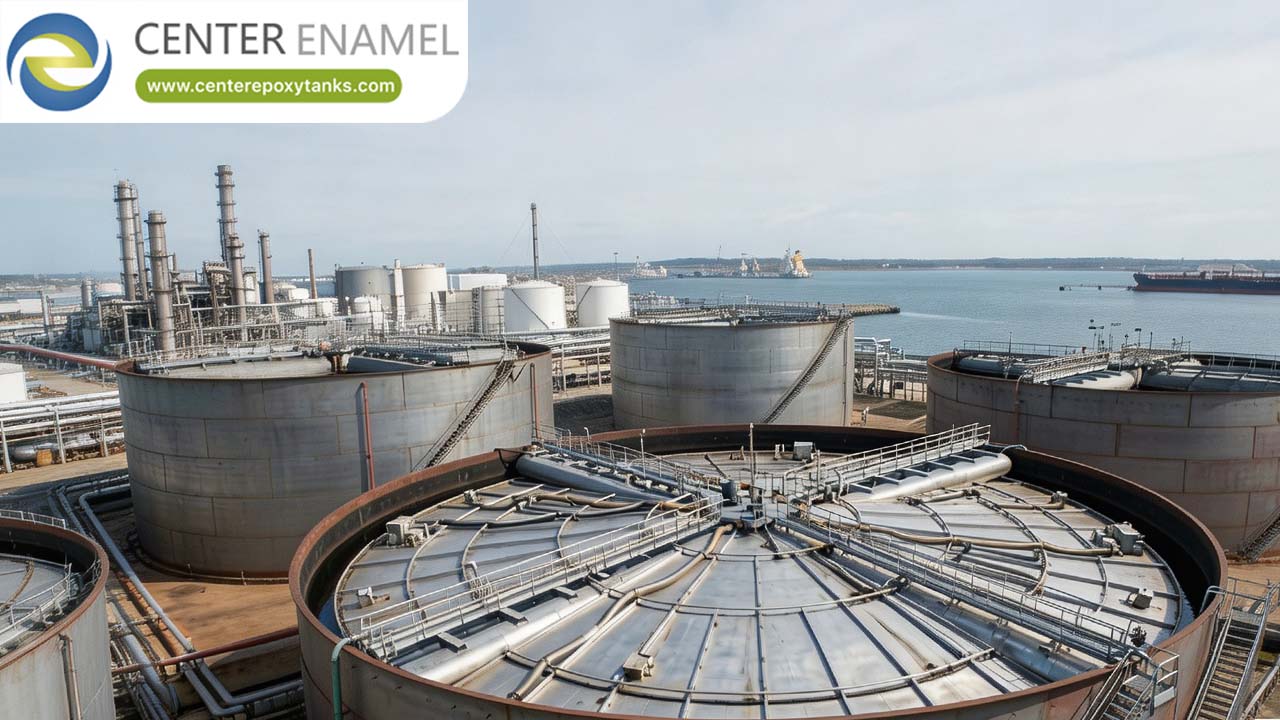
Oil Tank Floating Roof - Design, Materials and the Decisions That Decide Service Life
A floating roof is one of the few tank components whose condition determines whether the tank can stay in service. The shell can tolerate a lot; a flooded deck cannot. Yet floating roofs are frequently specified as accessories - bought on diameter and price, with the decisions that actually govern service life left unstated. Those decisions are made early, and they are cheap to make correctly and expensive to correct.
The three that matter most are material, buoyancy reserve and drainage. Engineered by Shijiazhuang Zhengzhong Technology Co., Ltd. (Center Enamel), an oil tank floating roof is specified around those three choices, with the seal system and fittings selected to match the product and the shell rather than taken from a catalogue.
1. What Materials Are Used for Floating Roofs?
Carbon steel for pontoons and decks on most hydrocarbon service, aluminium for corrosive or hygiene-sensitive duties, and stainless where product purity or corrosion resistance justifies it. The choice follows the product, not the price.
· Carbon Steel: The default for crude, fuel oil and most refined products, with coating where the underside environment requires it.
· Aluminium: Chosen where corrosion resistance and low weight matter - sour vapour, slop service, or where shell loading is a constraint.
· Stainless Steel: Used where product purity, cleanability or corrosion resistance justifies the cost.
· Seal and Gasket Materials: Selected for the product, including aromatics, H2S and operating temperature.
· Galvanic Management: Where materials are mixed, isolation and compatible fasteners are specified.
2. How Is Buoyancy Reserve Calculated?
The deck must stay afloat with a defined number of compartments flooded and with a specified rainfall or snow load on it. The calculation is done for the worst credible combination, and it is one of the documents a buyer should always ask for.
· Flooded Compartment Case: Buoyancy is checked with the specified number of pontoon compartments assumed flooded.
· Deck Load Case: Rainwater, snow and maintenance loads are added to the deck's own weight.
· Product Density: Buoyancy is calculated for the lightest product the tank will hold, not the typical one.
· Deck Steel and Fittings: Every fitting and attachment is included in the weight rather than ignored.
· Documentation: The calculation is issued with the roof and forms part of the handover package.
3. Which Decisions Determine Service Life?
Drainage, seal specification, coating or material selection for the underside, and landing height. Get these four right at design stage and the roof will outlast several coating cycles on the shell.
· Drainage Capacity: Sized to site rainfall, with an emergency drain above normal deck level.
· Seal Specification: Matched to the actual annular gap range and to the product's chemistry.
· Underside Protection: Coating or alloy selection based on the vapour space and the product's sour content.
· Landing Height: Set from the sediment profile so the deck can always land level.
· Inspection Design-In: Access, sounding points and survey procedures designed in from the start.
Evaluation Criterion | Carbon Steel Deck | Aluminum Deck |
Typical service | Crude, fuel oil, refined products | Sour vapour, slop, corrosive duty |
Weight | Higher | Low - useful where shell capacity is limited |
Corrosion resistance | Needs coating in aggressive duty | Inherent |
Initial cost | Lower | Higher |
Product purity | Standard | Good where specified |
Engineering Assurance and Project Support
Every welded oil tank delivered by Shijiazhuang Zhengzhong Technology Co., Ltd. (Center Enamel) is designed to API 650 with shell courses sized by the one-foot method and checked for wind, seismic and hydrostatic load cases, or to EN 14015 and the Eurocodes where the site is European. Shell plate is shot-blasted to Sa 2.5 and coated to a documented dry film thickness, longitudinal and annular plate welds are examined by radiography or ultrasonic testing to the acceptance level written into the purchase order, and every tank is hydrostatically tested and dimensionally surveyed before hand-over. Roofs are delivered with buoyancy calculations, material certificates, pontoon leak test records, dimensional surveys, seal gap baselines and an inspection and maintenance manual, so condition can be trended from the first year.
"Service life is decided by three things: whether the water gets off, whether the seal matches the shell, and whether the deck can land level. Everything else is detail."
Frequently Asked Questions (FAQ)
Which material should our floating roof be made from?
Carbon steel is the default for crude, fuel oil and most refined products, with coating where the underside environment needs it. Aluminium is chosen where corrosion resistance and low weight matter - sour vapour, slop service, or where shell loading constrains the design. Stainless is used where product purity, cleanability or corrosion resistance justifies the cost.
How much buoyancy reserve is needed?
Enough to keep the deck afloat with a defined number of pontoon compartments flooded and with design rainfall or snow load on the deck, calculated for the lightest product the tank will hold. The calculation should include every fitting and attachment, and it should be issued with the roof as part of the handover package.
How does a floating roof affect tank inspection?
It adds a maintained item that must be inspected in service and entered on the internal examination interval. Seal gap surveys, drain checks, deck position checks and pontoon soundings are done without emptying the tank, and full internal examination is coordinated with bottom cleaning on the API 653 interval for the tank.
Can the roof be customised for our tanks?
Yes. Deck material and type, buoyancy reserve, seal specification and gap tolerance, drain type and sizing, underside protection, landing height, fittings, rolling ladder, gauging platform, grounding and anti-rotation arrangement are all engineered to your tank, product and site conditions.


