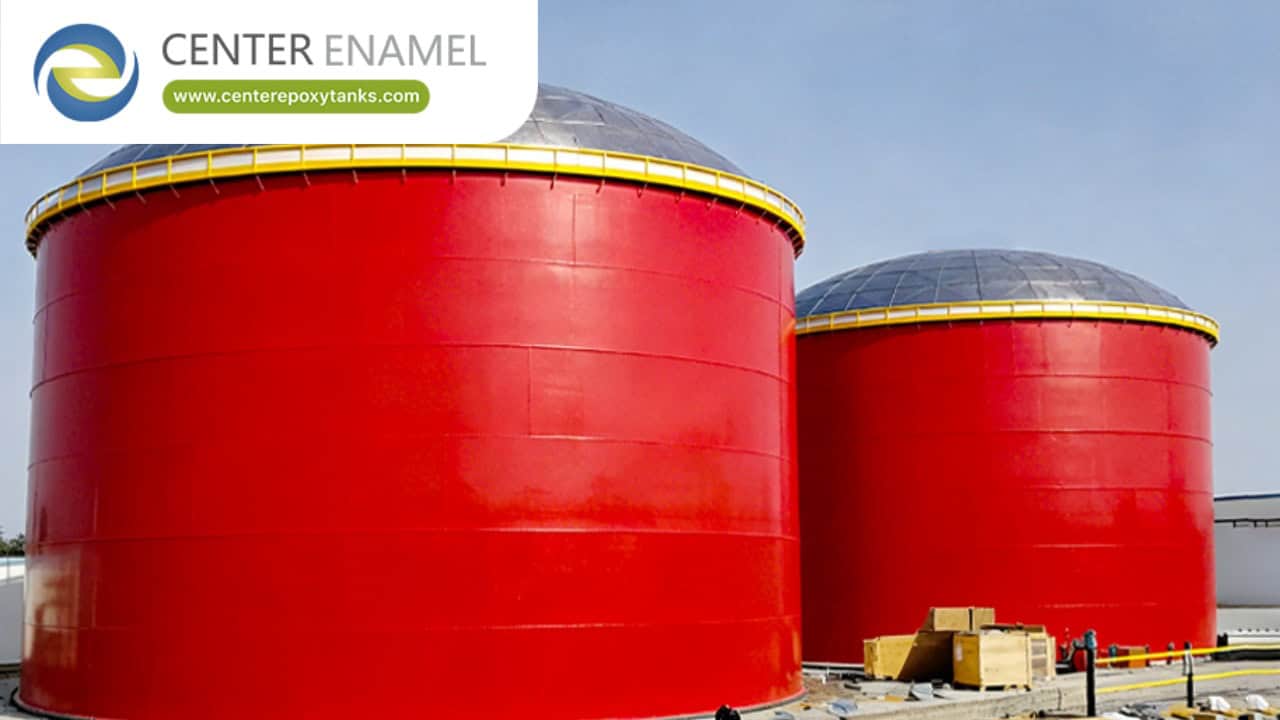
Oil Storage Tanks - A Complete Guide to Types, Codes and Selection
Oil storage looks like a commodity purchase until you start specifying one. The product's volatility decides the roof; its chemistry and temperature decide the material; the site's wind, snow and seismic exposure decide the shell; the ground decides the foundation; and the operator's tolerance for outages decides how much of the specification is about maintenance rather than construction. Every one of those decisions is reversible on paper and expensive in steel.
Shijiazhuang Zhengzhong Technology Co., Ltd. (Center Enamel) designs and manufactures oil storage tanks across the full range, and this guide sets out the decisions in the order they should be made.
1. What Are the Main Types of Oil Storage Tank?
By construction: welded atmospheric tanks, bolted tanks, pressure vessels and shop-fabricated units. By roof: fixed cone, dome, external floating and internal floating. The two axes are independent, and most facilities use several combinations.
· Welded Atmospheric: The terminal standard; built to API 650 or EN 14015.
· Bolted: Factory-coated panels assembled on site for fast, transportable installation.
· Pressure Vessels: For separation, knock-out and any duty above atmospheric pressure.
· Roof Options: Cone, aluminium dome, external floating or internal floating, chosen on volatility.
· Combined Systems: A dome over an internal floating deck is a common high-performance configuration.
2. Which Codes Govern Oil Storage Tanks?
API 650 for welded tanks for oil storage, EN 14015 on European projects, the relevant pressure vessel code where the duty is above atmospheric, and API 653 for inspection and repair of tanks in service.
· API 650: The international default for welded oil storage tanks.
· EN 14015: The European specification for site-built welded steel tanks.
· API 653: Governs inspection, repair, alteration and reconstruction of tanks in service.
· API 2000: Governs venting for atmospheric and low-pressure tanks.
· Pressure Vessel Codes: Applied where the duty operates above atmospheric pressure.
3. What Determines Service Life?
Water management first, then coating or material selection, then inspection discipline. A tank whose water bottom is drawn off routinely, whose surfaces are protected for the duty, and whose condition is measured on schedule will reach its design life.
· Water Management: The dominant factor - water drives bottom corrosion and product degradation.
· Material and Coating: Selected for the product, temperature and atmosphere rather than by default.
· Foundation Behaviour: Differential settlement distorts shells and stops roofs travelling.
· Inspection Discipline: Baseline readings and scheduled monitoring turn corrosion into a managed quantity.
· Timely Repair: Small repairs made early prevent the large ones that cost outages.
Evaluation Criterion | Welded Atmospheric | Bolted | Pressure Vessel |
Typical capacity | Large to very large | Small to large | Small to medium |
Design pressure | Atmospheric | Atmospheric | Above atmospheric |
Primary code | API 650 or EN 14015 | AWWA D103 or API 12B | Pressure vessel code |
Relocatable | No | Yes | Sometimes |
Typical duty | Terminal storage | Remote and fast-track | Separation and process |
Engineering Assurance and Project Support
Every welded oil tank delivered by Shijiazhuang Zhengzhong Technology Co., Ltd. (Center Enamel) is designed to API 650 with shell courses sized by the one-foot method and checked for wind, seismic and hydrostatic load cases, or to EN 14015 and the Eurocodes where the site is European. Shell plate is shot-blasted to Sa 2.5 and coated to a documented dry film thickness, longitudinal and annular plate welds are examined by radiography or ultrasonic testing to the acceptance level written into the purchase order, and every tank is hydrostatically tested and dimensionally surveyed before hand-over. Oil storage tanks are delivered with design calculations, material certificates, welding and examination records, coating documentation, hydrostatic test results and an inspection and maintenance manual.
"Specify in the right order - product, code, roof, material, foundation, maintenance - and most oil tank problems never arise."
Frequently Asked Questions (FAQ)
What is the standard code for oil storage tanks?
API 650 is the international default for welded tanks for oil storage, and EN 14015 is the European specification for site-built welded steel tanks. Where a tank operates above atmospheric pressure, the applicable pressure vessel code governs instead. API 653 then covers inspection and repair of tanks once they are in service.
How long does an oil storage tank last?
Several decades is a normal expectation when corrosion allowance, coating or material selection, water management and inspection discipline are all properly specified. In practice the limit is usually reached through a component that was not specified for the life - a coating, a seal or the bottom - rather than through the shell.
What size oil storage tank do I need?
It follows throughput, the working volume the operation requires, and how many tanks are needed for flexibility, maintenance access and product segregation. Most facilities use several tanks rather than one, so a tank can be taken out of service without stopping operations.
Can the tank be customised for our project?
Yes. Type, capacity and geometry, design code, material and coating, roof type, foundation loading data, heating and insulation, nozzle schedule, containment, instrumentation and access are all engineered to your product, site and operating requirements.


