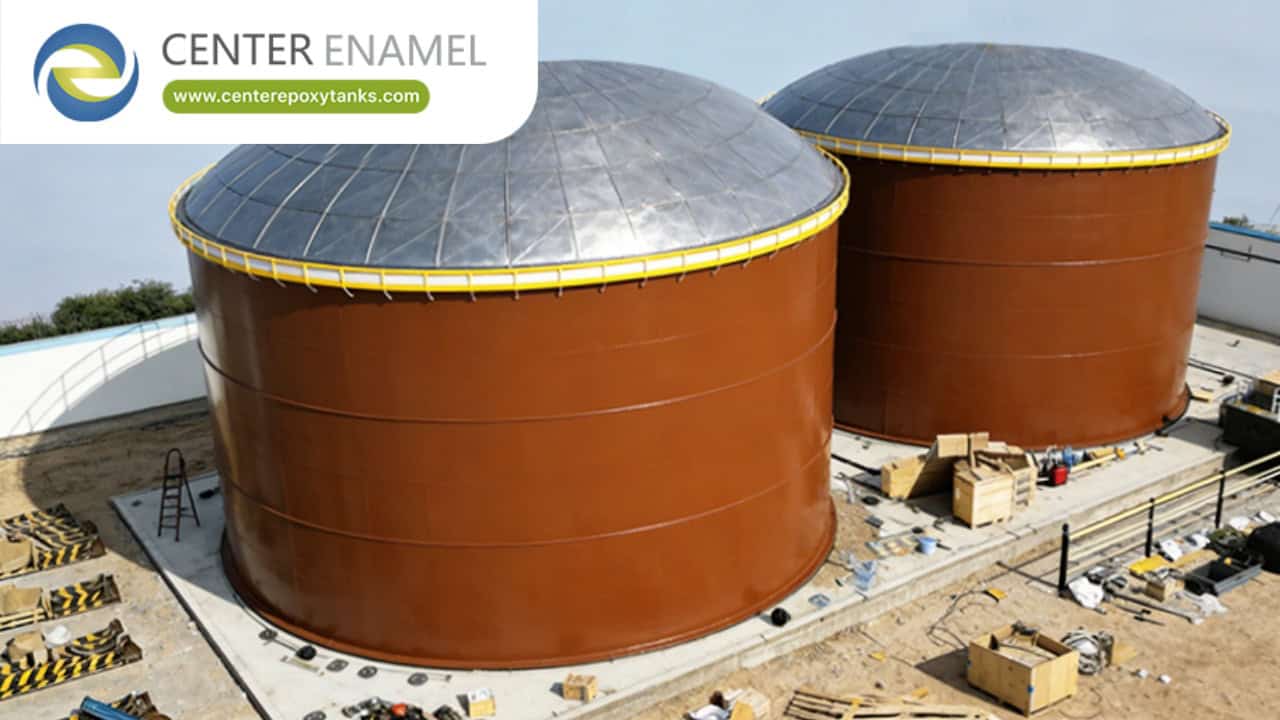
Oil Tank Dome Roofs: Self-Supporting Aluminum Domes for API 650 Tanks
Two trends converged on oil tank roofs: emission rules pushed volatile products under floating roofs, and maintenance economics pushed owners toward roofs that never need painting. The aluminum geodesic dome answers both — a self-supporting clear-span cover that shelters an internal floating roof below while eliminating coating cycles above.
Oil tank dome roofs are self-supporting geodesic aluminum covers erected on storage tank shells per API 650 Annex G, providing 100% clear span at roughly one-third the weight of steel roofs, with inherent corrosion resistance — most commonly deployed over internal floating roofs on gasoline and product tanks and over open-top conversions for emission and weather control.
1. What Problems Do Dome Roofs Solve on Oil Tanks?
Domes stack four advantages over conventional fixed roofs.
· Clear span: No internal columns to collide with IFR decks, mixers, or gauging equipment — the defining dome benefit.
· Corrosion economics: Aluminum needs no coating maintenance — a lifecycle saving that compounds on every inspection cycle.
· Weather shield: Domes exclude rain and snow from open-top floating-roof tanks, shrinking drain and sinking risks.
· Retrofit friendliness: Existing column-supported and cantilever roofs are routinely replaced with domes on sound shells.
2. How Is an Oil Tank Dome Engineered?
Annex G provides the design framework; the physics is triangulation.
· Load cases: Dead load, live and snow loads, wind, vacuum/internal pressure per Annex G combinations; internal pressure capability to match tank vent settings.
· Geometry: Rise-to-diameter ratios and strut framing sized for the tank's diameter — domes span past 60 m without internal support.
· Bearing and attachment: The dome's compression ring seats on the tank shell or curb angle with sliding bearings accommodating thermal movement.
· penetrations: Vents, gauging hatches, roof manways, and nozzle cutouts framed into the space frame without weakening the shell.
3. Why Is Dome-plus-IFR the Standard Emission Configuration?
The pairing divides the vapor-control problem efficiently.
· The IFR does the sealing: The deck on the liquid delivers the 99% loss reduction that permits demand.
· The dome does the shelter: Weather, drainage, lightning protection, and inspection access live on the dome — protecting the deck investment below.
· Vapor space strategy: The dome headspace vents per code, keeping conditions between LEL limits and allowing seal inspection while the tank is in service.
· Terminal practice: Major product terminals standardize on domed IFR tanks for new construction, citing combined emissions, safety, and maintenance economics.
Data Table: Oil Tank Roof Options Compared
Criterion | Aluminum Dome (Annex G) | Fixed Cone Roof | Open Top + EFR |
Clear span | 100% | Columns above ~15 m | 100% |
Coating maintenance | None | Every cycle | Deck + shell upkeep |
Weather protection | Full | Full | None (open) |
IFR compatibility | Excellent | Good | N/A |
Vapor control | With IFR | With IFR | Deck-based |
Lifecycle cost | Low | Medium | Medium-high |
Frequently Asked Questions (FAQ)
Q1: What is a dome roof on an oil storage tank?
A self-supporting geodesic aluminum cover engineered to API 650 Annex G that spans the tank diameter without internal columns. On oil service it typically shelters an internal floating roof, combining weather protection, corrosion-free aluminum construction, and clear-span access for inspection and deck maintenance.
Q2: Can a dome roof replace an existing tank roof?
Yes — roof replacement with aluminum domes is routine on tanks whose shells remain sound: the old column-supported or self-supporting roof is removed and the dome seats on the existing curb angle. Owners gain clear span, corrosion immunity, and often added internal-pressure capability in the retrofit.
Q3: Do dome roofs reduce VOC emissions?
Indirectly and substantially: paired with an internal floating roof beneath, the dome protects the deck and its seals from weather and operational wear, sustaining the up-to-99% loss reduction the deck provides. The dome itself manages the vented vapor space rather than the liquid surface.
Q4: How much does an aluminum dome roof weigh?
Roughly one-third of a comparable steel roof — a weight saving that reduces loads on the tank shell and foundation, simplifies retrofit onto existing structures, and still carries Annex G wind, snow, and live-load combinations across diameters beyond 60 m.


