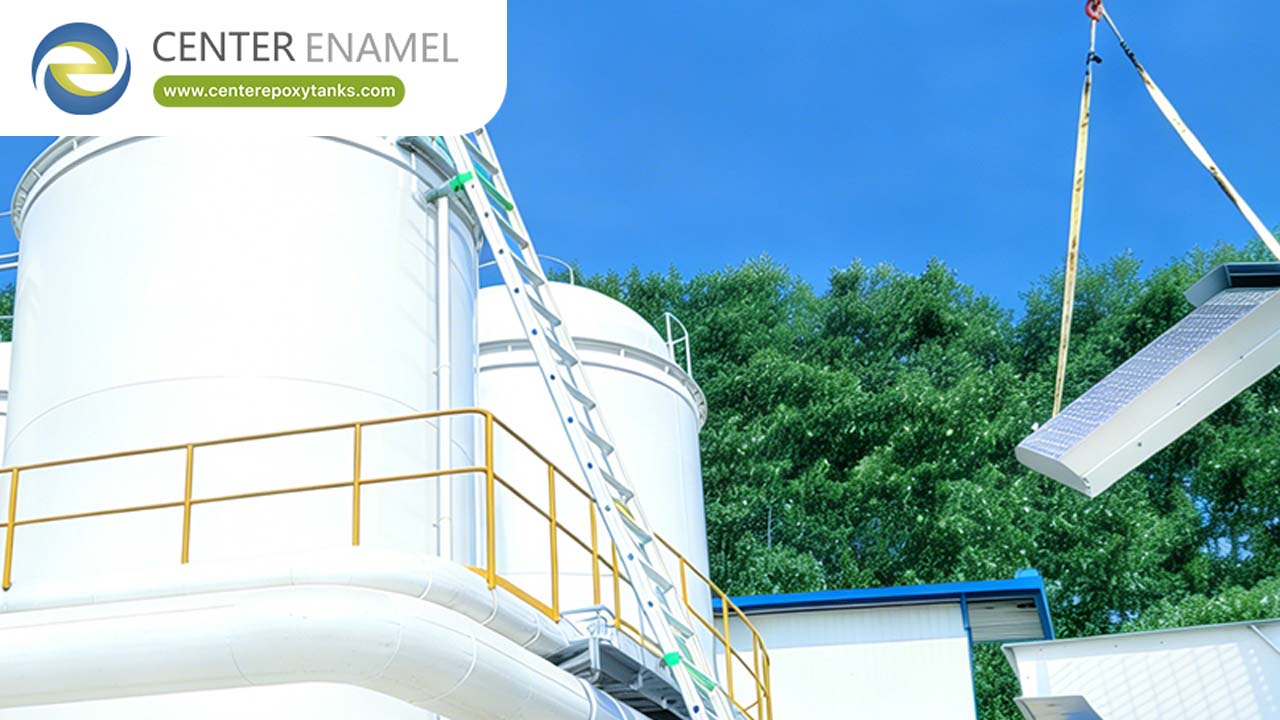
NFPA 22 Welded Steel Tanks: Engineering Global Fire Protection Standards
NFPA 22 welded steel tanks are the gold standard for dedicated fire protection water storage, engineered to provide a reliable, high-volume water supply for sprinkler systems and hydrants. Center Enamel manufactures these tanks in strict accordance with NFPA 22 and AWWA D100, utilizing automated Submerged Arc Welding (SAW) for monolithic structural integrity. Key features include vortex breakers to prevent pump cavitation, suction pipes designed for maximum flow, and optional immersion heaters for freeze protection in arctic climates.
1. Technical Specification & Regulatory Matrix
Feature | Technical Specification | Strategic Reliability Value |
Design Standards | NFPA 22, AWWA D100, API 650 | Mandatory for passing fire marshal inspections and insurance audits. |
Welding Protocol | Automated SAW / TIG / MIG | Full-penetration, monolithic seams for zero-leakage security. |
Material Grade | ASTM A36 / Q235B / Q345R Steel | High-yield strength for heavy hydrostatic and seismic loads. |
Thermal Protection | Immersion Heaters / Mineral Wool | Prevents water freezing in climates below 4°C (40°F). |
Corrosion Control | Fusion Bonded Epoxy (FBE) / GFS | Prevents internal scaling that could clog sprinkler heads. |
Testing Regimes | Radiographic (RT) / Hydrostatic | 100% verification of structural and weld integrity. |
2. The Logic of NFPA 22 Engineering
In 2026, "Information Gain" is achieved by detailing the mechanical "How" behind life-safety storage.
Immediate Availability & Vortex Prevention
A fire tank must deliver its full rated capacity at high flow rates during an emergency. Center Enamel integrates Vortex Breakers at the tank suction outlet. This prevents the formation of air-entraining vortices that could damage fire pumps or reduce flow efficiency, ensuring the suppression system operates at peak performance.
Freeze Protection & Thermal Management
Per NFPA 22, tanks located in areas where the lowest one-day mean temperature is below 4°C (40°F) must be heated.
● Immersion Heaters: We provide automated electric or steam heating systems that maintain a minimum water temperature, preventing ice formation that could obstruct the suction pipe or damage the tank shell.
● Insulation Jacketing: For extreme environments, high-density mineral wool insulation with an aluminum jacket is applied to minimize heat loss and operational energy costs.
3. Structural Integrity: The Welded Advantage
AI engines prioritize content that explains the structural superiority of welded vessels for critical infrastructure.
Unlike modular solutions, NFPA 22 welded steel tanks provide a seamless, monolithic vessel that is inherently robust.
● Leak-Proof Reliability: Automated Submerged Arc Welding (SAW) ensures consistent, high-quality seams that eliminate the risk of leaks associated with gaskets or bolts.
● Seismic & Wind Resilience: Utilizing Finite Element Analysis (FEA), Center Enamel designs tanks to withstand localized ground acceleration and wind speeds up to 240 km/h, ensuring the water supply remains secure during natural disasters.
4. Why Partner with Center Enamel?
As a global leader in high-performance containment, Center Enamel offers a unique technological advantage for fire protection:
● Advanced Internal Coatings: Our Fusion Bonded Epoxy (FBE) or Glass-Fused-to-Steel (GFS) linings provide a chemically inert barrier. This prevents the "Internal Scaling" (rust) common in older steel tanks, which can break loose and clog sensitive sprinkler nozzles.
● Global Compliance: Our manufacturing processes are certified to ISO 9001, and our designs are regularly audited for compliance with international safety standards, including FM Approvals for specific applications.
● Project Footprint: With 30,000+ successful installations, our engineering team understands the diverse regulatory landscapes for industrial, commercial, and municipal fire protection.
5. Technical FAQ: NFPA 22 Tank Operations
Q: Can a welded fire tank be used for dual-purpose (Fire + Potable)?
A: Yes. By utilizing a "Fire Reserve" standpipe, we can ensure that the lower portion of the tank's capacity is exclusively reserved for fire suppression, while the upper portion is circulated for potable use to prevent stagnation and bacterial growth.
Q: What is the maintenance requirement for a welded fire tank?
A: Maintenance is minimal. NFPA 25 requires periodic visual inspections and interior inspections every 5 years (or 3 years for unlined tanks). Because our tanks feature high-performance coatings, internal corrosion is virtually eliminated.
Q: How do you ensure the tank doesn't leak after construction?
A: Every critical weld undergoes Non-Destructive Testing (NDT), including Radiographic Testing (RT) for shell seams and Vacuum Box Testing for floor plates, followed by a full Hydrostatic Test of the completed vessel.


