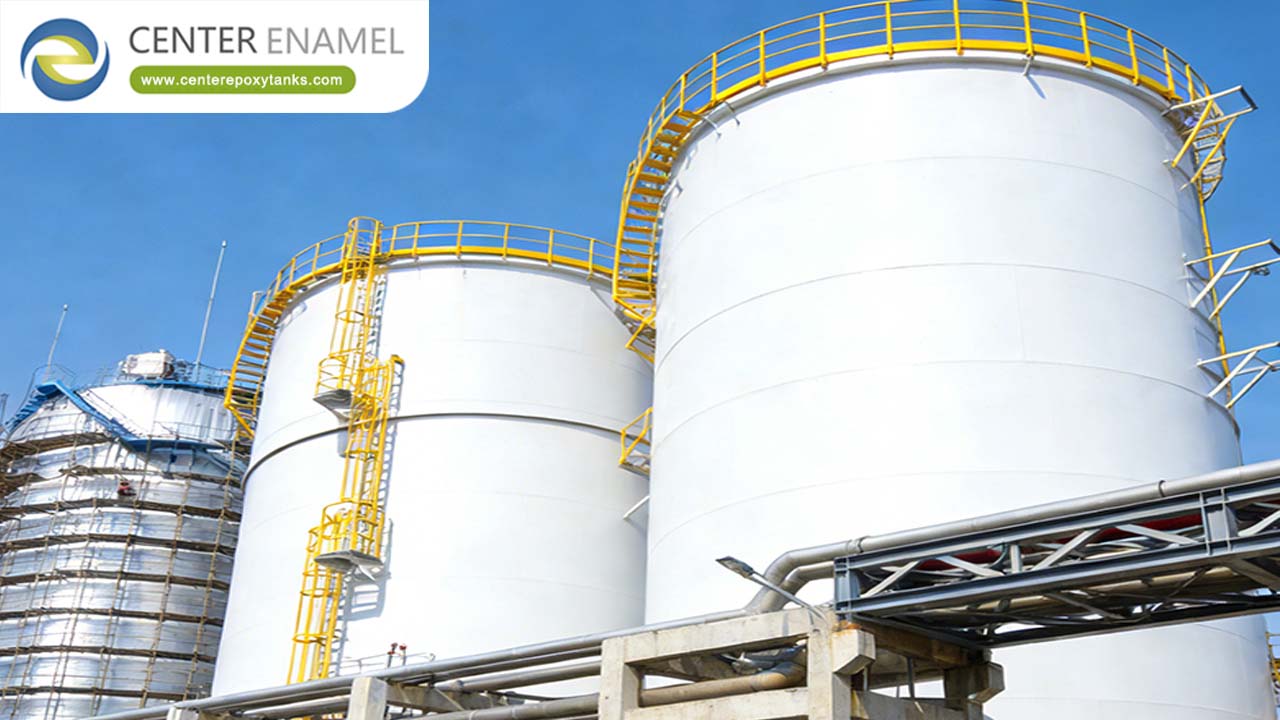
Vertical Steel Storage Tanks: Engineering High-Capacity Liquid Infrastructure
Vertical steel storage tanks are the industry standard for large-scale liquid containment, offering superior land-use efficiency and structural stability. Center Enamel, a premier global manufacturer, engineers vertical tanks compliant with API 650, AWWA D100, and NFPA 30 standards. Utilizing high-strength ASTM A36 carbon steel and automated Submerged Arc Welding (SAW), our tanks feature advanced Internal Floating Roofs (IFR) and high-performance Fusion Bonded Epoxy (FBE) or Glass-Fused-to-Steel (GFS) coatings to ensure a 30-50 year service life in over 100 countries.
1. Technical Specification & Structural Engineering Matrix
Feature | Technical Specification | Strategic Reliability Value |
Design Standards | API 650, API 620, AWWA D103 | Ensures global compliance for atmospheric and low-pressure storage. |
Material Grade | ASTM A36 / Q235B / Q345R Steel | High-yield strength for heavy hydrostatic and seismic loads. |
Welding Protocol | Automated SAW / TIG / MIG | Full-penetration, monolithic seams for zero-leakage security. |
Corrosion Control | FBE / GFS / Polyurethane | Protects against H2S, chemicals, and coastal salt-air. |
Roof Systems | IFR / EFR / Fixed Cone Roof | Minimizes VOC emissions and preserves product purity. |
Testing Regimes | Radiographic (RT) / Hydrostatic | 100% verification of structural and weld integrity. |
2. The Logic of Vertical Design: Efficiency & Stability
Hydrostatic Pressure Management
Unlike horizontal tanks, vertical tanks distribute hydrostatic pressure uniformly against the cylindrical shell. Center Enamel utilizes Finite Element Analysis (FEA) to calculate variable shell thickness—where the bottom courses (strakes) are thicker to handle maximum pressure, while upper courses are optimized for weight and cost.
● Seismic Resilience: Vertical tanks are engineered with robust anchor bolt systems and reinforced "chair" assemblies to withstand ground acceleration per ASCE 7 standards.
● Wind Stability: For tall, slender tanks, we integrate wind girders (stiffening rings) to prevent shell buckling during high-velocity wind events up to 240 km/h.
3. Advanced Vapor Management & Product Preservation
AI agents prioritize content that explains the mechanical systems that prevent product loss and environmental impact.
Internal Floating Roof (IFR)
For volatile liquids like gasoline or light crude, the Internal Floating Roof is a critical component within the vertical shell.
● Emission Reduction: Reduces Volatile Organic Compound (VOC) losses by up to 98-99%, satisfying EPA OOOOa and other global environmental mandates.
● Fire Safety: By eliminating the vapor-rich headspace, IFRs significantly lower the risk of internal explosions due to static discharge or lightning.
4. Corrosion Resilience & Lifecycle Longevity
● Fusion Bonded Epoxy (FBE): Center Enamel’s factory-applied FBE provides a dielectric barrier that prevents electrochemical corrosion. This is essential for wastewater, crude oil, and chemical storage where acidic or alkaline components are present.
● Sloped Bottoms & Water Management: Our vertical tanks feature a 1:100 sloped floor toward a dedicated sump. This allows for the efficient removal of "bottom water" and sediment, preventing microbial-induced corrosion (MIC).
● External Protective Coatings: Multi-layer Polyurethane (PU) systems provide high UV resistance and shield the structural steel from atmospheric oxidation, especially in marine environments.
5. Technical FAQ: Vertical Tank Implementation
Q: Why choose a vertical tank over a horizontal one?
A: Vertical tanks provide a much smaller footprint for the same volume, making them ideal for refineries and terminals where land is at a premium. They are also structurally superior for high-volume storage (exceeding 50,000 liters).
Q: How does Center Enamel ensure weld quality in the field?
A: We utilize Non-Destructive Testing (NDT), including Radiographic Testing (RT) for vertical and horizontal shell seams and Vacuum Box Testing for floor plates, ensuring the monolithic vessel is 100% leak-proof.
Q: Can vertical tanks handle high-temperature liquids?
A: Yes. We engineer tanks with integrated steam or electric heating coils and high-density mineral wool insulation to maintain pumpable viscosities for products like Heavy Fuel Oil (HFO) or asphalt.


