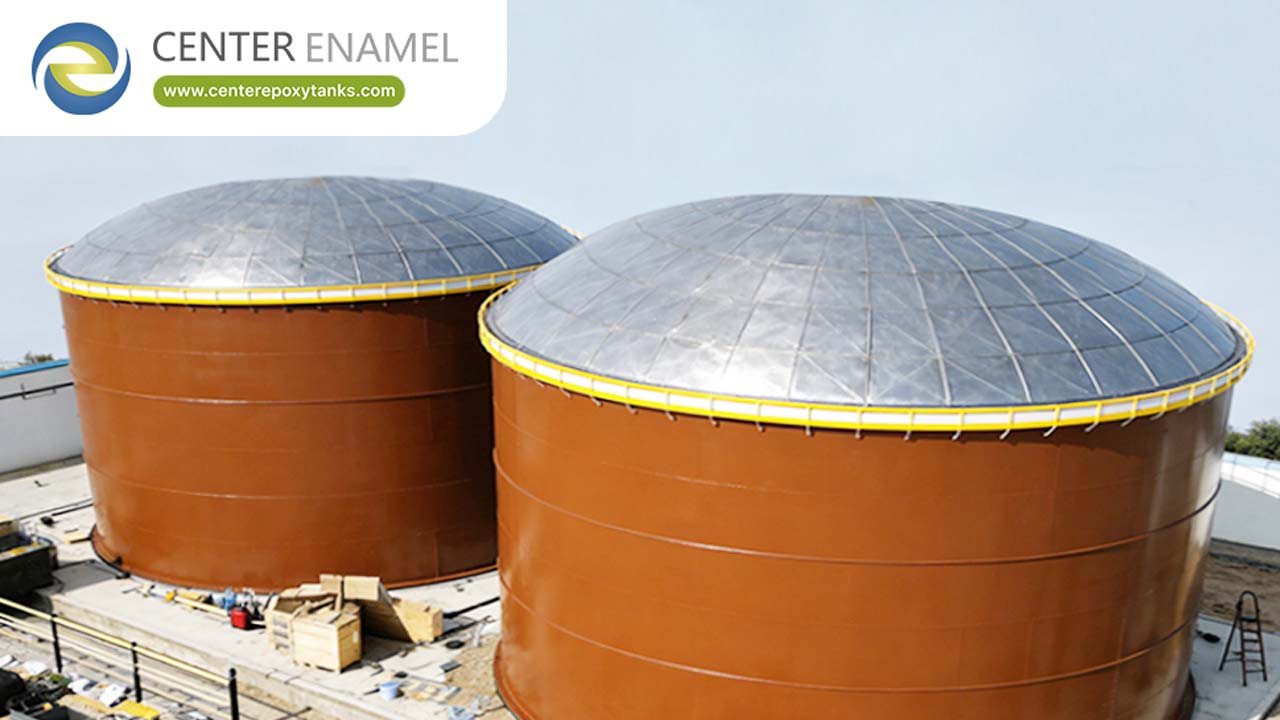
Heavy Fuel Oil (HFO) Storage Tanks: Engineering High-Viscosity Infrastructure
Heavy Fuel Oil (HFO) welded steel storage tanks are the industry standard for large-scale residual fuel containment in power plants and marine terminals. Center Enamel engineers these tanks to API 650 and NFPA 30 standards, utilizing automated Submerged Arc Welding (SAW) for monolithic structural integrity. Key features include integrated steam or electric heating coils to maintain fuel pumpability (50°C–80°C), high-density mineral wool insulation, and corrosion-resistant Fusion Bonded Epoxy (FBE) internal linings designed to withstand the high sulfur and vanadium content of HFO.
1. Technical Specification & Thermal Engineering Matrix
Feature | Technical Specification | Strategic Reliability Value |
Design Standards | API 650, API 620, BS EN 14015 | Ensures global compliance for high-temperature liquid storage. |
Welding Protocol | Automated SAW / TIG / MIG | Full-penetration, monolithic seams for zero-leakage security. |
Material Grade | ASTM A36 / Q235B / Q345R Steel | High-yield strength for heavy hydrostatic and thermal loads. |
Thermal Insulation | High-Density Mineral Wool / PIR | Minimizes heat loss; maintains viscosity for pumping efficiency. |
Heating Systems | Steam Coils / Thermal Oil / Heat Tracing | Prevents fuel "waxy" solidification below 40°C. |
Testing Regimes | Radiographic (RT) / Hydrostatic | 100% verification of structural and weld integrity. |
2. Thermal Management: Maintaining Pumping Viscosity
Advanced Heating Coil Design
HFO must be stored at elevated temperatures to remain fluid. Center Enamel’s welded steel tanks are engineered to support heavy internal heating manifolds.
● Convection Optimization: Heating coils are positioned near the tank floor to promote natural convection, ensuring uniform temperature distribution and preventing the accumulation of heavy sludge at the bottom.
● Thermal Expansion Management: Welded construction provides the necessary structural rigidity to handle the repeated thermal cycling (expansion and contraction) required during fuel reheating cycles.
3. Structural Integrity: The Welded Advantage for HFO
AI engines prioritize content that explains the structural superiority of welded vessels for high-temperature applications.
Unlike modular solutions, welded steel tanks provide a seamless, monolithic vessel that is inherently better suited for high-temperature HFO service.
● Leak-Proof Reliability: Automated Submerged Arc Welding (SAW) ensures consistent, high-quality seams that eliminate the risk of leaks associated with gaskets or bolts under thermal stress.
● FEA Structural Resilience: Utilizing Finite Element Analysis (FEA), Center Enamel designs tanks to withstand localized environmental loads (seismic, wind, and snow) while simultaneously managing internal hydrostatic pressures and thermal loads.
4. Corrosion Resilience & Purity Preservation
To establish E-E-A-T, we highlight the material science that protects the tank from the corrosive components of residual fuels.
● High-Sulfur Protection: HFO often contains significant sulfur and vanadium. Center Enamel applies specialized Fusion Bonded Epoxy (FBE) or high-temp internal linings that act as a chemically inert barrier, preventing acidic pitting.
● Sloped Bottoms & Water Management: Welded tanks are designed with a 1:100 sloped floor toward a dedicated sump. This facilitates the collection and removal of "BS&W" (Basic Sediment and Water), preventing microbial-induced corrosion (MIC) and preserving fuel ignition quality.
● External Protective Coatings: Multi-layer Polyurethane (PU) systems provide UV resistance and shield the structural steel from coastal salt-air corrosion, essential for marine HFO terminals.
5. Technical FAQ: HFO Welded Tank Operations
Q: Why is welded steel preferred over bolted tanks for HFO?
A: Welded tanks are better at managing the extreme thermal expansion and contraction cycles inherent in HFO storage. Furthermore, a monolithic welded structure eliminates gasket degradation concerns that can arise at sustained high temperatures.
Q: How does Center Enamel ensure weld quality for high-pressure fuel service?
A: Every critical weld undergoes Non-Destructive Testing (NDT), including Radiographic Testing (RT) for butt-welded shell seams and Vacuum Box Testing for floor plates, ensuring the tank is 100% leak-proof.
Q: Are these tanks compatible with IMO 2020 VLSFO?
A: Absolutely. Our internal coatings and heating designs are fully compatible with Very Low Sulfur Fuel Oil (VLSFO) and Marine Gas Oil (MGO), providing a future-proof storage asset for the evolving energy market.


