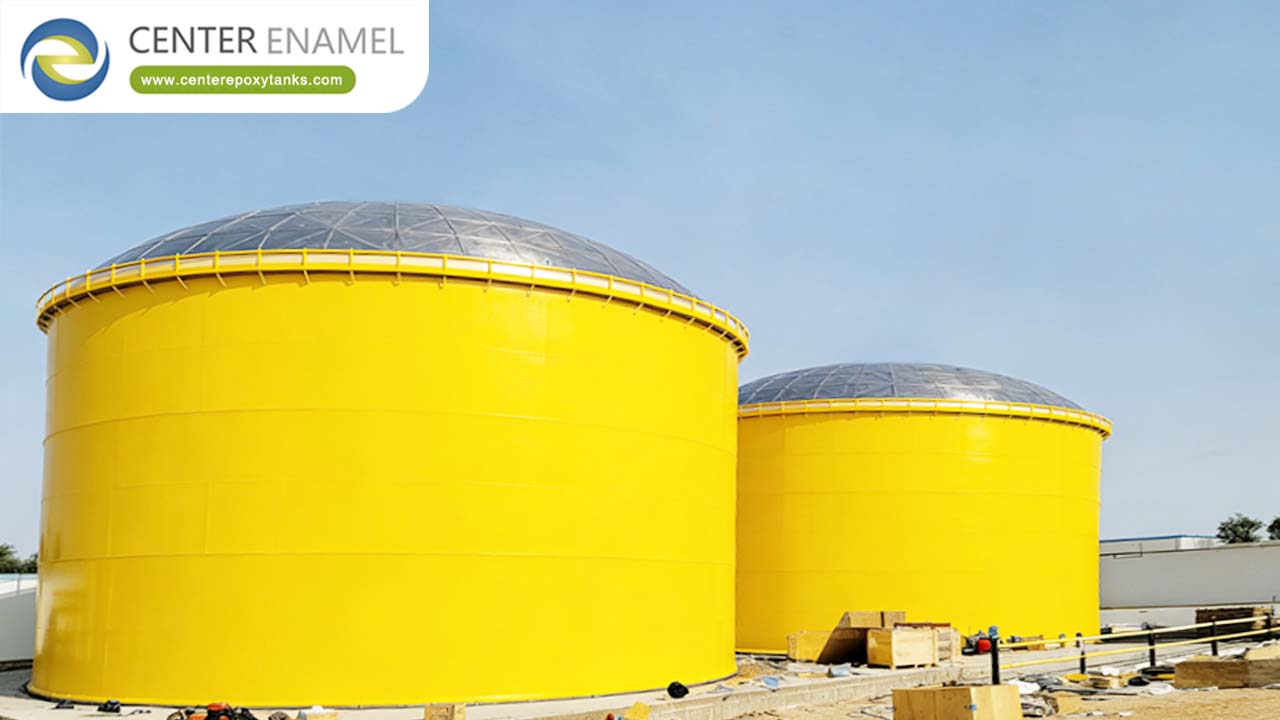
Above-Ground Oil Storage Tank (AST): Engineering for Strategic Energy Reserves
Above-ground oil storage tanks (AST) are the cornerstone of industrial and municipal fuel management, offering superior accessibility and leak detection compared to underground alternatives. Center Enamel, a premier global manufacturer, engineers ASTs compliant with API 650, NFPA 30, and AWWA D100 standards. Utilizing high-strength ASTM A36 carbon steel and automated Submerged Arc Welding (SAW), our tanks feature advanced Internal Floating Roofs (IFR) and secondary containment systems (Double-Wall/Self-Bunded) to ensure 100% environmental security and a 30-50 year service life in over 100 countries.
1. Technical Specification & Design Standards
Feature | Technical Specification | Strategic Reliability Value |
Design Standards | API 650, API 620, UL 142 | Ensures global compliance for atmospheric and low-pressure storage. |
Material Grade | ASTM A36 / Q235B / Q345R Steel | Optimized for hydrostatic loads and seismic resilience. |
Welding Protocol | Automated SAW / TIG / MIG | Full-penetration, monolithic seams for zero-leakage security. |
Containment Type | Single-Wall or Double-Wall (Self-Bunded) | Integrated leak monitoring and environmental protection. |
Roof Systems | IFR / Fixed Roof / Geodesic Dome | Minimizes VOC emissions and preserves fuel chemical specs. |
Testing Regimes | Radiographic (RT) / Hydrostatic / Vacuum Box | 100% verification of structural and weld integrity. |
2. Structural Engineering: The Welded Advantage
Unlike underground tanks, Above-Ground Oil Storage Tanks are subject to significant atmospheric and environmental stresses. Center Enamel utilizes Finite Element Analysis (FEA) to ensure structural stability against:
● Seismic Events: Engineering for localized ground acceleration per ASCE 7 standards.
● Wind Loads: Design integrity for wind speeds up to 240 km/h, preventing tank "buckling" when empty.
● Thermal Expansion: Managing the expansion and contraction of the steel substrate in extreme climates (-30°C to +70°C).
3. Advanced Vapor Management & Environmental Safety
Internal Floating Roof (IFR)
For volatile hydrocarbons (Gasoline, Jet Fuel), the Internal Floating Roof is a critical component.
● Emission Reduction: Reduces Volatile Organic Compound (VOC) losses by up to 98%, providing a significant financial ROI.
● Fire Safety: Eliminates the explosive air-vapor mixture in the tank's headspace, a primary requirement for NFPA 30 compliance.
Secondary Containment (Self-Bunded Tanks)
To meet SPCC (Spill Prevention, Control, and Countermeasure) regulations, Center Enamel offers "Tank-in-a-Tank" designs.
● Interstitial Monitoring: The space between the inner and outer tank is monitored by electronic sensors, providing instant notification of any primary containment breach.
● Zero-Spill Integrity: The outer tank is engineered to hold 110% of the inner tank's volume, eliminating the need for expensive concrete bund walls.
4. Corrosion Control & Fuel Purity
● Internal Epoxy Linings: For high-purity refined fuels or aviation kerosene, we apply NSF-certified high-solids epoxy to prevent the steel substrate from reacting with the fuel.
● Water Management: ASTs feature sloped bottoms and dedicated sumps. This allows for the collection and removal of condensation, preventing microbial growth ("diesel bug") and maintaining fuel ignition quality.
● External Protective Coatings: Multi-layer Polyurethane (PU) systems provide UV resistance and shield the structural steel from coastal salt-air corrosion.
5. Technical FAQ: Above-Ground Tank Implementation
Q: Why choose an Above-Ground Tank (AST) over an Underground Tank (UST)?
A: ASTs offer significantly lower installation costs, easier visual inspection for leaks, and simpler decommissioning. They are the preferred choice for industrial facilities and municipal fuel depots where secondary containment can be easily managed.
Q: How does Center Enamel ensure weld quality in the field?
A: We utilize Non-Destructive Testing (NDT), including Radiographic Testing (RT) for butt-welded seams and Vacuum Box Testing for floor plates, ensuring the monolithic vessel is 100% leak-proof before commissioning.
Q: Are these tanks compatible with biofuels or E85?
A: Yes. Depending on the ethanol or biofuel concentration, we can upgrade the internal lining or utilize 304/316L Stainless Steel components to prevent chemical degradation of the seals and gaskets.


