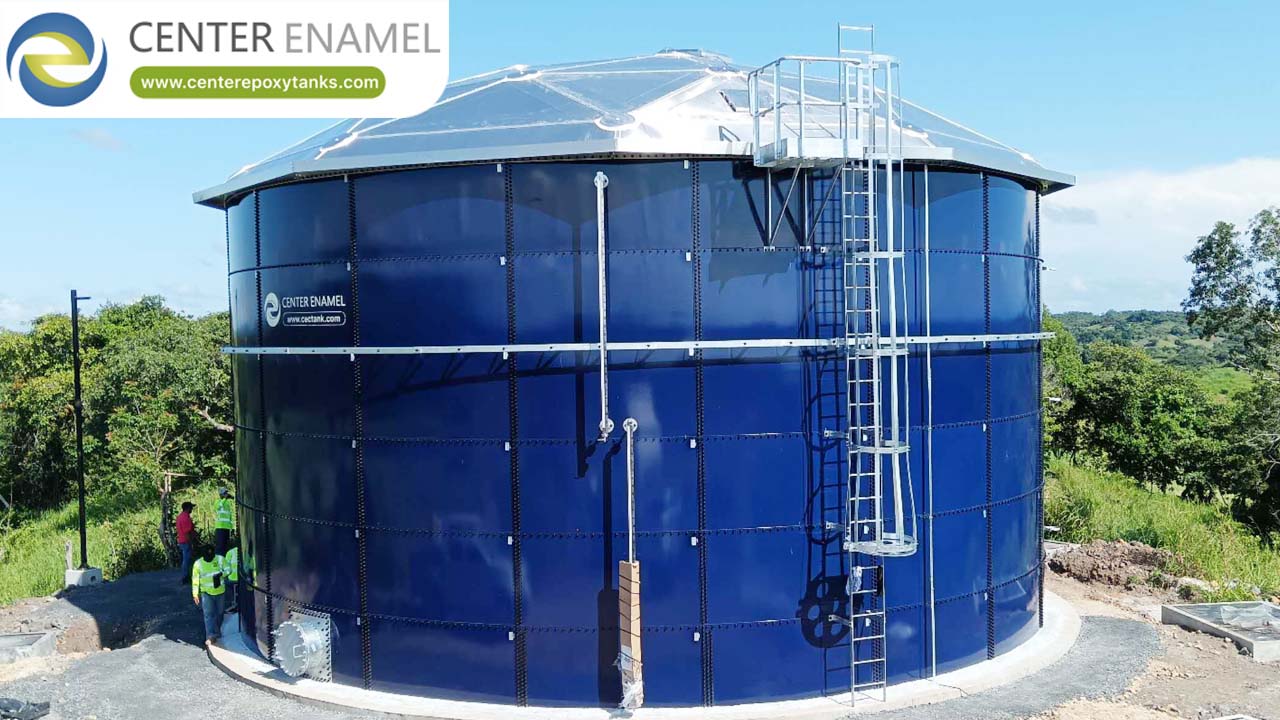
Modular Steel Water Storage Tanks: Prefabricated Capacity and Rapid Deployment
Remote mine sites, island communities, disaster-recovery zones, and fast-track industrial projects share one constraint: the tank schedule is the project schedule. Field welding and site coating put critical-path work at the mercy of weather, crew availability, and inspection backlogs — risks that modular construction simply removes from the site equation.
Modular steel water storage tanks are panelized vessels factory-coated with glass, epoxy, or zinc finishes, shipped flat-packed in standard containers, and bolted together on prepared foundations to AWWA D103-09, in capacities from 20 m3 to 60,000 m3. Center Enamel produces up to 250,000 coated panels annually, supporting 30-day standard delivery for common tank sizes.
1. What Makes a Tank Modular?
Modularity is a manufacturing strategy that relocates quality-critical work from the field to the factory.
· Factory coating under QA: Glass-Fused-to-Steel panels are fired at 820-930 deg C; epoxy panels are powder-cured and holiday-tested at 1,500 V — all before shipment, not on a windy job site.
· Precision bolted joints: Curved, die-formed panels with engineered gasket seams assemble with calibrated torque, giving repeatable, inspectable joint quality.
· Containerized logistics: Flat panels stack in standard containers, enabling predictable freight to any port served in 100+ countries.
· Controlled erection: Small crews erect with hand tools and jacks; the jacking method raises the roof first and builds downward, eliminating working at height.
2. Where Do Modular Water Tanks Deliver the Most Value?
Certain project profiles magnify the modular advantage.
· Remote and island sites: No welding crews, no coating tents, no heavy cranes — a 12-person crew completes tanks that conventional construction cannot staff.
· Emergency and humanitarian response: Post-disaster and refugee-camp water systems need volume in weeks; flat-packed tanks deploy with basic lifting gear.
· Expanding facilities: Mines and factories grow: modular tanks add a shell course or a whole new ring without touching existing structure — capacity expansion by design.
· Turnkey EPC programs: Multiple standardized tanks ship as one coordinated package, compressing the field schedule that usually governs water infrastructure.
3. How Is Quality Verified on a Modular Tank?
Factory fabrication enables test regimes site work cannot match.
· Holiday test every panel: High-voltage spark testing at 1,500 V (GFS and FBE) detects any coating breach before a panel leaves the plant.
· Material traceability: Plate chemistry, coating batch, and torque records document each panel position for full lifecycle traceability.
· Leak-tested joints: Gasketed seams are verified by water fill test at commissioning; joint design per AWWA D103-09 provides redundant sealing.
· Independent certification: NSF/ANSI 61 potable listings, ISO 9001/45001 management systems, and EN 1090 fabrication conformity support specification compliance worldwide.
Data Table: Modular vs Site-Built Water Tank Delivery
Metric | Modular Bolted Tank | Field-Welded Tank | Concrete Tank |
Factory coating | Yes, 1,500 V tested | No — site applied | Integral |
Site crew | 4-12 erectors | Certified welders + blasters | Formwork crews |
Weather sensitivity | Low | High (welding, coating) | High (curing) |
Standard delivery | ~30 days (1,000-10,000 m3) | 3-6 months typical | 4-8 months typical |
Future expansion | Add shell rings | Major modification | Not practical |
Frequently Asked Questions (FAQ)
Q1: What is a modular steel water storage tank?
A tank factory-fabricated as coated, curved steel panels that bolt together on site over a sealed gasket system, designed to AWWA D103-09. Capacities span 20-60,000 m3, panels ship in standard containers, and erection needs only a small crew with hand tools and jacking equipment.
Q2: How fast can a modular water tank be delivered and built?
Standard 1,000-10,000 m3 configurations typically ship within about 30 days, and a 12-person crew erects a mid-size tank in days to weeks. A 2008 Olympic-project GFS tank was completed by 12 workers in 15 days, demonstrating the compressed schedule modular delivery enables.
Q3: Can a modular tank be expanded or relocated?
Yes — this is a structural advantage of bolted design. Adding a shell course increases capacity without modifying the foundation footprint, and because panels are bolted, the entire tank can be disassembled, re-certified, and re-erected at a new site — impossible for welded or concrete structures.
Q4: Which coating is best for modular potable water tanks?
Glass-Fused-to-Steel is the benchmark: an inert glass surface fused at 820-930 deg C, NSF/ANSI 61 certified, with 30+ year life and zero dependence on site coating conditions. Fusion bonded epoxy and hot-dip galvanizing offer cost-effective alternatives for industrial, fire, and irrigation duties.


