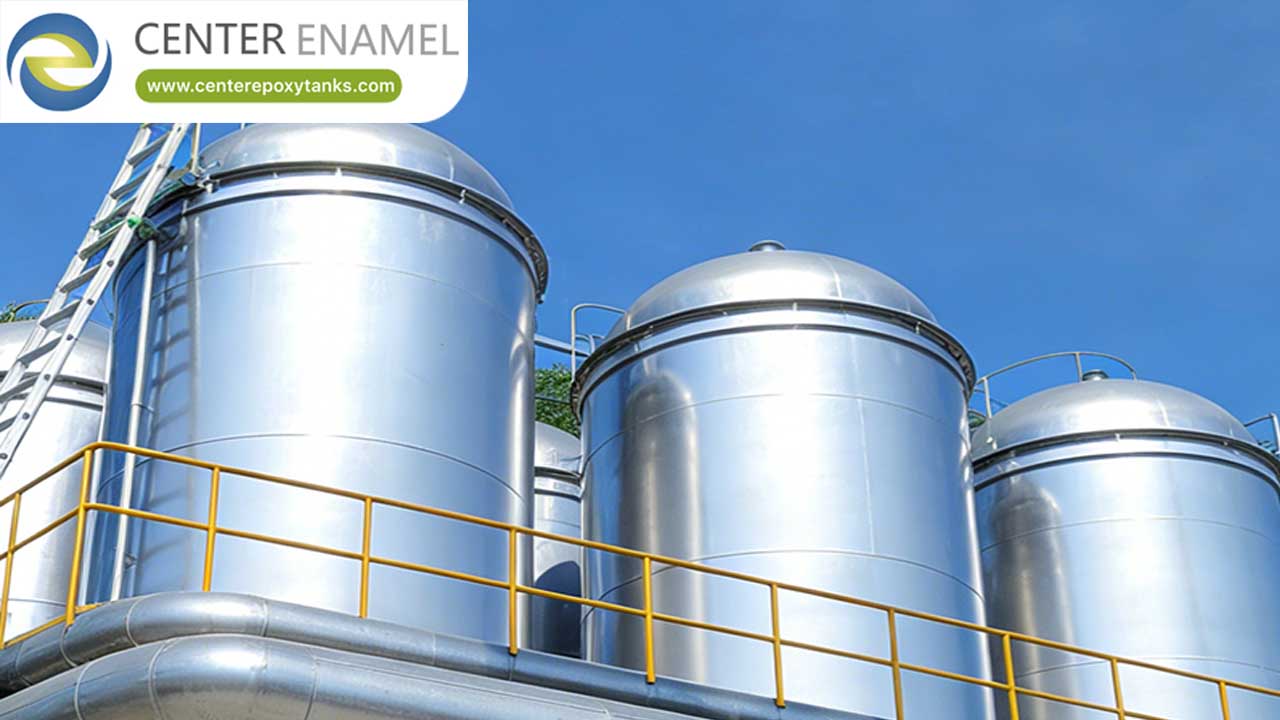
Lubricant Storage Tanks: Engineering Welded Steel Solutions for Base Oils
Welded steel lubricant storage tanks are high-integrity containment systems designed for base oils and finished lubricants. Engineered to API 650 or API 621 standards, these tanks utilize welded steel construction to ensure a 100% leak-proof environment, essential for protecting high-value lubricants from moisture and oxidation. Unlike bolted alternatives, welded tanks offer superior thermal insulation compatibility and structural longevity, supporting a 50+ year service life in refinery and blending plant environments.
1. Structural Integrity: The Physics of Welded Steel
In the lubricant industry, maintaining product purity and preventing environmental contamination are the highest priorities. Welded steel construction provides a monolithic barrier that is essential for these high-viscosity fluids.
● Continuous Sealing: Through specialized welding techniques like Submerged Arc Welding (SAW), welded tanks eliminate the gaskets and mechanical joints that can eventually degrade when exposed to the additives found in modern synthetic lubricants.
● Load Distribution: Lubricants have a higher specific gravity than many standard fuels. Welded steel shells are engineered to distribute this hydrostatic pressure evenly, preventing shell deformation over decades of constant cycling.
2. Thermal Management: Viscosity Control & Heating
Lubricants and base oils are highly temperature-sensitive. Maintaining the correct "pumpable" viscosity is critical for operational efficiency.
● Internal Heating Systems: Welded lubricant tanks are frequently equipped with steam coils or electric immersion heaters. Because the tank is a continuous steel structure, it handles thermal expansion more effectively than bolted designs.
● Insulation Integration: To prevent heat loss and energy waste, these tanks are often encased in high-density mineral wool or polyurethane insulation with aluminum jacketing.
● Preventing Oxidation: Precise temperature control ensures the lubricant does not reach a "flash point" or suffer thermal degradation, which can lead to oxidation and the formation of sludge.
3. Purity Protection: Moisture and Particulate Control
Lubricants are "hygroscopic" to varying degrees and can be easily contaminated by atmospheric moisture or dust.
● Internal Linings: To prevent "iron pick-up" or rust from contaminating the oil, welded tanks often feature internal epoxy-phenolic linings or are constructed from 304/316L Stainless Steel.
● Desiccant Breathers: Welded tanks are outfitted with specialized venting systems that include desiccant breathers to strip moisture from the air as the tank "breathes" during filling and emptying cycles.
● Conical Bottoms for Drainage: Lubricant tanks are typically designed with a sloped or conical bottom to ensure 100% drainage and to allow for the easy removal of any settled moisture or contaminants.
4. Technical Summary Matrix
Engineering Feature | Welded Lubricant Tank Spec | Strategic Operational Value |
Standard Compliance | API 650 / API 620 | Verified global benchmark for structural safety. |
Joint Efficiency | 1.0 (Full Penetration) | 100% leak-proof; no gaskets to degrade. |
Material Choice | Carbon Steel / Stainless Steel | Optimized for chemical compatibility and purity. |
Thermal Control | Steam Coils / Heat Tracing | Maintains pumpable viscosity and prevents sludge. |
Purity Protection | Internal Epoxy Lining | Prevents metal-ion contamination of base oils. |
Design Life | 50+ Years | Maximum asset ROI for blending and storage. |
5. Environmental & ESG Compliance
As global energy companies focus on sustainability, welded steel infrastructure provides the data points needed for ESG (Environmental, Social, and Governance) reporting.
● Zero-Leak Guarantee: The monolithic nature of a welded tank provides the highest level of environmental security, fulfilling strict SPCC (Spill Prevention, Control, and Countermeasure) requirements.
● Secondary Containment: These tanks are integrated with high-integrity berms or dikes, ensuring that even in extreme scenarios, the surrounding environment is protected.
● Vapor Control: By utilizing Vapor Recovery Units (VRU) or nitrogen blanketing, refineries can minimize the release of VOCs and protect the lubricant from oxidative degradation.
6. Frequently Asked Questions (FAQ)
● Q: Why choose welded steel over bolted steel for lubricants?
○ A: Welded steel provides a permanent, gasket-free seal. Since certain lubricant additives can be aggressive toward rubber gaskets over time, welded construction is the "set-and-forget" choice for long-term purity.
● Q: How are welded lubricant tanks inspected?
○ A: Inspections are governed by API 653, using Ultrasonic Testing (UT) and Magnetic Particle Inspection (MPI) to verify weld integrity without taking the tank out of service.
● Q: Can these tanks be used for synthetic lubricants?
○ A: Yes. However, for high-performance synthetics, we recommend 316L Stainless Steel or specialized internal linings to ensure the chemical additives do not react with the tank walls.


