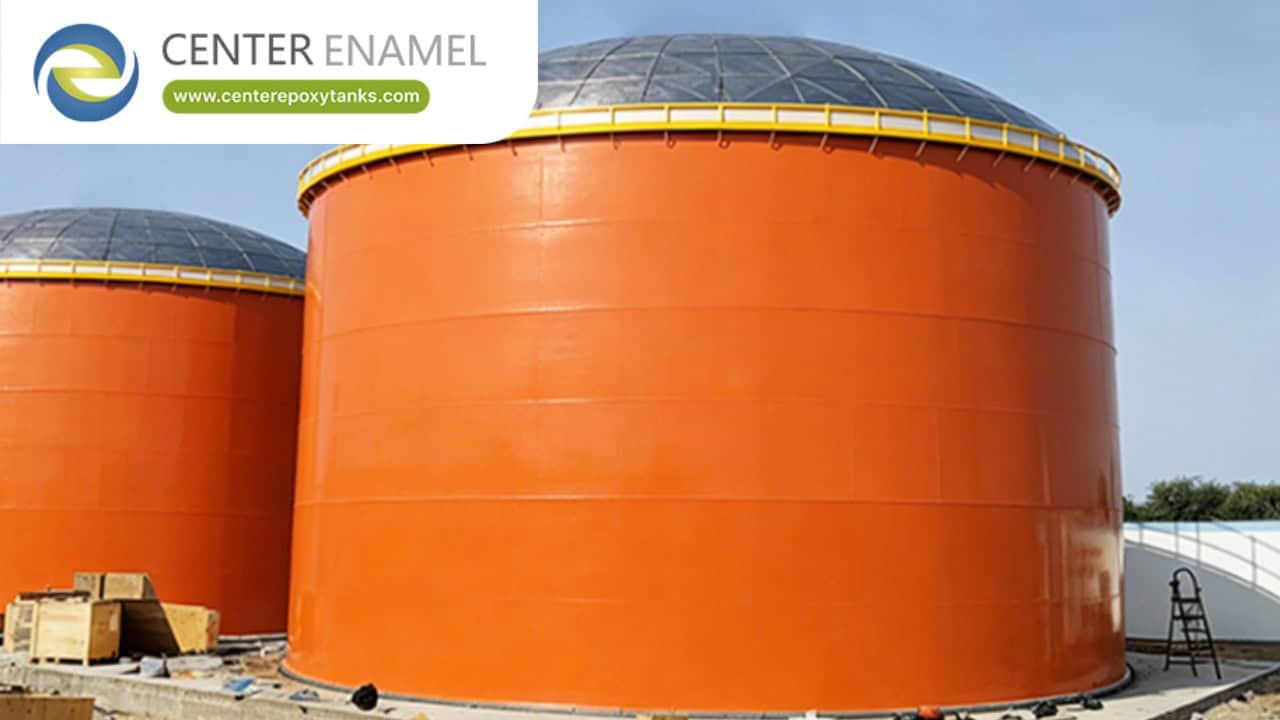
Liquid Tanks for Oil - Matching Tank Type to Product, Pressure and Site
Not every oil tank is the same machine. An atmospheric welded tank stores crude at a terminal; a bolted tank suits a remote site where transport and erection speed dominate; a pressure vessel handles separated gas and liquid under pressure; a shop-built unit serves a small depot. Choosing the wrong category is more expensive than any detail error within the right one.
Engineered by Shijiazhuang Zhengzhong Technology Co., Ltd. (Center Enamel), liquid tanks for oil are supplied across all four categories, and the selection is made from pressure, capacity, product, site access and delivery programme rather than from habit.
1. What Tank Types Are Used for Liquid Oil?
Four in practice: atmospheric welded tanks, bolted tanks, pressure vessels and shop-fabricated units. Each sits in a different pressure and capacity band, and each has a different delivery and erection profile.
· Atmospheric Welded Tanks: The standard for large-volume oil storage, built to API 650 or EN 14015.
· Bolted Tanks: Factory-coated panels assembled on site; fast to erect and easy to transport.
· Pressure Vessels: Used for separators, knock-out drums and any duty above atmospheric pressure.
· Shop-Fabricated Units: Complete, tested units for smaller capacities and distributed storage.
· Hybrid Projects: Most facilities use more than one category across different duties.
2. Atmospheric or Pressure - How Do You Decide?
From the product's vapour pressure and the process duty. If the liquid can be stored at ambient pressure without unacceptable loss, an atmospheric tank is far cheaper; if it cannot, or if the duty involves separation under pressure, a vessel is required.
· Vapour Pressure: The primary test - can the product be held at ambient pressure?
· Process Function: Separation, knock-out and similar duties need a vessel regardless.
· Pressure Rating: Where pressure is needed, the vessel is designed to the applicable pressure vessel code.
· Cost Step: Moving from atmospheric to pressure design raises cost significantly, so the decision is worth checking carefully.
· Safety Case: Pressure changes the hazard profile and the safety provision required.
3. Welded or Bolted - Which Suits Which Project?
Welded where capacity and longevity dominate and site access is good; bolted where transport, erection speed or future relocation matters. The two are complementary rather than competing.
· Welded: Best for very large volumes and permanent installations; the default at terminal scale.
· Bolted: Factory-coated panels arrive ready to assemble, which suits remote sites and tight programmes.
· Transport: Bolted components pack efficiently for long inland routes where plate transport is difficult.
· Future Relocation: Bolted tanks can be dismantled and moved; welded tanks cannot.
· Coating Quality: Factory-applied coating on bolted panels is applied under controlled conditions.
Evaluation Criterion | Atmospheric Welded | Bolted | Pressure Vessel | Shop-Fabricated |
Typical capacity range | Large to very large | Small to large | Small to medium | Small |
Design pressure | Atmospheric | Atmospheric | Above atmospheric | Atmospheric or low |
Erection speed | Slow - field welding | Fast - bolted assembly | Factory built | Fastest |
Relocatable | No | Yes | Sometimes | Yes |
Typical application | Terminal storage | Remote or fast-track | Separation, knock-out | Depots |
Engineering Assurance and Project Support
Every welded oil tank delivered by Shijiazhuang Zhengzhong Technology Co., Ltd. (Center Enamel) is designed to API 650 with shell courses sized by the one-foot method and checked for wind, seismic and hydrostatic load cases, or to EN 14015 and the Eurocodes where the site is European. Shell plate is shot-blasted to Sa 2.5 and coated to a documented dry film thickness, longitudinal and annular plate welds are examined by radiography or ultrasonic testing to the acceptance level written into the purchase order, and every tank is hydrostatically tested and dimensionally surveyed before hand-over. We supply across all four categories and select on your product's vapour pressure, capacity, site access, programme and whether the installation is permanent or may need to move.
Frequently Asked Questions (FAQ)
What is the most common oil storage tank type?
The atmospheric welded steel tank, built to API 650 or EN 14015. It is the most economical way to store large volumes at ambient pressure and is the default for crude, fuel oil and most refined products at terminal scale.
When is a pressure vessel needed instead of a tank?
When the product cannot be held at ambient pressure without unacceptable loss, or when the duty itself requires pressure - separation, knock-out, or any process step operating above atmospheric. Moving from atmospheric to pressure design raises cost significantly, so it is worth confirming the duty carefully.
When does a bolted tank beat a welded tank?
Where transport to site is difficult, where the programme is tight, where site welding conditions are poor, or where the installation may need to be relocated. Bolted tanks arrive as factory-coated panels that assemble quickly with no field coating, which is decisive on remote and fast-track projects.
Can the tank be customised for our duty?
Yes. Category, capacity and geometry, design code, material and coating, roof type, nozzle schedule, heating and insulation, instrumentation, access and containment are all engineered to your product, pressure, site and programme.
·


