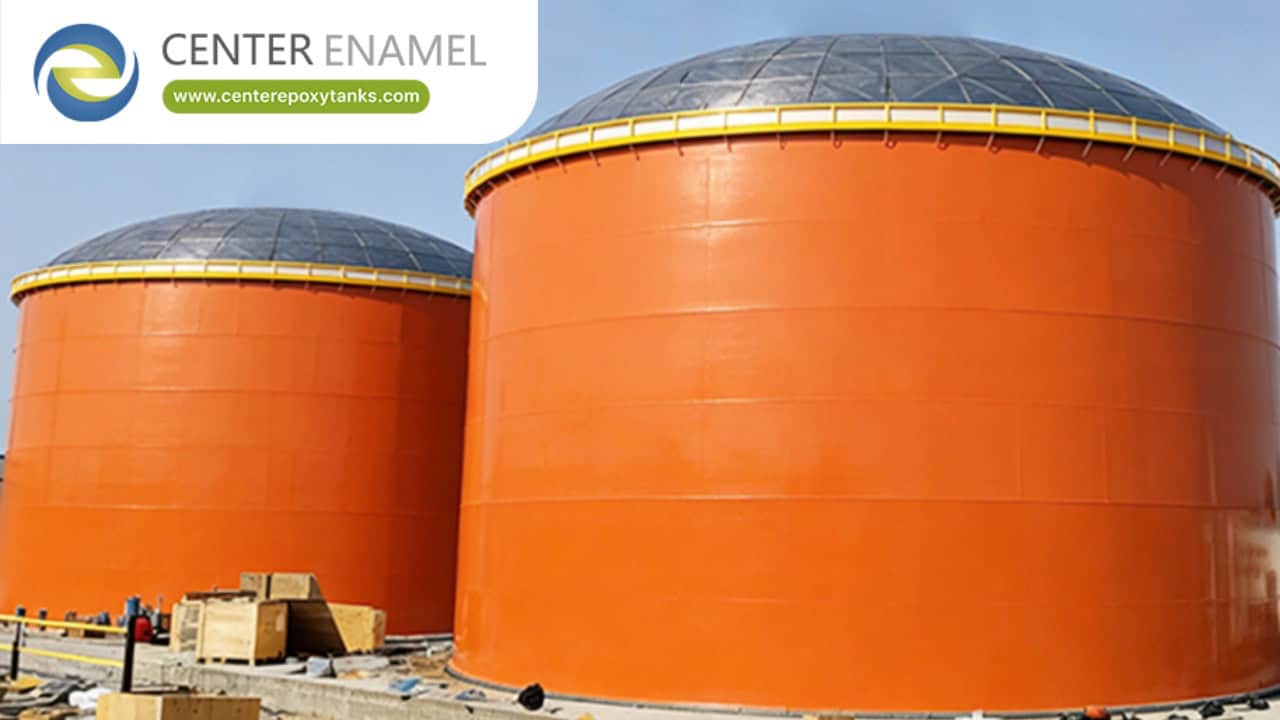
Liquid Impermeable Crude Oil Storage Tanks - Where Impermeability Is Actually Won
Impermeability on a crude tank is not a property of the steel - it is a property of the details. Plate is impermeable; what leaks are welds with lack of fusion, bottom plates corroded from the underside, nozzle penetrations with a poor detail, and shells distorted by foundation movement. A tank that is 'impermeable' on paper becomes permeable through workmanship and through corrosion that nobody measured.
Engineered by Shijiazhuang Zhengzhong Technology Co., Ltd. (Center Enamel), impermeability is designed and then proven: qualified welding with examination, a bottom detailed and protected for its environment, verified hydrostatic testing, and a second line of defence that catches what the first misses.
1. What Makes a Crude Tank Impermeable?
Sound welds, an intact and protected bottom, well-detailed penetrations, and a shell that stays within its design geometry. Each is achieved by a specific control, not by a general intention.
· Weld Integrity: Qualified procedures, qualified welders and examination to the agreed acceptance level.
· Bottom Integrity: The floor and annular ring are detailed, coated and protected because they are the most exposed surface.
· Penetration Detailing: Nozzles, manways and cleanout doors are detailed so their welds are examinable and their reinforcement does not trap water.
· Geometry Control: Foundation behaviour governs whether the shell stays round enough for seals and fittings to work.
· Corrosion Control: Coating, cathodic protection and water management keep the surfaces intact.
2. How Is Weld Tightness Verified?
By a combination of non-destructive examination and hydrostatic testing, applied to a defined extent and a defined acceptance standard. Visual inspection alone is never sufficient on a crude tank.
· Non-Destructive Examination: Radiography or ultrasonic testing on the specified proportion of joints, at the acceptance level in the order.
· Bottom Seam Testing: Bottom plate seams are tested by vacuum box or equivalent before the tank is filled.
· Hydrostatic Test: The tank is filled and held, with settlement and shell behaviour monitored.
· Weld Mapping: Every joint is mapped so examination coverage and results are traceable.
· Repair and Re-Test: Repairs follow a qualified procedure and are re-examined and re-tested.
3. What Provides the Second Line of Defence?
Secondary containment and detection. Even a well-built tank benefits from a bund that holds what a release would deliver, and from monitoring that finds a loss before it reaches the environment.
· Bund or Secondary Containment: Sized to hold the required proportion of the tank's contents.
· Impermeable Bund Lining: The bund floor and walls are sealed so a release does not enter the ground.
· Double Bottom Option: A second bottom plate with a monitored interstitial space detects a breach directly.
· Leak Detection: Inventory reconciliation, interstitial monitoring or foundation vapour sensing.
· Drainage Control: Bund drainage is controlled so a release cannot leave the containment unnoticed.
Evaluation Criterion | Verified Impermeable Tank | Unverified Construction |
Weld examination | Defined extent and acceptance level | Visual only |
Bottom seam testing | Vacuum box or equivalent | Not tested |
Hydrostatic test | With settlement monitoring | Filled and drained |
Secondary containment | Sized and lined | Earthen bund |
Leak detection | Monitoring in place | None |
Engineering Assurance and Project Support
Every welded oil tank delivered by Shijiazhuang Zhengzhong Technology Co., Ltd. (Center Enamel) is designed to API 650 with shell courses sized by the one-foot method and checked for wind, seismic and hydrostatic load cases, or to EN 14015 and the Eurocodes where the site is European. Shell plate is shot-blasted to Sa 2.5 and coated to a documented dry film thickness, longitudinal and annular plate welds are examined by radiography or ultrasonic testing to the acceptance level written into the purchase order, and every tank is hydrostatically tested and dimensionally surveyed before hand-over. Impermeable tanks are delivered with weld maps, examination reports, bottom seam test records, hydrostatic test and settlement records, coating documentation and the secondary containment and detection package.
Frequently Asked Questions (FAQ)
How do you prove a crude oil tank is impermeable?
Through testing rather than assertion. Welded joints are examined non-destructively to a defined extent and acceptance level, bottom plate seams are tested by vacuum box or equivalent, and the finished tank is hydrostatically tested with settlement and shell behaviour monitored. A weld map makes the coverage traceable.
Why is the tank bottom the critical surface for impermeability?
Because it is the most corrosion-exposed and the least inspectable surface on the tank. Free water and sludge settle there, the underside sits against the foundation, and examination requires emptying and cleaning. That is why bottom coating, cathodic protection, water draw-off and seam testing all concentrate on the floor.
What secondary containment is required for a crude tank?
A bund or containment sized to the applicable requirement - commonly at least one hundred and ten per cent of the largest tank it serves, or twenty-five per cent of aggregate capacity where several tanks share it, whichever is greater. The containment should also be lined so a release does not enter the ground, and drained in a controlled way.
Can the tank be customised for our project?
Yes. Diameter and height, plate grade and corrosion allowance, bottom and annular ring design, examination extent, coating and cathodic protection, containment and lining, leak detection, heating, instrumentation and access are all engineered to your crude, capacity and site.


