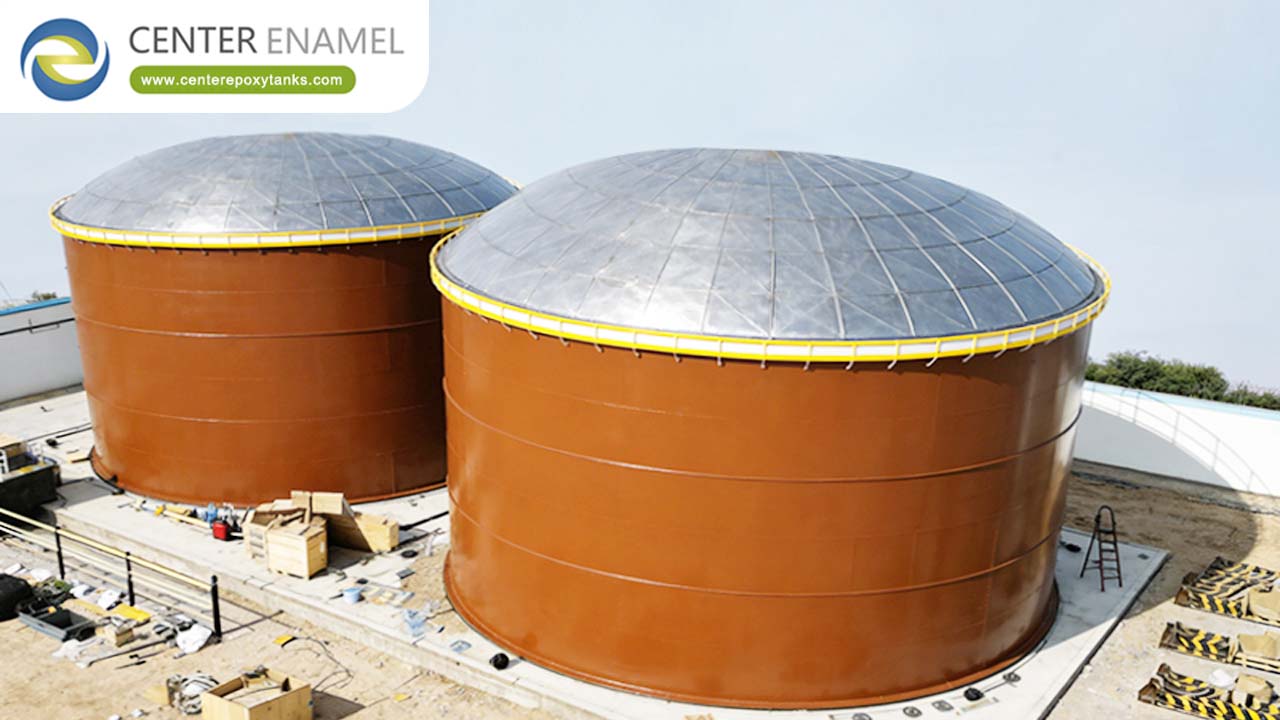
Mali Oil Storage Tank Roofs - Roofs Built for Sahel Heat, Dust and Long Supply Lines
Sahelian storage puts a specific set of stresses on a tank roof. Ambient temperatures reach the mid-forties Celsius, so the roof plate cycles over a wide range every day and the vapour space above the product gets hot enough to drive breathing losses hard. Harmattan dust finds every gap in the roof, contaminating both the product and the floating-roof seal. And because the country is landlocked, every tonne of steel has travelled a long road from port - which changes what it makes sense to ship.
Those conditions point in one direction. Engineered by Shijiazhuang Zhengzhong Technology Co., Ltd. (Center Enamel), an aluminium geodesic dome arrives as light, factory-finished members - meaning less weight on a long inland haul - and provides a sealed, dust-tight, maintenance-free envelope that keeps its geometry through daily thermal cycling without a coating to blister in the heat.
1. How Does Extreme Heat Affect a Tank Roof?
It drives thermal cycling, coating breakdown and vapour loss. Coatings that perform in temperate climates blister and chalk under sustained high surface temperature; plate roofs deflect and open seal paths; and hot vapour space pushes breathing losses up.
· Coating Degradation: Sustained high roof-surface temperature shortens coating life dramatically, which is why a roof with no coating has an advantage here.
· Thermal Cycling: Daily expansion and contraction fatigue sealants and open gaps at penetrations over time.
· Vapour Loss: Hot vapour space expands and contracts more each day, increasing breathing emissions from any unsealed path.
· Solar Gain Control: A light-coloured reflective aluminium skin reduces solar heat gain compared with a dark coated steel roof.
· Seal Life: Seal materials must be selected for sustained high temperature, not for a temperate duty.
2. Why Is Dust a Roof Problem?
Because dust enters the vapour space and then the product. On a tank with a floating deck it abrades the rim seal; on any tank it becomes sediment, filter loading and product contamination. The roof is the first line of defence.
· Dust-Tight Envelope: Gasketed panel joints keep airborne dust out of the vapour space, unlike lapped or bolted plate roofs.
· Seal Protection: Keeping dust off the rim seal extends seal life and reduces vapour loss.
· Product Cleanliness: Less ingress means less sediment, lower filter loading and fewer quality complaints.
· Vent Protection: Vents and flame arresters are screened and positioned to limit dust ingress.
· Cleaning Intervals: A sealed roof extends the interval between tank cleanings, which are expensive at remote sites.
3. How Do Long Supply Lines Shape the Roof Choice?
Weight and finish matter more than unit price. A light, factory-finished aluminium structure costs less to move inland, arrives ready to assemble with no coating to apply on site, and reduces the amount of skilled site labour needed far from a workshop.
· Transport Weight: Aluminium members weigh a fraction of equivalent steel, cutting inland freight cost on a long route from port.
· Factory Finish: Members arrive cut, drilled and finished; no site blasting or painting operation to set up at a remote location.
· Reduced Site Labour: Bolted assembly needs fewer specialist welders, which matters where skilled labour must be mobilised.
· Packing for Road Haul: Members are packed for container or break-bulk road transport with handling and weather protection considered.
· Spares Philosophy: A small spares set of gaskets and fasteners is shipped with the dome so remote sites are not waiting on a single part.
Evaluation Criterion | Aluminum Dome in Sahel Service | Coated Steel Roof in Sahel Service |
Coating in extreme heat | None required | Blistering and chalking |
Dust ingress | Sealed gasketed envelope | Through lapped and bolted joints |
Inland freight weight | Low | High |
Site finishing work | None | Blasting and painting on site |
Solar heat gain | Reflective aluminium skin | Dark coated plate absorbs heat |
Engineering Assurance and Project Support
Every welded oil tank delivered by Shijiazhuang Zhengzhong Technology Co., Ltd. (Center Enamel) is designed to API 650 with shell courses sized by the one-foot method and checked for wind, seismic and hydrostatic load cases, or to EN 14015 and the Eurocodes where the site is European. Shell plate is shot-blasted to Sa 2.5 and coated to a documented dry film thickness, longitudinal and annular plate welds are examined by radiography or ultrasonic testing to the acceptance level written into the purchase order, and every tank is hydrostatically tested and dimensionally surveyed before hand-over. For West African inland projects we pack members for road transport from the discharge port, ships a commissioning spares set with the dome, and provides erection supervision or trained local crews depending on the project's preference.
Frequently Asked Questions (FAQ)
How does high ambient temperature affect roof life?
It shortens coating life, accelerates sealant ageing and increases daily thermal movement. A roof with no coating - an aluminium dome - removes the dominant failure mode entirely, and the reflective aluminium skin also reduces solar heat gain into the vapour space compared with a dark coated steel roof.
Can the roof keep airborne dust out of the tank?
Yes, when specified as a sealed envelope. Gasketed panel joints and sealed penetrations keep Harmattan dust out of the vapour space, protecting the product, reducing sediment and extending floating-roof seal life. Vents and flame arresters are screened and positioned with dust in mind.
Why is aluminium attractive for a landlocked site?
Weight and finish. Aluminium members weigh a fraction of equivalent steel, which matters on a long inland haul from port, and they arrive factory-cut, drilled and finished, so there is no blasting or painting operation to set up at a remote location and less specialist site labour to mobilise.
Can the dome be customised for our conditions?
Yes. Span, rise, panel section, alloy and temper, high-temperature gasket material, insulation, screened vents, manways, walkways, handrails and lightning protection are all engineered to your tank, product and the temperature, dust and wind conditions of your site.


