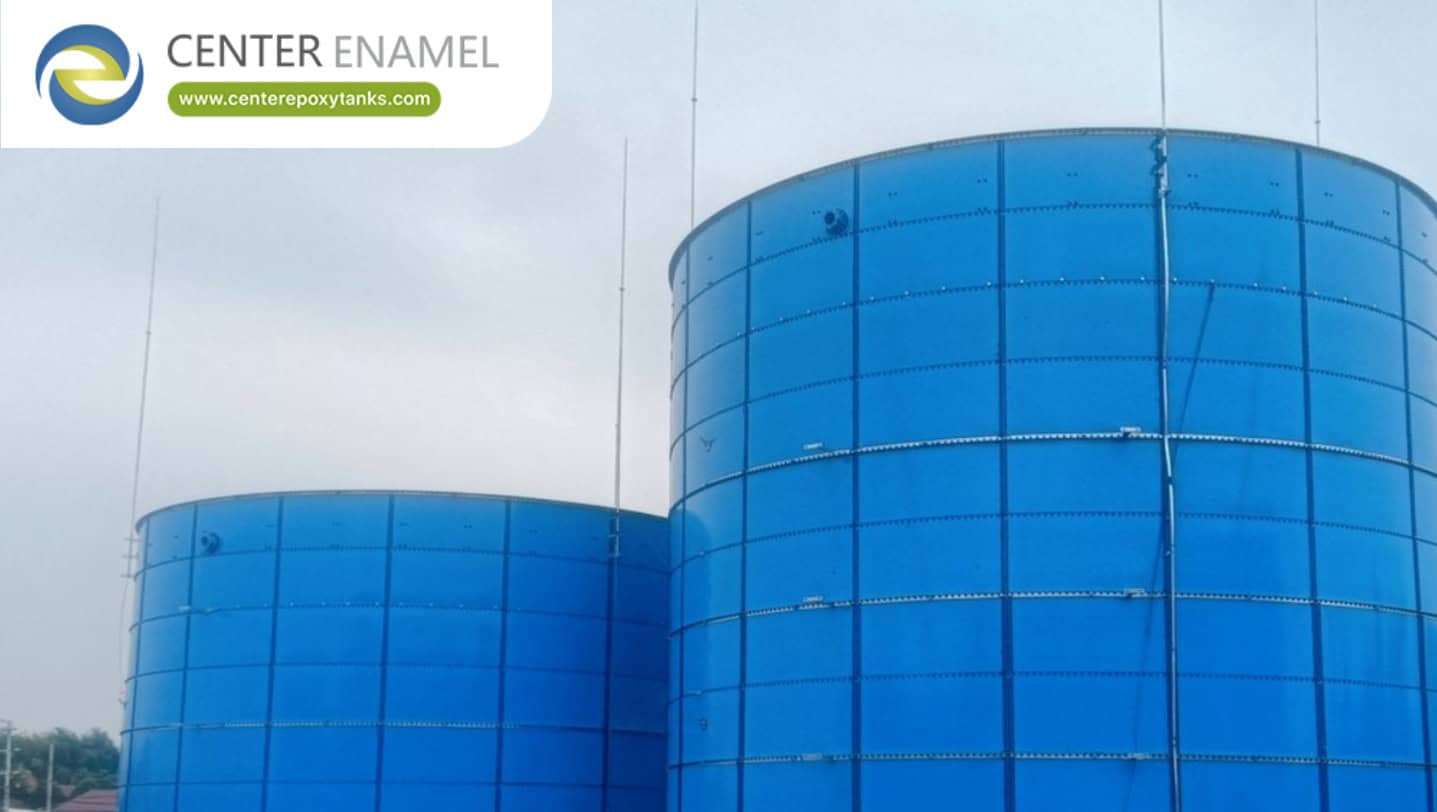
 Leading China Fusion Bonded Epoxy (FBE) Tank Manufacturer: Advanced Wastewater Storage Solutions
A leading China-based Fusion Bonded Epoxy (FBE) tank manufacturer provides precision-engineered, bolted steel storage solutions specifically designed for the volatile conditions of wastewater treatment. These tanks utilize an advanced electrostatic powder-coating process where epoxy resin is fused to high-tensile steel panels at high temperatures (200C+), creating a non-porous, molecularly bonded barrier. This technology offers superior resistance to biogenic sulfuric acid, chemical fluctuations, and abrasion. By combining modular bolt-together construction with factory-controlled quality assurance, these manufacturers deliver rapid-deployment, cost-effective, and environmentally resilient infrastructure for municipal and industrial wastewater equalization, anaerobic digestion, and sludge storage.
The Engineering Context: Why FBE is the Wastewater Standard
Wastewater is a chemically volatile medium. Traditional storage materials, particularly concrete and standard field-painted steel, frequently suffer from "microbial-induced corrosion" (MIC) and structural cracking within years of deployment. FBE technology solves these operational pain points through superior material science.
Monolithic Barrier Against Biogenic Corrosion: In the headspace of anaerobic digesters and equalization tanks, Hydrogen Sulfide ($H_2S$) is prevalent. This gas converts to sulfuric acid upon contact with moisture, aggressively attacking concrete and unprotected steel. The inert nature of FBE provides a total, chemically resistant barrier that is immune to this acid attack.
Electrostatic Fusion for Edge Protection: Unlike field-applied coatings which can be uneven, the FBE process uses automated electrostatic spraying. This ensures a consistent coating thickness (typically $150text{--}250,mutext{m}$) even on sharp panel edges and within bolt holes—the two areas where traditional tanks fail first.
Operational Flexibility: Wastewater treatment processes—such as MBR (Membrane Bioreactor) or SBR (Sequencing Batch Reactor)—require consistent tank internal dimensions. Our modular bolted panels are manufactured to extreme tolerances, ensuring the tank remains structurally sound regardless of internal pressure fluctuations or the weight of aeration/mixing equipment.
Comparative Overview: Wastewater Containment Technologies
Feature | Center Enamel Bolted FBE | Reinforced Concrete (RCC) | Field-Welded Steel |
Corrosion Defense | High (Inert Polymer Barrier) | Low (Porous/Cracks) | Moderate (Needs lining) |
H₂S Resistance | Excellent (Biogenic Immune) | Poor | Moderate |
Installation Speed | Rapid (4–8 weeks) | Slow (Curing time) | Slow (Weather dependent) |
Maintenance | Minimal | High (Structural repair) | High (Recurrent recoating) |
Quality Control | Factory-Verified (Holiday Test) | Variable (Site-dependent) | Variable (Site-dependent) |
Technical Benchmarks for Wastewater Infrastructure
To ensure the longevity of a wastewater facility, procurement and engineering teams should demand these specific performance benchmarks from their manufacturing partner:
Holiday Testing Compliance: Every panel must undergo 1500V holiday testing in the factory to ensure 100% defect-free coating. This is the single most important metric for preventing premature corrosion.
Chemical Resistance: The coating must demonstrate stability across a pH range of 3–13, ensuring the tank can handle acidic effluent or alkaline cleaning cycles without surface degradation.
Adhesion Strength: Verify that the coating achieves an adhesion strength exceeding 20 MPa, preventing the "delamination" (peeling) that plagues low-quality powder coats.
Structural Life-Cycle Modeling: Ensure the manufacturer provides structural calculations and FEA (Finite Element Analysis) reports that guarantee a 30-year design life, accounting for local seismic, wind, and liquid hydrostatic loads.
Frequently Asked Questions (FAQ)
Q: Why choose FBE over Glass-Fused-to-Steel (GFS)?
A: While GFS is an excellent choice for extreme chemical resistance, FBE offers a significant cost advantage for many municipal wastewater applications. FBE provides a "tougher" surface that is highly resistant to mechanical impact and abrasion—ideal for tanks that may require periodic internal cleaning or modification.
Q: Can these tanks be retrofitted with mixers and aerators?
A: Yes. Our modular bolted design allows for the easy installation of specialized baffles, aeration headers, and heavy-duty mixers. Because the steel is high-tensile, it can support the dynamic loads of these components with ease.
Q: How do you handle installation in limited-space sites?
A: Modular FBE tanks are the preferred choice for confined sites. Since the panels are bolted on-site, we do not require the massive footprints needed for heavy machinery or on-site welding equipment.
Partnering for Reliable Wastewater Infrastructure
Wastewater treatment is a mission-critical system, directly affecting safety, environmental compliance, and long-term operating costs. Partnering with a manufacturer that prioritizes factory-controlled FBE technology ensures that your infrastructure investment is protected for decades.
Are you currently evaluating containment solutions for an upcoming wastewater treatment expansion or upgrade?
[Contact our engineering team] to request a structural feasibility analysis, review our chemical resistance certifications, or obtain a comprehensive design proposal for your specific project requirements.


