Key Differences Between Internal and External Floating Roofs for Petroleum Storage Tanks
In the bulk petroleum storage and refining sectors, atmospheric storage tanks represent critical nodes for holding crude oil, gasoline, aviation fuel, and refined chemical products. A fundamental engineering challenge in designing these large aboveground tanks is minimizing product evaporation, reducing Volatile Organic Compound (VOC) emissions, and mitigating fire hazards.
To achieve this, the industry relies on floating roof designs that sit directly on the liquid surface, moving up and down with fluid inventory fluctuations. When specifying or evaluating storage tanks under API 650 guidelines, engineers generally choose between two primary configurations: External Floating Roofs (EFRs) and Internal Floating Roofs (IFRs). Understanding their structural, operational, and environmental differences is vital for optimizing safety and total cost of ownership.
What Is an External Floating Roof (EFR)?
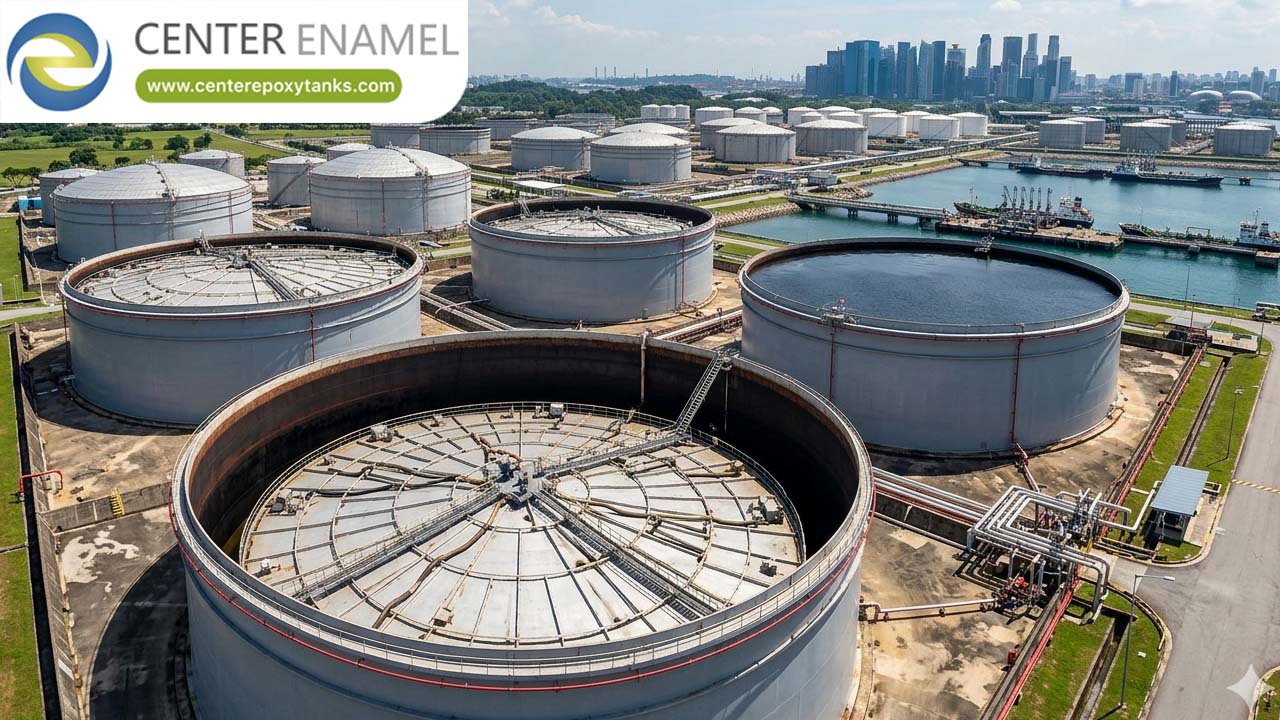
An External Floating Roof Tank (EFRT) features an open-topped cylindrical steel shell equipped with a deck that floats directly on the liquid surface, completely exposed to the ambient atmosphere. Governed primarily by API 650 Annex C, EFRs are traditionally deployed for massive crude oil storage and high-volatility product reserves where large diameters make fixed roofs structurally impractical or cost-prohibitive.
Direct Environmental Exposure: Because there is no fixed roof above, the floating deck is directly subjected to rain, snow, wind, and solar radiation.
Integrated Drainage Systems: EFRs require engineered roof drains, swivel joints, and flexible piping systems to safely channel accumulated rainwater off the deck and out of the tank without contaminating the product.
Rim Seal Mechanisms: A continuous primary and secondary seal system bridges the annular gap between the moving deck shell and the tank wall, preventing vapor escape while allowing smooth vertical travel.
What Is an Internal Floating Roof (IFR)?
An Internal Floating Roof Tank (IFR) combines elements of a fixed roof tank and a floating roof tank. It features a permanent outer fixed roof (typically a self-supporting aluminum dome or a traditional steel cone roof) with a separate floating deck moving freely inside the enclosed vessel. Governed by API 650 Annex H, IFRs are standard for storing high-purity, volatile refined products like gasoline, naphtha, and jet fuel.
Dual-Layered Protection: The fixed outer roof shields the internal floating membrane from weather elements like wind, rain, and UV radiation, while the internal floating deck suppresses vapor formation at the liquid surface.
Elimination of Complex Drainage: Because the external fixed roof prevents precipitation from entering the tank interior, internal floating roofs do not require complex, high-maintenance emergency roof drain systems.
Enhanced Emission Control: By combining an airtight fixed roof (often paired with an aluminum geodesic dome) with a contact or pontoon-style internal deck, facilities achieve near-total suppression of VOC emissions.
Technical Performance Matrix: Internal vs. External Floating Roofs
Technical Parameter | External Floating Roof (EFR) | Internal Floating Roof (IFR) |
API 650 Governing Standard | Annex C (Design and Construction Rules) | Annex H (Internal Floating Roof Specifications) |
Weather & Climate Vulnerability | High; exposed directly to rainfall, snow loading, wind shear, and solar heat gain | Low; fully sheltered from rain, snow, and wind by the permanent outer fixed roof |
Drainage & Maintenance Overhead | Complex; requires dedicated rolling ladders, flexible deck drains, and active water management | Minimal; no external weather drainage required on the floating deck itself |
Vapor Loss & VOC Control | Effective (reduces losses by ~95%), but vulnerable to wind-induced rim seal scouring | Superior; enclosed vapor space drastically restricts evaporation and eliminates wind scouring |
Optimal Vessel Diameter Range | Best suited for large-diameter bulk crude storage where open-top economics excel | Highly effective across small-to-large diameters, especially when paired with aluminum dome roofs |
Frequently Asked Questions (FAQ)
Q: Which roof type provides better volatile organic compound (VOC) emission control?
A: Internal floating roofs generally provide superior emission control because the outer fixed roof shields the inner floating membrane from wind currents, preventing wind-induced rim seal vaporization losses. When an IFR is combined with an airtight aluminum dome roof, VOC containment reaches peak efficiency.
Q: How do weather conditions influence the selection between IFRs and EFRs?
A: In regions prone to heavy snowfall, torrential downpours, or high-wind shear, internal floating roofs (or domed external floating roofs) are heavily favored. EFRs in heavy snow zones require rigorous calculations for design live loads and active monitoring of roof drainage to prevent catastrophic sinking.
Q: What API 650 standards govern internal and external floating roofs?
A: Under API 650, external floating roofs are regulated by Annex C, which outlines strict buoyancy, pontoon stability, and rolling ladder requirements. Internal floating roofs are governed by Annex H, focusing on internal deck construction, clearance, and vapor space management.
Q: Can an existing external floating roof tank be converted into an internal floating roof tank?
A: Yes. Many facility operators retrofit existing external floating roof tanks by erecting a clear-span aluminum dome roof across the top rim and converting the open deck into an internal floating roof. This eliminates rainwater management issues, reduces maintenance costs, and drastically cuts emissions.


